 In 30 Seconds




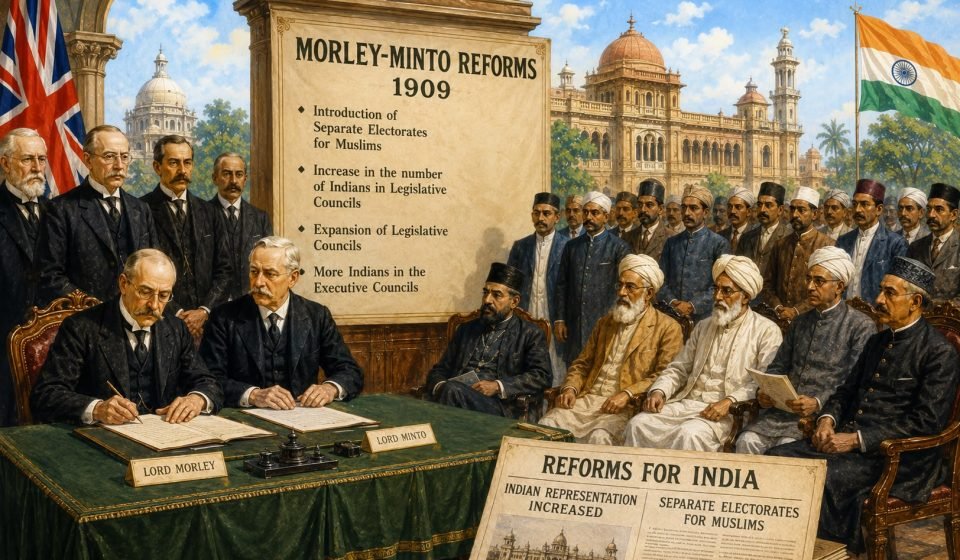
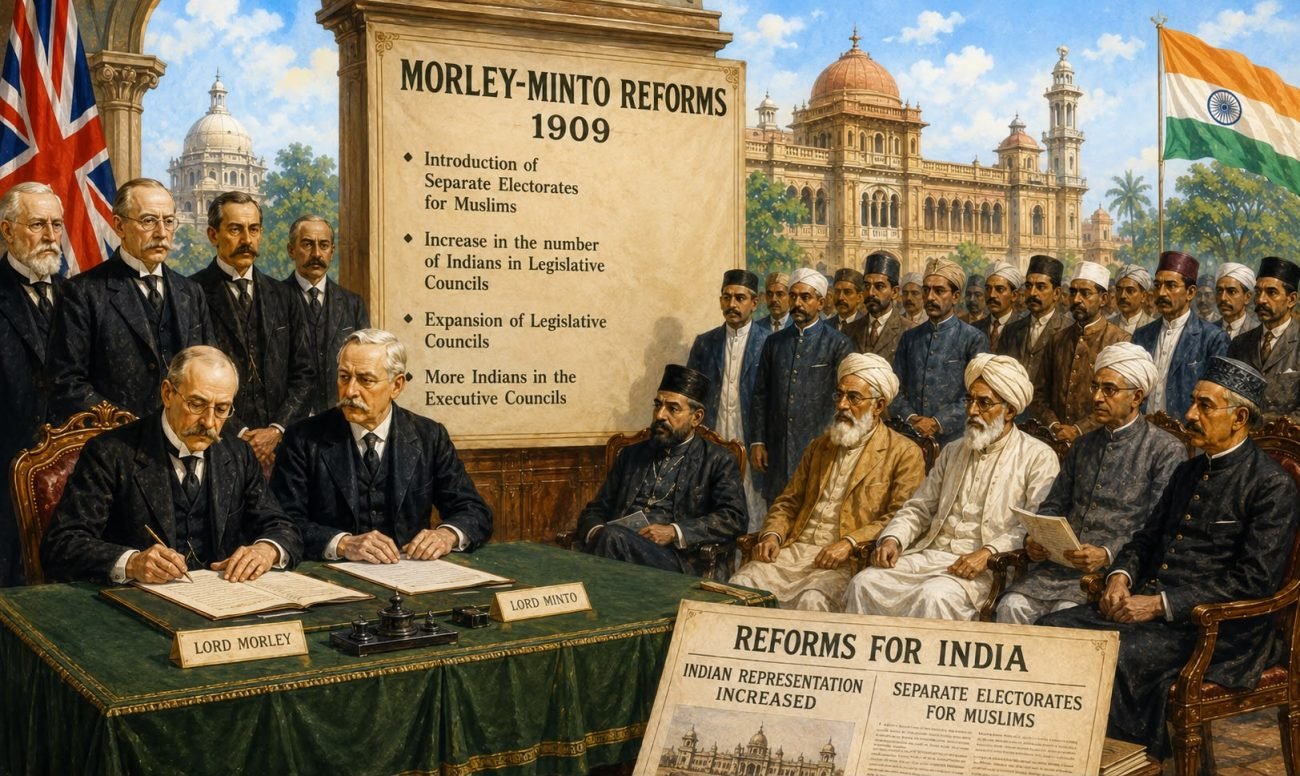
The Indian Councils Act of 1909, remembered by the names of the Secretary of State and the Viceroy who made it, Morley and Minto, was the Raj’s answer to the storm of the partition years, a package of council reform designed, in the frank words of its makers, to rally the moderates and isolate the extremists. It gave Indian politics its first real elections, its first Indian in the government of India, and, in the provision that outweighed all the rest, the separate Muslim electorates whose consequences ran, widening decade by decade, all the way to 1947.
John Morley was the most Indian sympathetic Secretary of State the office had known, a Gladstonian man of letters, biographer of his master, who believed sincerely in liberalising the Raj and stated with equal sincerity the limit of his intention, telling the House of Lords that if the reforms led directly or necessarily to a parliamentary system in India, he for one would have nothing to do with them. Within that boundary the Act moved considerably. The Imperial Legislative Council was enlarged to sixty additional members, the provincial councils more, with nonofficial majorities conceded in the provinces though not at the centre, and the councils received substantive new functions, the moving of resolutions, the discussion of the budget by stages with the right to propose amendments, and supplementary questions, the equipment with which a Gokhale could conduct opposition in everything but the vote. Election, the word evaded in 1892, was at last admitted, through constituencies of municipalities, district boards, landholders, universities and chambers. And by appointments running with the Act, an Indian entered for the first time the Viceroy’s Executive Council itself, Satyendra Prasanna Sinha as law member in 1909, over resistance whose record does neither King nor council credit, while two Indians joined the Secretary of State’s council in London.
The provision that history remembers stood apart from all this machinery. Redeeming the pledge implied at Simla in 1906, the Act created separate electorates for Muslims, seats reserved for the community and filled exclusively by Muslim voters, with weightage besides, representation in excess of population in provinces where Muslims were few, and a lower property franchise than the general roll. The League had asked, Minto’s government had encouraged the asking, and Morley, after resisting alternatives through two years of drafting, conceded the principle whose logic he privately doubted. The case made for it was minority protection in a society where, it was argued, votes would follow faith regardless. The case against it was made by contemporaries and confirmed by consequences, that the state had now certified religion as the unit of Indian politics, given every Muslim politician a constituency to which no Hindu vote mattered and every Hindu politician the mirror image, and installed at the foundation of representative government an arithmetic of separation that each subsequent reform, 1919 and 1935, would extend to more communities and deeper levels, until the electorates voted, in 1946, on partition itself. Constitutional historians dispute much about the road to Pakistan. Almost none dispute the milestone of 1909.
The reforms’ immediate politics played out as designed and then as not. The Moderate Congress, meeting under Madan Mohan Malaviya, welcomed the advance while condemning the communal principle, a double position it maintained for a decade. Gokhale entered the enlarged council and made it his instrument. The extremist party, leaderless with Tilak in Mandalay, could only note that agitation had extracted in four years what petitioning had not in twenty. And the government discovered the oldest law of constitutional concession, that appetite grows by feeding. The councils became schools of opposition, the elected members coalescing across communal lines often enough to trouble officials, and within a decade the demand had moved past representation to responsibility, past advice to power, forcing the next instalment in 1919.
Morley Minto thus occupies a double place in the Indian story. It was the true beginning of electoral politics in India, the first time an Indian voted a representative into a legislature of the Raj, the seed of the parliamentary institutions the republic inherited. And it was the constitutionalisation of communal division, the point at which the census category became a voting booth. The Act of 1909 opened two doors at once, and the twentieth century walked through both of them.
1905 to 1911 - Swadeshi, Revolutionaries and Reform
Part 5 of 10 in this chapter.