 In 30 Seconds




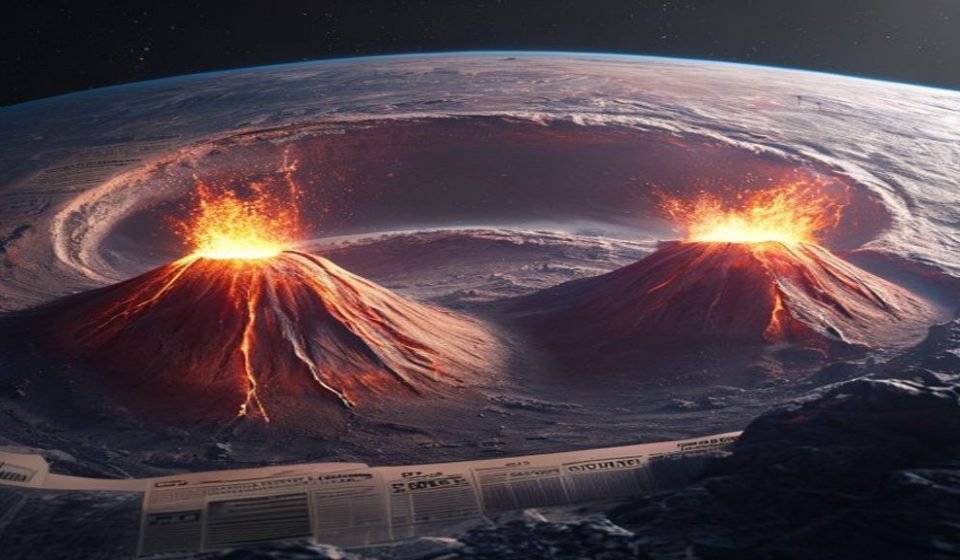
In a fascinating celestial discovery, NASA has recently observed Barnard’s Loop, an expansive emission nebula, appearing to link what some reports describe as celestial ‘twin volcanoes.’ This breathtaking sight is characterized as a stunning cosmic illusion, a testament to the intricate and often deceptive beauty of the universe. Notably, according to initial reports, including those from Moneycontrol.com, neither of these so called ‘twin volcanoes’ has shown any signs of actual eruption, underscoring the visual metaphor rather than literal volcanic activity.
This latest observation by NASA provides astronomers and space enthusiasts alike with a fresh perspective on one of the most prominent features in our galactic neighborhood. The intricate interplay of light and shadow, combined with the vast distances involved, often creates such compelling visual deceptions in deep space, challenging our perceptions and deepening our understanding of cosmic structures. The identification of this apparent connection within Barnard’s Loop adds a new layer of intrigue to an already well studied region of the sky, inviting further exploration into its formation and dynamic processes.
Background
Barnard’s Loop is a colossal emission nebula located in the constellation Orion, a vast cloud of ionized gas that glows due to the radiation from nearby hot, young stars. Its sheer size and striking appearance have made it a subject of astronomical interest for generations. Typically seen as a large arc spanning across a significant portion of the Orion constellation, the nebula is believed to be part of the Orion Molecular Cloud Complex, a massive star forming region. This recent observation, highlighting a connection between ‘twin volcanoes’ within this loop, refers to specific bright knots or formations within the nebula that, when viewed from Earth, present a resemblance to terrestrial volcanic peaks.
The concept of a ‘cosmic illusion’ is central to appreciating this discovery. In astronomy, illusions often arise from our perspective on Earth, where three dimensional structures are projected onto a two dimensional sky. What appears to be a close proximity or a direct link might, in reality, be a grand alignment of distinct features separated by immense distances along our line of sight. These ‘twin volcanoes’ are not geological formations akin to those on Earth or other rocky planets; rather, they are concentrations of gas and dust within the nebula that, due to their shape and brightness, evoke a powerful visual metaphor. The fact that no actual eruption has occurred, as clearly stated in reports, reinforces that this is an optical phenomenon, a trick of cosmic perspective, offering a unique opportunity to marvel at the universe’s artistry without the implications of destructive stellar events.
Timeline of Events
The story of this captivating cosmic observation first emerged into public view on July 30, 2026, at approximately 06:54:01 Universal Coordinated Time. It was at this precise moment that reports began to circulate detailing NASA’s remarkable sighting. These initial disclosures brought to light the stunning image of Barnard’s Loop appearing to link what were described as celestial ‘twin volcanoes.’ The immediate impact of these early reports was to highlight the visual spectacle and the intriguing nature of the discovery, emphasizing the illusionary aspect of the connection. Journalists and scientific communicators were quick to point out that despite the striking imagery of ‘volcanoes,’ these celestial features were not undergoing any actual eruptive activity, maintaining scientific accuracy while conveying the wonder of the observation.
Why It Matters
The observation of Barnard’s Loop in this context holds significant importance for several reasons. Firstly, it reiterates the profound aesthetic value inherent in astronomical exploration. Such visually stunning phenomena capture public imagination, inspiring interest in science and space, which is crucial for fostering future generations of scientists and innovators. It serves as a powerful reminder of the beauty and mystery that pervades the cosmos, far beyond our immediate terrestrial environment.
Secondly, this discovery contributes to our ongoing understanding of nebulae and star formation. Barnard’s Loop, as part of the Orion Molecular Cloud Complex, is a stellar nursery where new stars are actively being born. While the ‘twin volcanoes’ are an illusion, their detailed observation may offer new data points about the distribution of gas and dust within the nebula, the impact of stellar winds, and the processes that sculpt such grand cosmic structures. Even an illusion can reveal underlying truths about the physical properties and dynamics of a region of space.
Furthermore, this event highlights the distinction between perceived activity and actual astrophysical processes. By explicitly stating that the ‘twin volcanoes’ have not erupted, the reports effectively educate the public about the careful interpretation required in astronomy. It teaches us to appreciate the metaphorical language used to describe complex cosmic phenomena while maintaining scientific rigor. This balance is vital for accurate science communication, preventing misconceptions about what is truly happening in distant space. The sustained effort by agencies like NASA to observe and document these distant wonders continually enriches our collective knowledge and broadens humanity’s cosmic perspective.
What Could Happen Next
Following this intriguing observation, it is highly probable that NASA and other global astronomical institutions will intensify their focus on Barnard’s Loop and the specific regions identified as ‘twin volcanoes.’ Further detailed imaging using advanced telescopes, both ground based and orbital, could provide higher resolution views and spectroscopic data. This additional information could help scientists better understand the true nature of these features, whether they are denser knots of gas, regions of intense star formation, or merely remarkable alignments.
Astronomers may also conduct long term monitoring of these areas within Barnard’s Loop. While no eruptions have been noted, changes in brightness, shape, or spectral signatures over time could offer invaluable insights into the evolutionary processes of nebulae and the life cycles of stars within them. Theoretical astrophysicists might also use this new visual information to refine models of nebular development, gas dynamics, and how stellar radiation shapes its environment.
Beyond scientific research, this stunning cosmic illusion is likely to feature prominently in public outreach and educational programs. The evocative imagery of ‘twin volcanoes’ provides an accessible entry point for discussing complex astronomical concepts, such as nebulae, star formation, and the nature of cosmic perspective. NASA, in particular, often leverages such visually compelling discoveries to engage the public, inspiring a deeper appreciation for space science and the ongoing quest to unravel the universe’s many mysteries. Educational materials, documentaries, and interactive exhibits are all potential avenues for sharing the wonder of this observation with a global audience.
Frequently Asked Questions
What exactly is Barnard’s Loop?
Barnard’s Loop is a vast, crescent shaped emission nebula located in the constellation Orion. It is composed of glowing ionized hydrogen gas, illuminated by the intense radiation from hot, young stars within or nearby the nebula. It is a well known feature in the night sky, particularly for those with access to telescopes or specialized cameras.
Are the ‘twin volcanoes’ within Barnard’s Loop actually erupting?
No, the ‘twin volcanoes’ are not actual volcanoes in the terrestrial sense, nor are they erupting. This description refers to a stunning cosmic illusion observed by NASA, where specific formations within Barnard’s Loop visually resemble volcanic peaks. Reports explicitly state that no actual eruptions have been detected, indicating it is a metaphorical or visual representation rather than a literal geological or stellar event.
Who made this significant observation?
The observation of Barnard’s Loop linking these celestial ‘twin volcanoes’ was made by NASA, the United States National Aeronautics and Space Administration. This discovery was subsequently reported by various news outlets, including Moneycontrol.com, bringing the fascinating cosmic illusion to public attention.