
 In 30 Seconds




Story
The Hindu civilization is one of the oldest civilizations to ever exist. Its first traces are seen during Indus Valley civilization in 2500 BCE. The Hindu society since then has come a long way. It did not do so by stagnating on its beliefs, but only by changing them with time. Our religious customs have changed from time to time according to the needs of the era. This is what makes us different from Egyptians and Romans, whose descendants live on, but their civilizational identity is long forgotten. The time has come yet again to change ourselves in this new era, just as Vishnu takes a new avatar in each yuga. Hindus too must change.
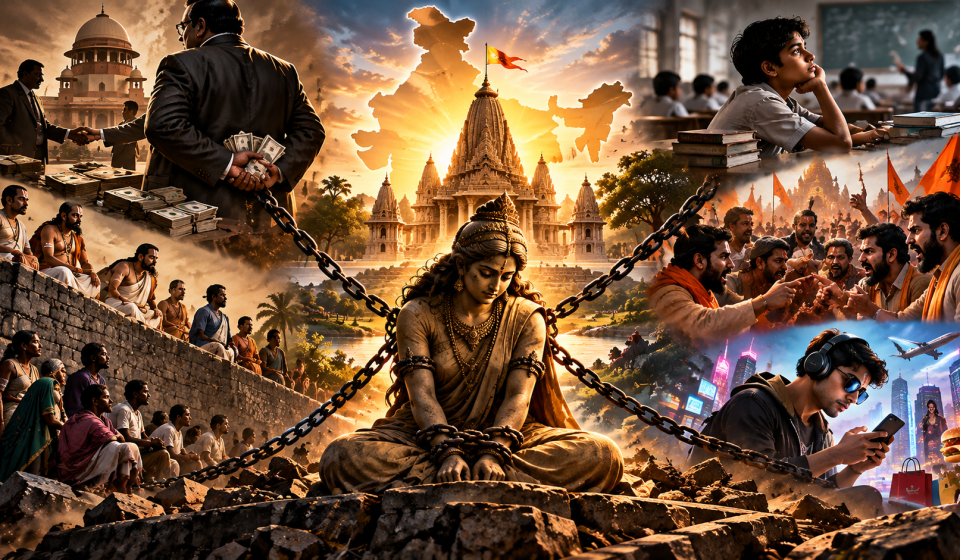
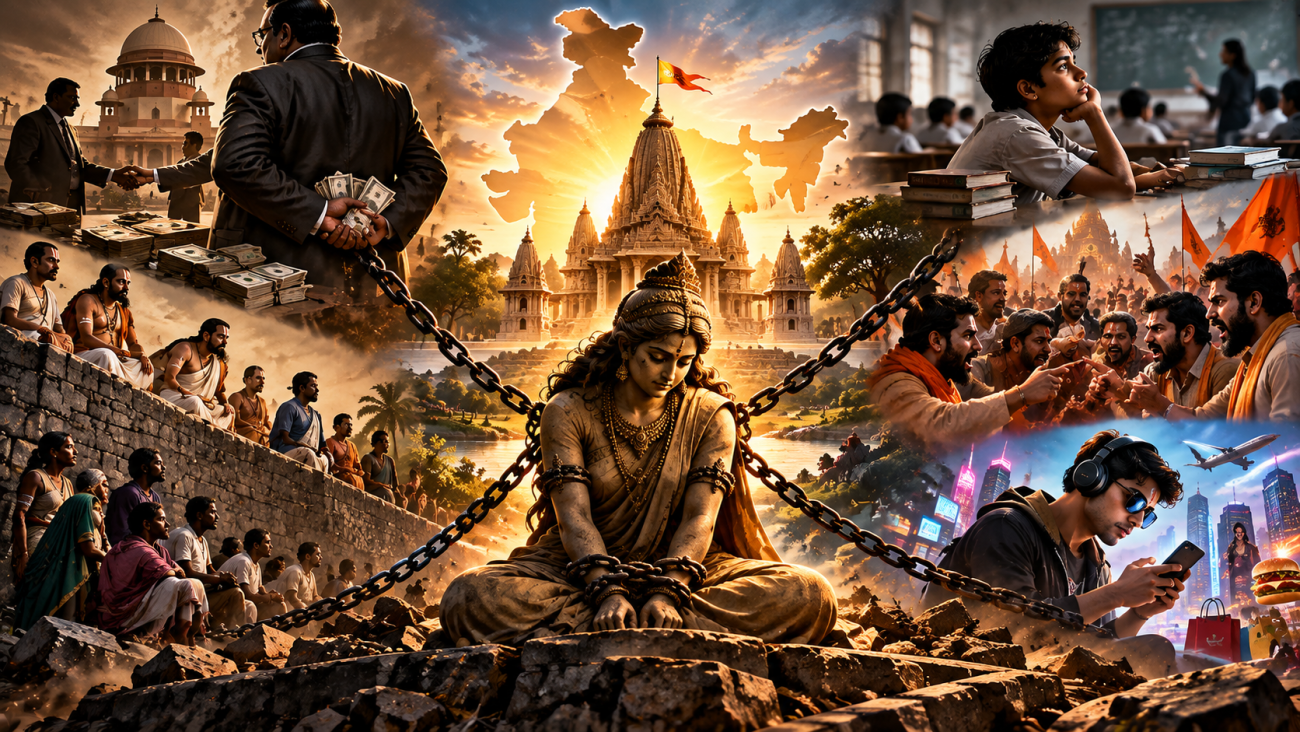
The Hindu society is held back by five impediments, which are:
1. Jātibandi:
The caste system is the biggest and the longest surviving behemoth of an impediment for the Hindus. The system that was once a symbol of viveka (discriminating intellect) and a civil society has now become a malpractice, holding back the Hindus. In the preceding thousand years, this system has been manipulated such that it has lost its roots, which was ‘caste on the basis of merit’ to a baseless ‘caste on the basis of birth’. The so-called lower castes of today gave the foundations of the Hindu society and religion, be it Valmiki, Vyas, or Matanga.
Valmiki’s original name was Ratnakar, and he was a Tribal outcaste and Looter. Once, he came across the divine sage Nārada. With the intention of looting him, he captured and tied him by a tree. Nārada used his wit, he asked him questions regarding the motive of his actions to which Ratnakar replied that he did all of them for the sake of his family. Nārada asked him a thought-invoking question “Will your family consider taking the share of Karmā you are committing for their sake?” Ratnakar, confident went to his family to confirm, and to his surprise, they all denied any share in his sins. This was an existential threat for his identity. He then approached Nārada who accepted him in Sanātan religion and after he proved himself, gave him his new name ‘Vālmiki’. This same Vālmiki later composed the text many consider equivalent to Bhagvad Gita, Vālmiki Rāmāyan.
Veda Vyāsa, his original name being ‘Krishna Dvaipayāna’ was born to a mother from Fishermen community, yet he regarded with highest of reverence among all the sages due to his contributions in segregating Vedas into four parts and composing Mahābhārata and 18 Puranas.
Sage Matanga is the most striking example. He was born of a mixed union. He was born to a Brahmin mother with a Shudra Father. However he was still raised as a Brahmin. He later discovers his true identity and decides to remove this Chandāla status from his birth. He did extreme penance and as a result, he gained great fame and is said to have achieved Moksha. His story is mentioned in Vālmiki Rāmāyan, he owned the Asharam where Shabari stayed and Lord Rama himself blessed the Asharam and her with his presence.
These are just a few examples of an ocean of infinite such examples, including personalities such as Satyakāma Jabala etc. We will not discuss all such examples as it is almost impossible to do so, but for sure these prominent figures give us the clue that the caste system had not always been this rigid as it is today. There are more examples such as Sage Vishvāmitra attaining Brahminhood though he was a Kshatriya by birth and Parshurāma who is widely accepted as a Kshatriya by Karma despite his Brahmin heritage. All of these examples suggest that the Varna system was in its early days, highly fluid. Its rigidity only came in later years, though debated when.
Just apply some logic and think, ‘Why would a religion and civilization call the caste of its biggest benefactors or flag-bearers as small or unworthy of knowledge’? Because if the Caste rigidity has existed from the start then Valmiki, Vyasa and Matanga wouldn’t have been possible. And with them being impossible, the glory of Sanātan today would have been impossible as well.
“To those who introduced this injustice—I ask thee, Oh God, did they feel not an ounce of shame while composing these hymns? Oh Righteous One, my soul cannot fathom how their disciples’ voices did not stutter while reciting these verses. I invoke thee, who art the vanquisher of foes: was the motherland so bereft of brave souls who could oppose these evil verses that harmed thy divine law? Where wast thou when this grave injustice befell thy children? Didst thou not hear their prayers for justice and protection? Didst thou ignore their cries? Couldst thou truly be so cruel to thine own children?”
No matter the reason, no matter how noble, it does not at any cost justify these additions.
The time has now come that we dispose this caste system from our society just as we throw away our old clothes.
2. Mānsbandi:
Indian society has a long history of meat in its cuisines. Meat consumption was and still is a crucial part in many yajnas. Including Yajnas like Ashvamedha Yajna, performed by powerful Kings to showcase their expanse and dominance. Notably performed by King Dashrath, Lord Rāma and many more. The Yajna demands horse sacrifice and consumption as mentioned in Rigveda:
Rigveda 1.162.11
“Whatever (portion) of your slaughtered (body) fall from your carcass when it is being roasted by the fire, (escaping) from the spit; let it not be left on the ground,nor on the (sacred) grass, but let it (all) be given to the longing gods.”
Rigveda 1.162.12
“Let their exertions be for our good who watch the cooking of the horse; who say, it is fragrant; therefore give us some; who solicit the flesh of the horse as alms.”
This was about rituals, but Mansumriti clearly states the guidelines for meat consumption by commoners in day to day life. The topic is extensively discussed in its Chapter 5. Let us see some prominent verses from that:
Manusmriti 5.30
“The eater incurs no sin by eating, even daily, such animals as are eatable: since the eater as well as the eaten animals have been created by the creator himself”
Manusmriti 5.32
Having bought it, or having obtained it himself, or having it presented by others,—if one eats meat after having worshipped the Gods and the Pitṛs, he does not incur sin.
Offering it to Pitrs here means performing a practice of ‘Prokshāna’, in which holy water is sprinkled on meat to purify it.
All of these verses show us the trend of that time. Meat eating was culturally and religiously accepted. Then why the dilemma today?
The clash of moral authority started with the rise of Buddhism and Jainism. Their core doctrine of absolute Ahimsa was, which prohibited animal sacrifices, valuing every life form became the new right. Noble thoughts truly. To match with their intensity and with the changing times, the leaders of thought and action of Sanatan Dharma added verses which promoted Ahimsā, and various practices of meat eating were dropped, just to keep religion surviving.
These new verses were indeed added, but the previous verses were not removed completely. The change was adopted but without abandoning the historical roots.
But today, we see some people taking the morality and Ahmisā part with absolutism, which is wrong because it was never intended to be taken this way. Our ancestors acknowledged the fact that different people can have different truths, and they acknowledged them all, and so should we.
Food is a personal choice. A Hindu who consumes meat is still a Hindu. “Down with the exclusion of Mānsāhari Hindus!”
3. Apārtha-Shāstrabandi
As technology has advanced in recent years, so has increased the spread of misinformation. This misinformation is being spread by the orthodoxy and those innocents who are already manipulated by them. These people misinterpret shastras to their will. The laws of God have been polluted by these men. They tell Ahimsa is absolute and condemn meat eating without showing viable scriptural proofs, only on the basis of some shlokas.
Let us take some examples from the verses of Rāmāyan to verify the claim that ‘Rama never ate meat’ as used by many First, let me tell you some basics, Ramayana, Mahabharat and Bhagvad Gita are writen in a specific meter called ‘Anushtup Chhanda’. As per this, the shloka consists of four parts, each part having no more than 8 syllables, hence the entire shloka has 32 syllables. In Itiihasa such as Rāmāyan and Mahabharat it has been used in a specific way. One part sets the Location, another the context, third the character and fourth the action. All of these together determine the meaning of the word as we will be seeing now.
So the Sholka comes from the context when Rāma was about to leave for exile and he assured Kauśalya with the following, The Verse below is from Ayodhya Kand Sarga 20, verse 29:
चतुर्दश हि वर्षाणि वत्स्यामि विजने वने।
मधुमूलफलैर्जीवन्हित्वा मुनिवदामिषम्।
Its most popularized meaning is as follows
“For fourteen years I shall dwell in the lonely forest, living on honey, roots, and fruits, and giving up meat—like a sage”
The first part tells Rama is going for 14 years, the second part tells he is going to forest (Context), the third part explains his conduct, that he will live in forest and the fourth part tells his action, that is he will like a sage. The whole point of manipulation as spread is by just one word i.e आमिषम् (Desire of enjoyment, joy and its another meaning being ‘meat’) So, as we mentioned above, as per the grammatic pattern of the Ramayan, the meaning of these words will be based on their context and internal harmony. आमिषम् means Desire for enjoyment and joy. And its another meaning is also ‘meat’.
Now I ask you all to judge what is the more befitting interpretation of this shloka
1) “For fourteen years I shall dwell in the lonely forest, living on honey, roots, and fruits, and giving up meat—like a sage”
or
2) “For fourteen years I shall dwell in the lonely forest, living on honey, roots, and fruits, and giving up worldly desires—like a sage”
Ofcourse, the second one sounds more befitting the meaning, dropping worldly desires to live like a sage! Not to mention that there have been many sages who have consumed meat.
See what a single misinterpretation can do, that too, just a single word. Due to these misconceptions, we today have a generation of radicals who are ready to kill you if you say anything against their self-constructed image of Rama. This is not an individual problem, but a collective problem.
The only solution for it is that all Hindus should have at least basic knowledge of Sanskrit, so that they are not easily manipulated by these false interpretations. More than that, they need to develop a sense of tolerance. We must accept that there can be multiple interpretations of a single verse, just as in the case of Ramayana.
4. Sabda-artha bandi
Our scriptures have a set of many exaggerations. These exaggerations were mainly present so that the long history would become easy to be memorized. But due to lack of nuance, the same mechanism that helped preserve thousands of years of culture and history has now become fatal for the Hindu society. The Hindus nowadays take statements such as ‘Ram conquered all the three lokas’ as literal, failing to recognize that it is a mere exaggeration to showcase Lord Rama’s dominance in the Indian subcontinent.
This habit that we have developed over the millennia is the exact reason why we see many people worshipping cows today. Do not get me wrong, Cow was meant to be protected because it was a valuable resource, not to be worshipped because it was something divine.
We see its evidences in texts such as Satapatha Brahmana, which is considered as one of the key texts documenting a transition of our society from viewing cow as normal to almost sacred.
In the text, the court clearly state Cow as inedible as the entire vigor of entire world resides in it and killing it could alter balance. But from among them Sage Yajnavalkya states almost casually “‘I, for one, eat it, provided that it is tender (amsala)”.
Lets first understand how poetic device ‘Atishyokti’ (Exaggeration) has been used here. The vigor of entire world here is not be taken literally, rather we can infer that cow is being acknowledged as a valuable resource by the court. They acknowledge that a cow provides them with milk and its cow dung is highly useful as well (As per their timeline) and they realize that it is more beneficial to keep the cow alive than to kill it for its meat.
But even in it, one of the most decorated sages of their era, Sage Yajnavalkya is clearly countering the decision while stating his orthodox view. And what is commendable is that this part was kept and not removed by the people of that era. Imagine something like this today, We can’t due to this deep instilled dogma. It is a shame that we lack the same tolerance as our ancestors on such matters.
So all these stories around cows like Kamadhenu and all were constructed to provide protection to such a valuable resource like cow. Worship could’ve had been a reason, it could be that a generation of our ancestors felt a connection with this animal, but one thing is for sure that it was not the only reason.
It is ok to want protection of the animal, but it is not at all fine to worship it as mother. As Veer Savarkar noted “It is a ridicule to human intellect” on this matter. Even he viewed critical views on this practice famously noting “If some people consider Cow as mother than is the bull their Father?”
The Hindus must develop a sense of nuance, which would help them separating exaggerations from the true meaning of these verses.
5. Vivekabandi
Hindus have discovered algebra, number system, the number zero itself, buttons, calculation processes, alongside religious progress. The descendants of the civilization shall always be thankful to Aryabhata and Sushruta and many more for adding science in the civilization. But the modern Hindus seem to lack the same scientific temperament of its ancestors. The people nowadays act more like religious dogmatic. I plea to all of them: ‘leave the tools of the past and make machines of the future’. Hindus fail to realise the fragility of religion. My critique is not on religion itself but on the limitations it brings. Sanatanis are our brothers, so are Buddhists, Jains and Sikhs. I myself am a deep admirer of Hindu religious philosophies, especially the Advaita Vedanta. I am an ardent follower of Buddha the Enlightened and I, with my heart and soul believe that the path laid by Tirthankaras is one of absolute truth. So is the one laid by others. But no matter the intensity of this divine knowledge, the truth of this world will remain unchanged, i.e it obeys power and only power. And power requires knowledge, it requires intellect, it requires advancements, it requires technology and most importantly of all, it requires ‘Temperament’ that of a scientist. A highly atheistic society like that of China will defeat the heart of religious land like India through its sheer industrial capabilities, no matter how religious and valorous people of this land are. Stories of bravery will live on indeed, as they have, but a civilization does not survive by stories alone. We need material power. But can we truly achieve material progress by sticking to the knowledge of the past? Religion will not protect us.
I myself am a devotee of Vishnu, but it is a matter of fact that many of his devotees died while worshipping him by the hands of cruel invaders but he did not intervene. He did not intervene even when his idols were crushed by invaders such as Ghori. At the time of War, 108 or even 1008 Hari Bhajans will not help us. What will only help us will be ‘steel’. And that is something we won’t be bestowed upon, we must make it ourselves.
Indeed, it is admirable what our ancestors achieved, but even they wouldn’t want us to stick to out-dated knowledge. Even our shastras and texts have evolved with time. Honor them by remembering them but we must pave the future for ourselves and our upcoming generations too, just as our Pitrs (Forefathers) did. Hindus must take science and scripture side by side. One ensures the survival in future and another gives us the unity and identity to be preserved. But if time comes when they have to choose any one of them, then they should choose science without forgetting their cultural link.
These are the five chains that hold back the Hindus today. Once these shackles break, no force will be able to stop our civilization from reclaiming its past glories, just as the Devas, had became unstoppable upon drinking the sacred somā. The Somā for Hindus is Reforms, and we must accept them.
Special thanks to Vinayak Damodar (Veer) Savarkar. The article is a modern version of his original, ‘Sapta Bedi’ or ‘Seven Shackles of the Hindu Society’.
Sources and Citations
- Manusmriti: https://www.wisdomlib.org/hinduism/book/manusmriti-with-the-commentary-of-medhatithi
- Rigveda: https://www.wisdomlib.org/hinduism/book/rig-veda-english-translation
- Valmiki Ramayam: https://sanskritdocuments.org/sites/valmikiramayan/vr_index.htm
- Satapatha Brahmana: https://www.wisdomlib.org/hinduism/book/satapatha-brahmana-sanskrit/d/doc1051103.html
- Sapta Bedi by Veer Savarkar
- Writings by Veer Savarkar