 In 30 Seconds




While the Company’s armies were completing the conquest of India, a Bengali scholar was beginning the reconquest of the Indian mind, and of the two enterprises his has proved the more durable. Raja Ram Mohan Roy, born into an orthodox Brahmin family of Bengal around 1772, became the first Indian to confront the West with full knowledge of both civilisations, taking from Europe what he judged true, defending in India what he knew to be precious, and attacking in both what he found indefensible. Historians who dislike large titles still concede him the one his century awarded, the father of modern India.
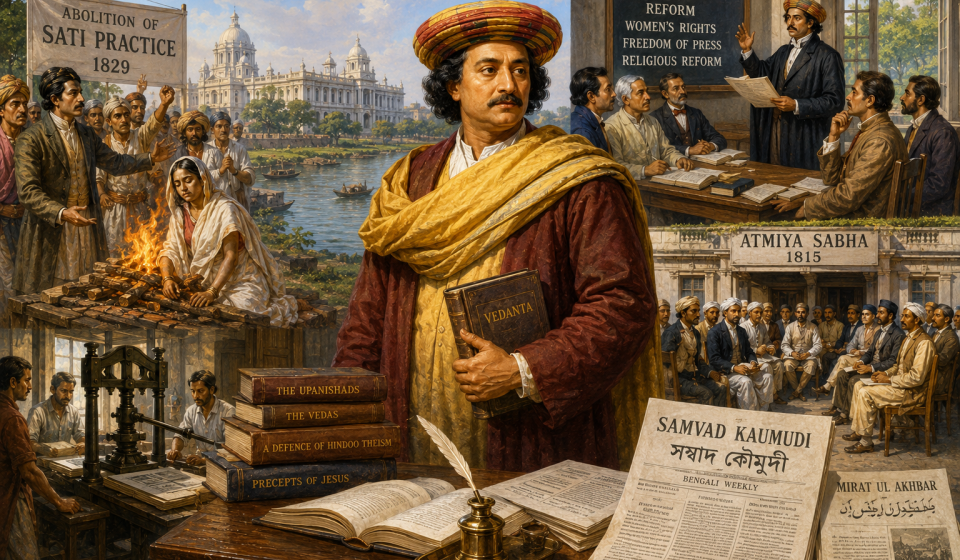
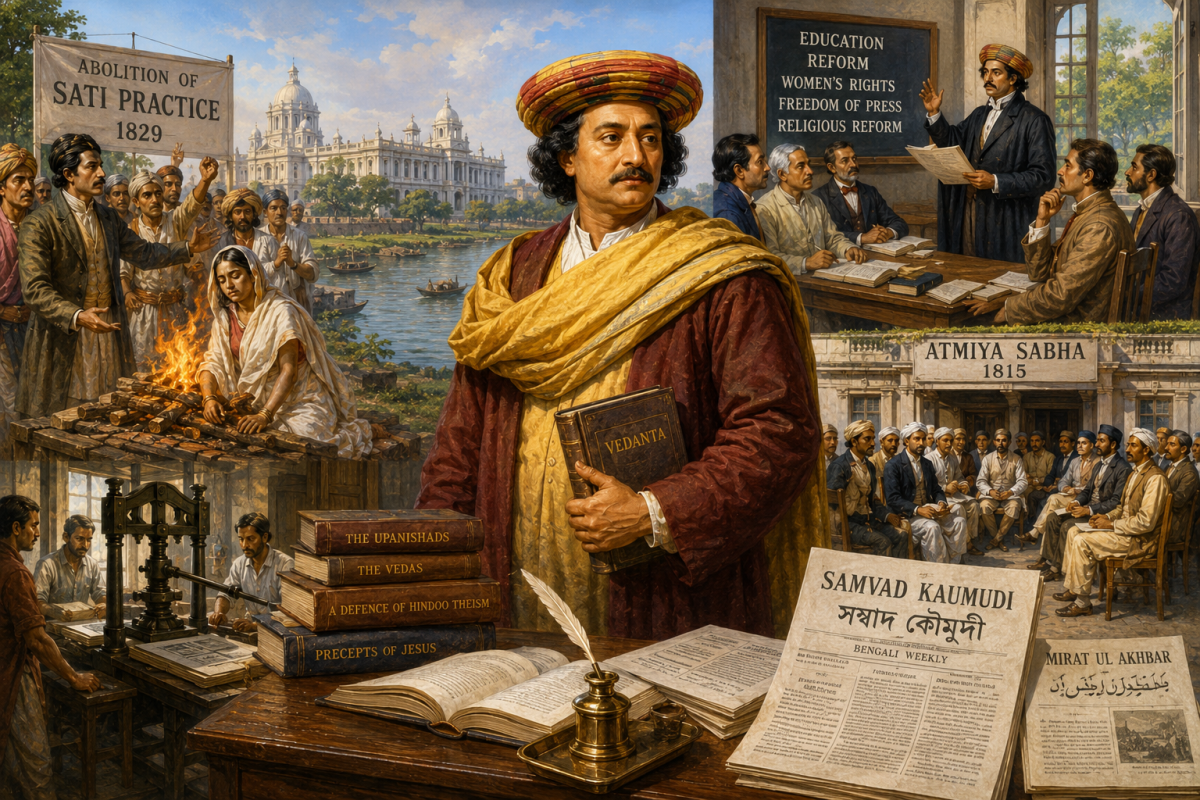
His learning was itself a program. Persian and Arabic at Patna gave him the rationalist theology of the Islamic schools, Sanskrit gave him the Vedanta, and English, learned in adulthood while he made a fortune in Company service and private finance, opened Locke, the Unitarians and the newspapers of Europe. His first book, written in Persian with an Arabic preface, the Tuhfat ul Muwahhidin, the Gift to Monotheists, argued that beneath the ornaments of every religion lay one truth, the unity of God, and that priesthoods everywhere had buried it for their profit. It was a young man’s thesis, and he spent his life applying it. In Bengali and English he translated the Upanishads and the Vedanta sutras, insisting that the purest fountain of Hindu faith taught the worship of one formless God, and that the idolatry and social cruelties of his day were later corruptions that the scriptures themselves condemned. Orthodox Calcutta answered with fury and debate, Christian missionaries who had welcomed his attacks on Hindu practice discovered to their dismay that his Precepts of Jesus admired the ethics and rejected the miracles and the Trinity, and Roy, serenely controversial, founded in 1828 the Brahmo Sabha, later the Brahmo Samaj, a congregation for the worship of the One without image, the seedbed from which a century of Bengali reform and much of modern Hindu self understanding would grow.
His public causes made the pattern of Indian liberalism. Against sati he campaigned for a decade with pamphlets in two languages, marshalling scripture and compassion together, and when Bentinck abolished the rite in 1829 Roy defended the regulation before hostile petitions and saw the appeal defeated in London. He fought for the property rights of Hindu women, against polygamy and child marriage, for the freedom of the press when the government muzzled it in 1823, his memorial against the press ordinance ranking among the first classics of Indian constitutional argument, and for English and scientific education, protesting in a famous letter of 1823 against the founding of a new Sanskrit college when the country, he said, needed mathematics, chemistry and Bacon. Yet the same man founded the Vedanta College, published Bengali grammars and pioneered Bengali journalism, for his quarrel was never with India’s languages but with anything that closed the Indian mind.
He watched politics with the same double vision. He welcomed British rule as a providential schoolroom and demanded that it behave like one, calling for the separation of powers, trial by jury, Indian judges and consultation of Indian opinion, the whole agenda of the later Congress moderates sketched a half century early. In 1830 the powerless Mughal emperor made him a Raja and his envoy to England, where he went, the first Brahmin of note to cross the forbidden seas, testified before Parliament on Indian conditions, was lionised by philosophers and Unitarians, and rejoiced publicly at the Reform Bill and the revolutions of Europe, for he held the liberty of every nation to be the business of all. He died at Bristol in September 1833 and lies buried there, his tomb a place of Bengali pilgrimage.
The movement he began, the Bengal Renaissance, ran on through Debendranath Tagore and Vidyasagar, Keshub Sen and the reformers of every province, an awakening that took from the West its sciences and its liberalism and increasingly turned both against Western rule. Roy’s deepest bequest was a method, to reform India by India’s own best lights, testing every custom against scripture and reason together, and conceding to no one, foreign or priestly, the ownership of truth. Modern India, arguing with itself in his manner ever since, is his monument.
1818 to 1856 - Consolidation and Reform
Part 2 of 10 in this chapter.