 In 30 Seconds




Empires live on taxes, and in India the tax was the land. How the British assessed and collected the land revenue was the deepest of all their interventions in Indian life, reaching past courts and armies into every village and every harvest, and the three great systems they devised, zamindari, ryotwari and mahalwari, reshaped rural society so thoroughly that independent India spent its first decades trying to undo them.
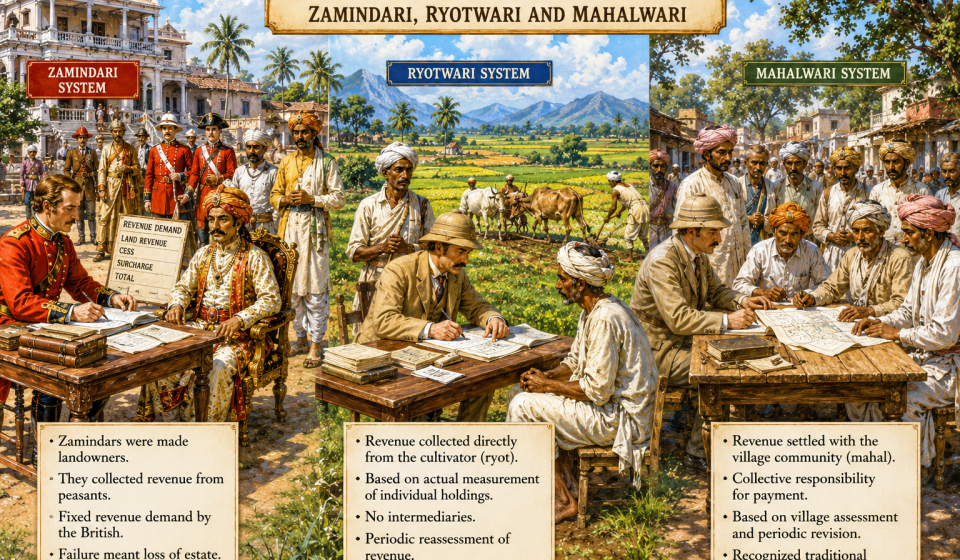
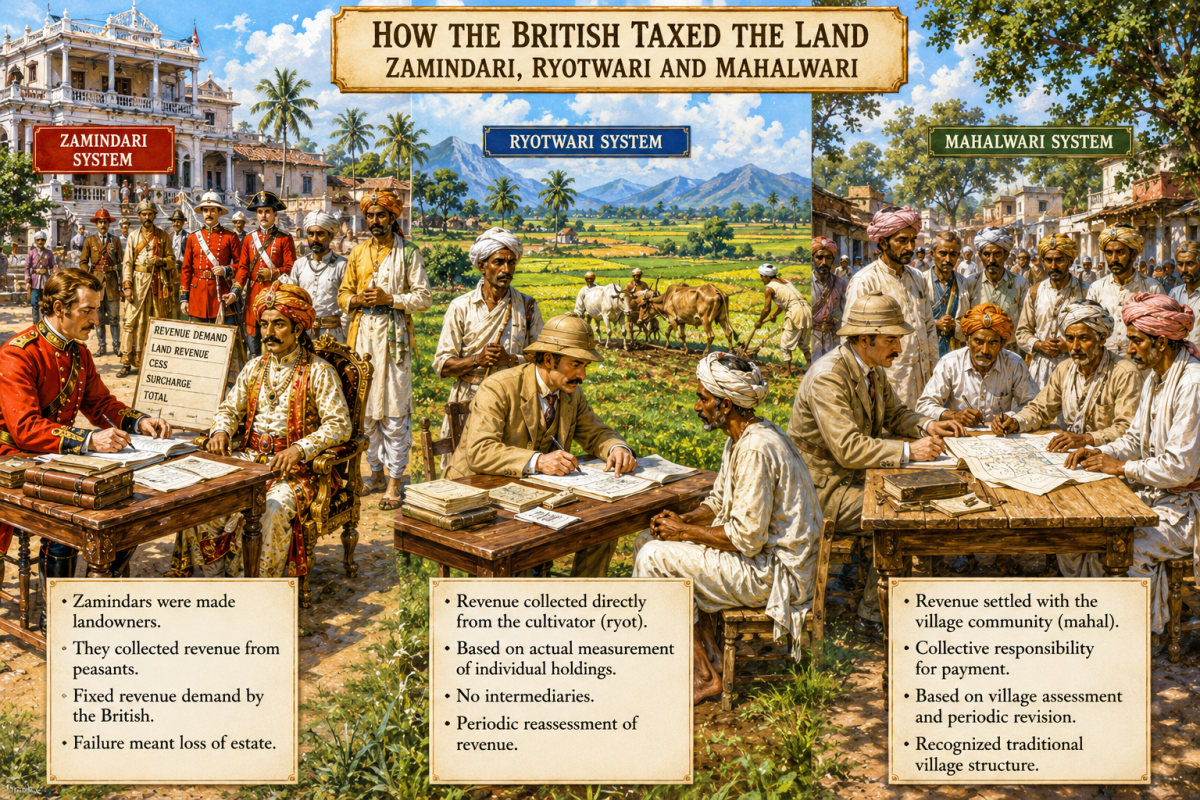
The first experiment was the grandest. In 1793 Lord Cornwallis, seeking to end the ruinous cycle of annual revenue auctions that had followed the famine of 1770, proclaimed the Permanent Settlement of Bengal, Bihar and Orissa. The zamindars, hitherto revenue collectors holding office under the state, were converted at a stroke into landlords with property in the soil, and the revenue they owed the Company was fixed forever, at about ninety percent of the rental as then reckoned. The theory was English and Whig, that secure property would create an improving gentry whose investment would enrich the land and, incidentally, attach a powerful class to British rule. The reality was harsher. The initial assessment was set so high that estates failed wholesale, and under the sunset law, which sold up any zamindar in arrears at sundown of the due date, a great churning transferred old houses to Calcutta money men. The peasant, meanwhile, gained nothing and lost his customary protections, becoming a tenant at the landlord’s mercy, while the state, its revenue frozen as prices rose over a century and a half, watched the growing surplus pass to a class that, with honourable exceptions, invested in rent receiving rather than improvement. Bengal got its landed aristocracy, absentee, litigious and loyal, and its agrarian question, which endures.
The southern answer was built against Bengal’s example. Thomas Munro, soldier and administrator of Madras, argued that in the south the true partner of the state was not any lord but the cultivating peasant, the ryot, and under the ryotwari system, extended across most of the Madras and Bombay presidencies in the early nineteenth century, each cultivator held his field directly from the government, with the revenue assessed on his individual holding and revised at intervals of about thirty years. The design honoured the peasant proprietor and removed the middleman, and where assessments were moderate it worked as intended. But the early assessments were anything but moderate, often claiming as much as half the estimated produce, collected in cash whatever the season, and the ryot’s independence delivered him, in a bad year, straight to the moneylender, whose bond replaced the zamindar as the instrument of rural subjection. The revenue settlement officer, measuring and classifying every field, made the ryotwari tracts the most minutely governed countryside on earth.
Between these poles, the mahalwari system of the North Western Provinces and later Punjab settled the revenue neither on a lord nor on the individual, but on the mahal, the village or estate as a body, with the coparcenary brotherhood of the village jointly responsible for the assessed sum. Devised in the 1820s and reformed after early over assessment, it preserved something of the old village community while binding the whole brotherhood to the treasury, so that default by some fell upon all.
Across all three systems certain effects ran uniform. The demand was fixed in cash, punctual and inflexible, where the old regimes had taken shares of grain that rose and fell with the harvest, and the change drove the peasant into the market and into debt in equal measure. Land itself, made saleable and mortgageable to secure the revenue, passed increasingly from cultivators to creditors, a transfer whose social bitterness exploded in episodes like the Deccan riots of 1875. Commercial crops, indigo, opium, cotton, spread where cash had to be found. And the revenue pressure of the early decades, softened only slowly by later reforms, left the countryside with thin reserves against the famines of the century.
The three systems were also three philosophies of rule, aristocratic, individualist and communal, argued between Cornwallis’s Whigs, Munro’s paternalists and the utilitarians who followed, each claiming to have found the true ancient constitution of India in the arrangement that suited its theory. What India received was not any theory but the sum of their extractions, a countryside remade around the revenue demand of a foreign state. When the Constituent Assembly of free India abolished the zamindari system in the 1950s, it was legislating against 1793, so long is the half life of a land settlement.
1818 to 1856 - Consolidation and Reform
Part 1 of 10 in this chapter.