 In 30 Seconds




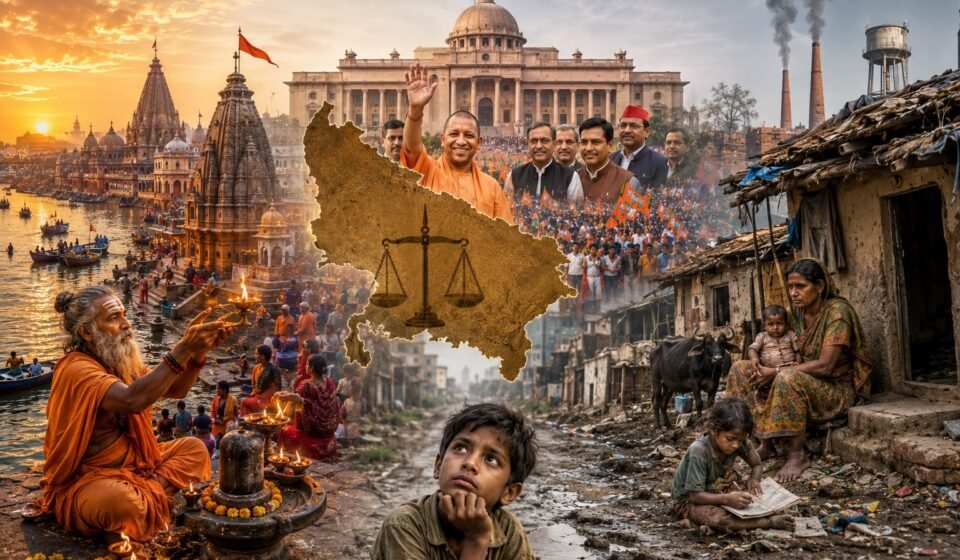
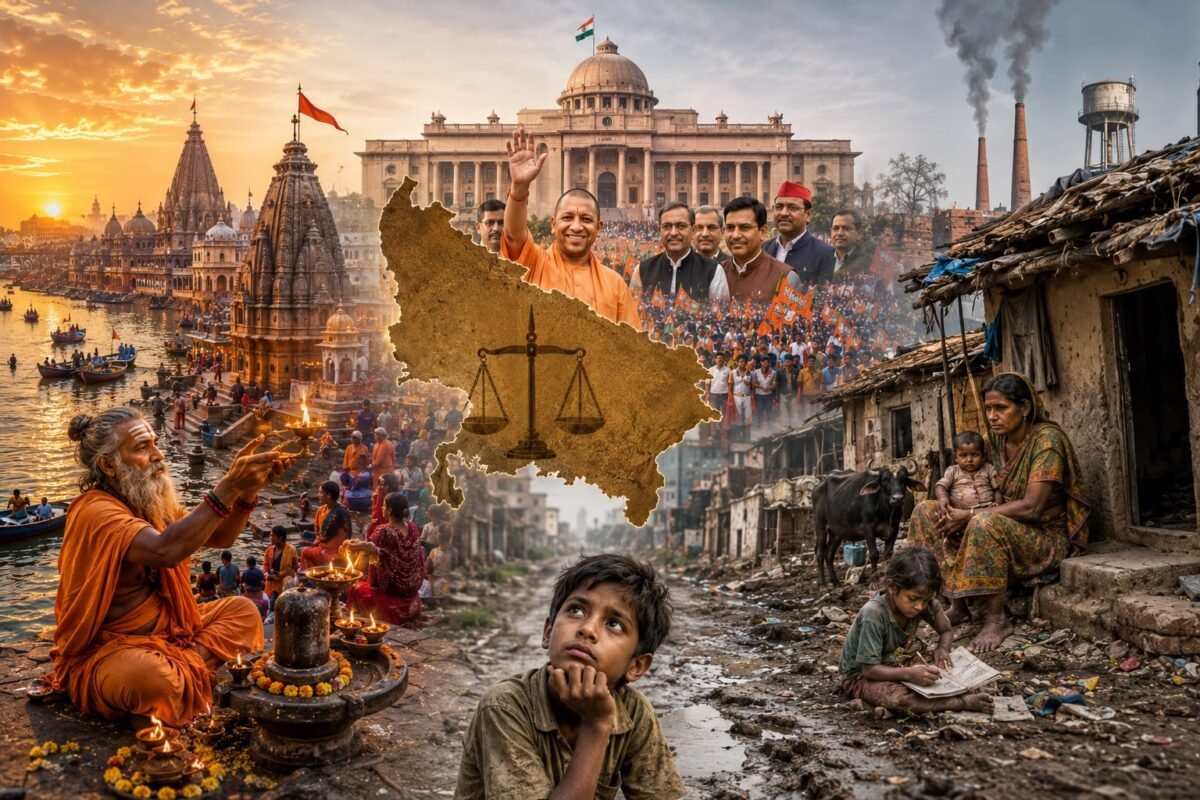
Hold the three facts side by side and the strangeness of Uttar Pradesh comes into focus. This is the holiest ground of Indian civilisation, keeper of Kashi, Ayodhya, Mathura, and the Sangam. This is the most powerful electorate in the democratic world, maker of prime ministers and breaker of governments. And this is, by most human measures, one of the poorest large societies on the planet, its districts crowding the bottom of India’s tables for income, schooling, and child health. Sacred geography, political power, persistent poverty. The UP paradox is the founding puzzle of this series, and every article that follows is, in one way or another, an attempt to explain it.
The scale of the lag should be stated plainly. UP’s per capita income has hovered around half the national average for decades, keeping company with Bihar at the foot of the state rankings. Multidimensional poverty indices have placed several of its eastern and Bundelkhand districts among India’s most deprived. Its historic record on infant mortality, stunting, and female literacy trailed the republic’s for most of the republic’s life, with improvement real but late. The state that elects India’s rulers has, for most of its history, been unable to secure for its own children what smaller and weaker states secured for theirs.
How did power fail to purchase prosperity? The explanations form a ledger, and honesty requires entering them all. The first entry is demographic arithmetic. Growth that would transform a smaller state disappears into UP’s denominators, and every school, clinic, and job scheme must first outrun the population before it can raise the average.
The second is the freight of history. Zamindari and the taluqdari settlement left the countryside with extreme inequality in land and a peasantry stripped of surplus, and the abolition that followed independence, as a later article will show, changed titles more than it changed power. The colonial economy assigned the region raw material and revenue duties rather than industry, and outside Kanpur’s mills the plain entered independence with little modern manufacturing to build on. Freight equalisation policies after independence then removed what advantage proximity to minerals might have offered.
The third entry is the one UP’s own citizens name first. Governance. For long stretches, the state’s politics consumed itself, with chief ministers averaging barely a year in office through the unstable decades, identity mobilisation crowding out administration, and the fusion of crime and politics, examined at length later in this series, imposing what economists politely call a security tax on enterprise. Businesses require order, contracts, and roads. UP too often offered them strongmen, litigation, and potholes. Capital went elsewhere, and the state’s ambitious young followed it, their remittances a substitute for the development that never arrived.
The fourth entry complicates the tale of failure. Where the state has functioned, results have followed. The canal built west grew rich by Indian standards. Noida, willed into existence by administrative fiat, became a revenue engine. The recent expressway and investment push, whatever one’s verdict on its politics, represents the first sustained attempt in generations to give the whole plain modern connective tissue. The paradox, in other words, is not a curse. It is a record of choices, which means different choices remain possible.
What of the sacredness? Some argue the pilgrim economy was always an underexploited asset, and point to the Kashi corridor’s traffic and the Kumbh’s colossal commerce as proof of what organised faith can generate. Others reply that spectacle is not development, and that a state cannot ghat build its way out of stunted children. Both positions will get their full hearing in the economy and culture sections of this series.
The paradox, finally, is not UP’s alone. A democracy in which the poorest region holds the most power was always going to test whether ballots convert into bread. Uttar Pradesh is where India runs that experiment at maximum scale, and the results, still arriving, will tell the country what its democracy is actually for. That is the wager of the UP Files, and the ground is now laid. The series turns next to where everything began, the sacred cities of the plain.
UP Files - Batch 1
Part 10 of 10 in this chapter.