 In 30 Seconds




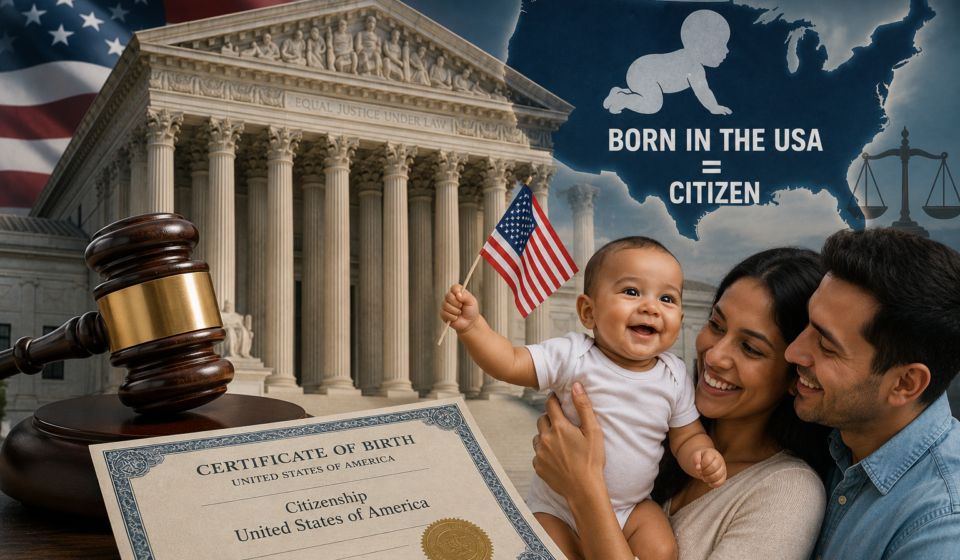
The United States Supreme Court delivered one of its most consequential rulings of the year on June 30 2026, striking down President Donald Trump's attempt to end automatic birthright citizenship through an executive order. In a 6 to 3 decision, Chief Justice John Roberts wrote for the majority that the Fourteenth Amendment guarantees citizenship to virtually every child born on American soil, regardless of their parents' immigration status.
What The Order Was Trying To Do
Trump signed the executive order on the very first day of his second term, seeking to deny automatic citizenship to children born in the United States to parents who were either undocumented or living in the country on temporary visas. The order never actually took effect, since every lower court that reviewed it, without exception, concluded it was unconstitutional, with one judge going so far as to call it blatantly unconstitutional. According to estimates from the Migration Policy Institute, roughly 255,000 children born every year to noncitizen parents would have lost legal status had the order gone into force, and some of those children could conceivably have ended up stateless, unable to claim citizenship anywhere.
The Reasoning Behind The Ruling
Roberts anchored the majority opinion in a case from 1898 called Wong Kim Ark versus United States, which involved a man born in San Francisco to Chinese immigrant parents who was denied re entry into the country after a visit abroad. The Supreme Court back then ruled that the phrase subject to the jurisdiction thereof in the Fourteenth Amendment meant that nearly all children born in the United States automatically became citizens, with only a narrow exception carved out for children of foreign diplomats. That interpretation held firm for well over a century, surviving even periods of intense hostility toward immigrants, including World War II, when children born in internment camps to detained Japanese families were still automatically granted American citizenship simply because they were born on US soil.
Roberts described citizenship in the opinion as the right to have rights, arguing that the framers of the Fourteenth Amendment deliberately extended that promise broadly rather than narrowly. Notably, only one of the court's conservative justices, Amy Coney Barrett, joined Roberts alongside the court's three liberal justices to form the majority, while three other conservative justices dissented, a split that surprised many legal observers who had expected a narrower or more procedural ruling rather than a full constitutional rebuke.
What Comes Next
House Speaker Mike Johnson suggested shortly after the ruling that Congress could still try to legislate around the decision, a point Justice Brett Kavanaugh had also raised in his own opinion despite ultimately siding with the majority. Legal experts, however, are largely sceptical that this path leads anywhere meaningful, since changing the actual constitutional guarantee would require a formal amendment, not an ordinary act of Congress. Cody Wofsy of the ACLU's immigrants rights project said the organisation does not expect a serious round two of this legal fight, calling the court's rejection emphatic. Cecillia Wang, who argued the case for the ACLU and is herself a birthright citizen born to Chinese immigrant parents, called the ruling a celebration of a principle she described as fundamental to American identity.
Why This Matters Beyond America
For Indian readers, this ruling carries a fairly direct relevance given the scale of the Indian diaspora in the United States, including a large population on temporary work visas such as H1B, many of whom have children born on American soil. Had the order been allowed to stand, families in exactly that situation could have faced real uncertainty over their children's citizenship status. The ruling effectively closes that door, at least for now, reaffirming that the constitutional guarantee of birthright citizenship applies uniformly regardless of the parents' visa category.
More broadly, the case is a reminder of how central the Fourteenth Amendment remains to debates over who counts as American, more than 150 years after it was first ratified following the Civil War. The Supreme Court has now reaffirmed that principle in about as forceful a manner as it could, even as the underlying political argument over immigration policy in the United States is almost certain to continue in other forms.
Related Reading
- Deadly Hodeidah Clashes Ignite Fears of Wider Yemen Conflict
- What Is the G20? How the Forum Shapes Global Policy
- What Is the United Nations Security Council? Power, Veto and Reform Explained
Official context: Readers can compare this story with public information from United Nations.