
 In 30 Seconds




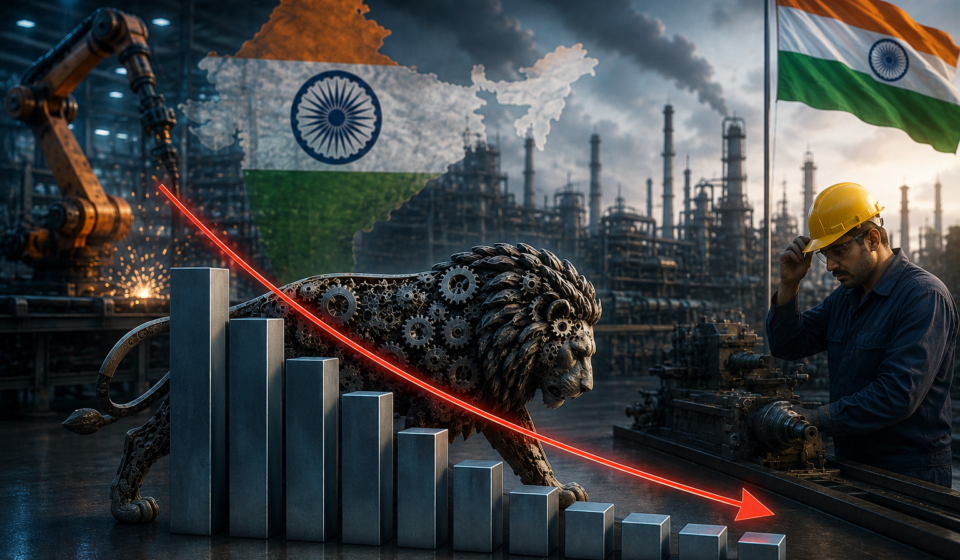
India's factories are still growing, but the pace has clearly lost some steam. The HSBC Manufacturing PMI fell to 54.5 in June 2026, a three month low, down from 55.0 in May, according to preliminary estimates released by S&P Global. Any reading above 50 still signals expansion, so the sector is not shrinking, but the direction of the trend line matters just as much as the absolute number, and right now that trend is pointing gently downward.
What Is Actually Slowing Down
The survey points to softer demand as the main culprit. New orders kept rising in June, but at a noticeably weaker pace than in previous months, with manufacturers citing stiffer competition and subdued interest from both domestic and export buyers. Export orders in particular grew at their slowest pace since March 2023, a fairly striking data point given how much emphasis Indian policymakers have placed on boosting manufacturing exports as part of the broader push toward becoming a global production hub.
Hiring told a similar story. Employment did rise in June, but only marginally, marking the weakest pace of job creation in six months as factories recalibrated staffing levels to match the softer demand environment. Purchasing activity, meaning how much raw material and components manufacturers were buying to feed future production, grew at its slowest pace in two and a half years, and finished goods inventories actually declined, suggesting factories are being more cautious about building up stock they might struggle to sell quickly.
On the cost side, pressures remained elevated even as growth cooled, a combination that tends to squeeze profit margins from both directions. Business confidence stayed in positive territory, meaning manufacturers still generally expect things to improve, but that confidence weakened to its lowest level in close to four years, suggesting even optimists in the sector are hedging their bets somewhat.
How This Fits The Bigger Trend
This is not an isolated blip. May's reading of 55.0 was itself a downward revision territory compared to April's 54.7, and the flash estimate for May had come in even lower at 54.3 before being revised upward. Stretch the timeline back further and April's PMI of 54.7 represented the second weakest improvement in factory conditions in nearly four years, with firms at the time citing competitive pressures, travel disruptions and the ongoing conflict in the Middle East as headwinds weighing on sales. Input cost inflation in that period hit its highest level since July 2022, driven by rising prices for energy, fuel, metals, plastics and transport, costs that ripple through nearly every stage of Indian manufacturing.
Services activity, which had been the stronger half of the Indian economy in recent months, softened too. The Services PMI dropped to 57.3 in June from a six month high of 58.9 in May, the weakest growth in that sector since January 2025, with companies again pointing to cost pressures, rising fuel prices and gas shortages as factors curbing the pace of business activity.
Why This Matters For Ordinary Readers
For anyone watching India's broader economic trajectory rather than just headline growth figures, this softening is worth paying attention to for a few reasons. Manufacturing and factory jobs remain one of the more reliable ladders into formal employment for workers moving out of agriculture, so a slower pace of hiring in this sector has knock on effects well beyond the factory floor. Weaker export growth also complicates the government's ambitions around positioning India as an alternative manufacturing base to China, a narrative that has gained real traction over the past few years but depends heavily on sustained overseas demand actually showing up in the order books.
At the same time, it is worth keeping some perspective here. A PMI reading of 54.5 still represents solid expansion by any conventional benchmark, and India's manufacturing sector has now been in growth territory continuously since March 2024. The Reserve Bank of India, in its own recent assessment, cut its GDP growth forecast to 6.6 percent, citing real headwinds facing corporate earnings over coming quarters, largely tied to how the West Asia situation and crude oil prices evolve from here. Whether June's dip proves to be a temporary pause or the start of a longer slowdown will likely become clearer once the July and August PMI readings come in, particularly if the geopolitical backdrop stabilises and input costs finally start easing.
Related Reading
- Centre Intensifies Scrutiny on Social Media Applications
- India’s Passport Ranking Dips to 125th in 2026 Global Index
- India Orders Removal of Battery Apps After E-Rickshaw Stalling
Official context: Readers can compare this story with public information from India.gov.in.