 In 30 Seconds



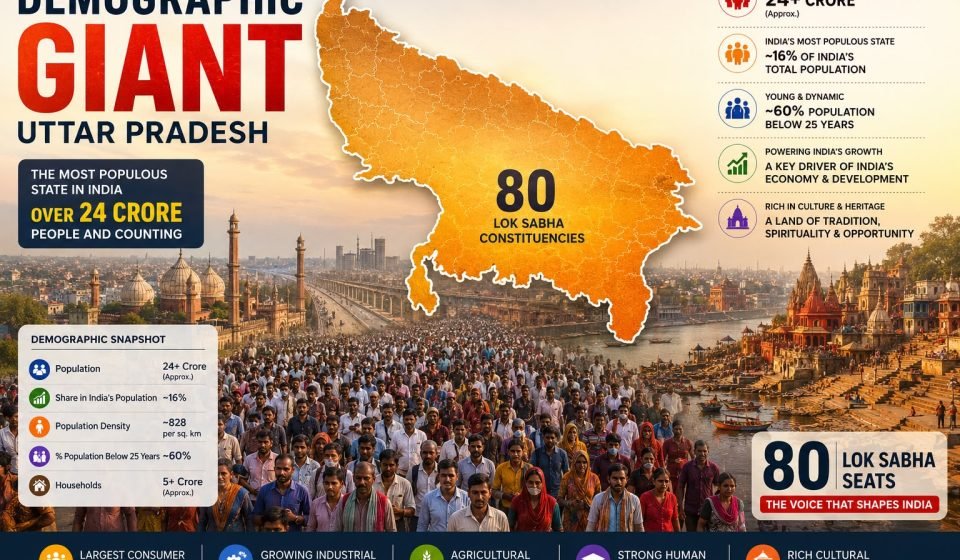
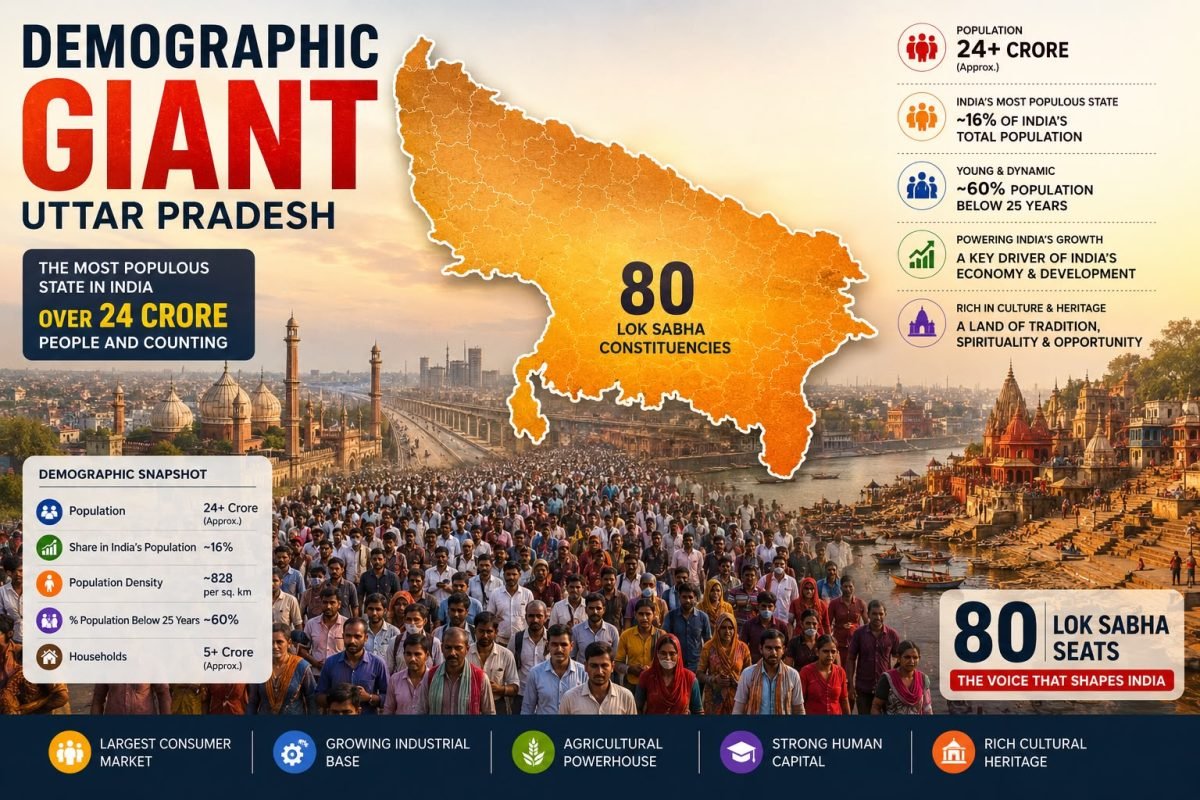
If Uttar Pradesh declared independence tomorrow, the United Nations would be seating one of the five most populous countries on earth. Its estimated 240 million people exceed the populations of Brazil and Nigeria and stand within reach of Indonesia’s. Pakistan, by several recent projections, has been overtaken. One administrative unit of one country, governed from one building in Lucknow, contains roughly three percent of the human species. Nothing about Uttar Pradesh makes sense until this single fact is absorbed.
The 2011 census, still the last full count, recorded just under 200 million residents, and the state has grown steadily since. The density is what the raw total conceals. UP packs its people onto its plain at more than 800 per square kilometre, among the highest figures for any large territory in the world. Districts like Ghaziabad and Varanasi run far higher. The state has more than 75 districts, over 900 towns, and something in the order of a hundred thousand villages. Fifty seven of its districts would individually rank among the world’s countries by population.
The structure of the population matters as much as its size. Uttar Pradesh is young, dramatically so. Around half its people are below the age of thirty, which means the state adds the equivalent of a mid sized country to India’s workforce every decade. Demographers call this a dividend, and it can be one, but only if the young find schooling, skills, and jobs. Where they do not, the dividend converts into its opposite, a vast cohort of underemployed young men whose frustrations become raw material for every kind of politics and, at the margins, every kind of crime. Much of the state’s modern story, from its migration streams to its recruitment melas to its unrest over army hiring reforms, is the story of this cohort searching for a future.
The social composition is the most consequential in Indian politics. Backward castes, in their dozens of communities, form the largest bloc. Dalits are roughly a fifth of the population, the Jatavs prominent among them. Upper castes, Brahmin, Thakur, and Bania, retain a weight in land, institutions, and leadership far beyond their share. Muslims are close to a fifth of the state, concentrated in the western districts and the eastern towns, the largest Muslim population of any Indian state and among the largest of any subnational unit anywhere. Every UP election is, beneath the slogans, a negotiation among these blocs, and because UP is so large, the negotiation reshapes national politics each time it concludes.
Scale transforms governance into something closer to logistics at civilisational size. The state runs the largest school system in India, the largest police force in the world, the largest public distribution network of any state. A single decision in Lucknow, a ration entitlement, a school uniform scheme, a change in police procedure, touches more people than most national governments will ever govern. When the state performs, the numbers are staggering, as the Kumbh Mela’s management of hundreds of millions of pilgrims periodically demonstrates. When it fails, the failures are equally enormous, measured in the health and learning outcomes that have kept UP near the bottom of India’s human development tables for decades.
For all its size, UP remains overwhelmingly a village society, with urbanisation lagging the national rate by a wide margin. Its cities are numerous but, with the exception of the Noida belt and greater Lucknow and Kanpur, they have not become the engines of transformation that Indian cities elsewhere became. The result is a countryside asked to hold far more people than its shrinking landholdings can employ, and a demographic pressure that expresses itself in fragmented farms, in disguised unemployment, and in the daily trains toward the metros. The giant, in short, has not yet built the cities its numbers demand, and that unfinished urban transition is one of the state’s defining unmet tasks.
The population is also the state’s great export. UP migrants drive Mumbai’s taxis, staff Surat’s looms, build Delhi’s towers, and cook in kitchens on every continent. Their remittances sustain districts whose local economies could never employ them. The lockdown exodus of 2020, when hundreds of thousands walked the highways home, revealed to the whole country how far the state’s people had spread and how thin the floor beneath them was.
Looming over everything is delimitation. UP’s population growth, faster than the south’s, means that when parliamentary seats are finally redrawn, the state’s delegation will swell further, and India’s federal balance will tilt with it. The demographic giant, in other words, is still growing into its weight. What 240 million people in one state means, finally, is that the futures of Uttar Pradesh and of India are not separate questions. They are the same question at two different scales.
UP Files - Batch 1
Part 4 of 10 in this chapter.