

 In 30 Seconds




The social world described across the many centuries of Vedic literature offers historians a rare and valuable opportunity to observe a civilization in the very process of defining its fundamental institutions. From the early hymns of the Rig Veda through the later Brahmana and Upanishadic texts, we can trace the gradual evolution of family structures, social hierarchy and religious practice that would eventually shape much of subsequent Indian civilization for thousands of years to come.
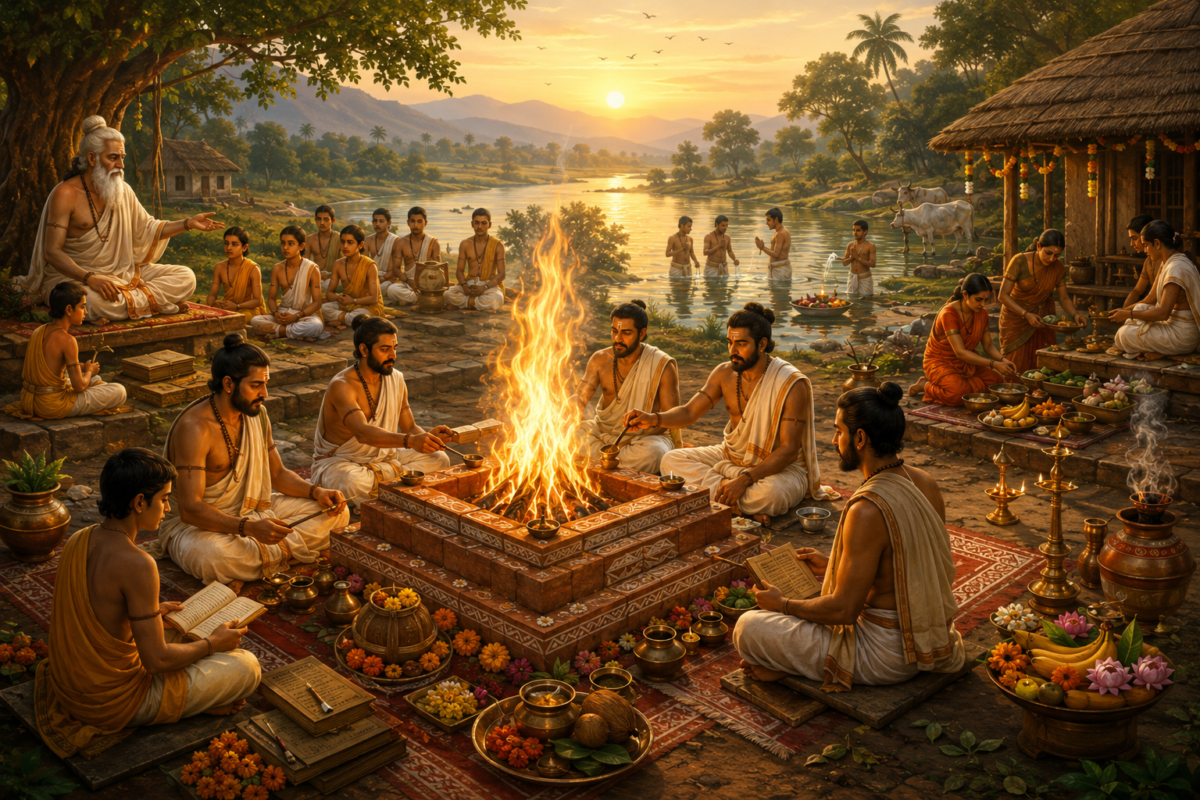
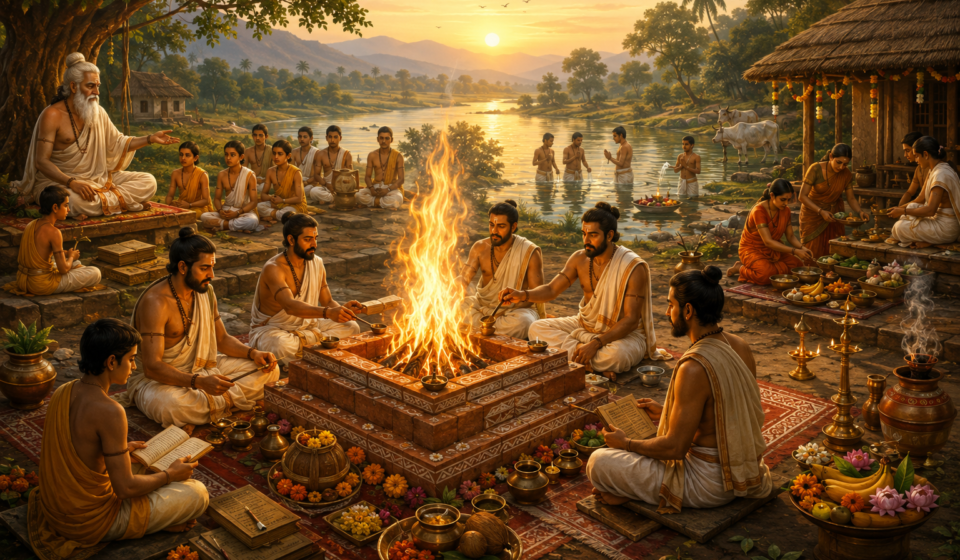
Family formed the essential building block of Vedic society. The joint family, encompassing multiple generations living under shared authority, typically that of the eldest male, appears as the dominant social unit throughout Vedic literature. The household fire, tended with careful ritual attention, symbolized the family’s continuity and its connection to both ancestors and divine forces, while elaborate rituals surrounding birth, initiation, marriage and death marked the significant transitions of individual life within this broader familial and cosmic framework. Marriage was considered a sacred duty rather than a purely personal choice, with hymns describing elaborate ceremonies intended to secure prosperity, fertility and social alliance between families.
The position of women within early Vedic society appears, based on textual evidence, to have been relatively more visible and participatory compared to certain later periods of Indian history. Several hymns within the Rig Veda are attributed to female composers, including notable figures like Lopamudra, Ghosha and Apala, suggesting women’s participation extended into the realm of religious composition and possibly ritual leadership during this early period. Women could apparently participate in certain religious ceremonies and philosophical debates, as suggested by figures like Gargi Vachaknavi, who appears in later Upanishadic literature engaging in sophisticated philosophical argument with male sages at the court of King Janaka. However, scholars caution against overly romanticizing this period, as patriarchal structures and eventual restrictions on women’s autonomy clearly intensified in later Vedic and post Vedic society, reflected in evolving legal and ritual texts.
The emergence of what would eventually develop into the caste system represents one of the most significant and consequential social developments of the Vedic period. Early Vedic society appears to have been organized more around occupational and tribal distinctions than the rigid hereditary hierarchy that later characterized the caste system. However, later Vedic texts, particularly a hymn known as the Purusha Sukta found in the tenth book of the Rig Veda, describe four social categories, Brahmins associated with priestly and scholarly functions, Kshatriyas associated with governance and military leadership, Vaishyas associated with trade, agriculture and commerce, and Shudras associated with service and labor, described metaphorically as emerging from different parts of a cosmic being’s body. Historians debate the extent to which this fourfold varna system reflected actual rigid social practice during the early Vedic period versus representing a later idealized theoretical framework that became more strictly enforced and hereditary over subsequent centuries.
Religious practice during the Vedic period centered heavily around yajna, or sacrificial ritual, conducted by specially trained priests who possessed the precise ritual knowledge necessary to properly invoke and please the various gods governing natural and cosmic forces. These sacrifices ranged from relatively simple household offerings to enormously elaborate royal ceremonies like the ashvamedha, or horse sacrifice, which could involve months of preparation and served to assert and legitimize a king’s territorial authority and political power. The priestly class, the Brahmins, accumulated considerable social influence and specialized knowledge through their exclusive command of the precise ritual formulas and procedures believed necessary for these sacrifices to achieve their intended cosmic effect.
By the later Vedic period, however, this ritualistic religious framework began facing significant internal challenge, as reflected in the philosophical inquiries of the Upanishads, which increasingly emphasized internal spiritual understanding over external ritual performance. This gradual shift, alongside growing urbanization, economic transformation and the eventual emergence of alternative religious movements including Buddhism and Jainism, set the stage for the next great transformation of Indian society as it moved from the tribal world of the early Vedic hymns toward the complex, urbanized civilization that would eventually give rise to the great empires of the Mauryan and Gupta periods.
Related Reading
- After Ashoka: The Slow Twilight of the Mauryan Dynasty
- The Aryan Question: What Genetics Now Tells Us
- Trade Routes of Ancient India: Silk, Spices and Civilization
Official context: Readers can compare this story with public information from Archaeological Survey of India.
Ancient India - Batch 1
Part 19 of 20 in this chapter.



Great Story