 In 30 Seconds




Long before modern globalization connected distant corners of the world through shipping containers and air cargo, ancient India had already established itself as one of the great commercial crossroads of the ancient world, its ports, caravan routes and river highways carrying goods, ideas and people across thousands of kilometers of ocean and desert. Understanding these ancient trade networks reveals just how deeply interconnected the ancient world truly was, and how central India’s role proved to be within that vast web of exchange.
The origins of Indian long distance trade stretch back remarkably far, at least to the era of the Indus Valley Civilization nearly five thousand years ago. Archaeological evidence, including Indus seals and characteristic carnelian beads discovered at sites in Mesopotamia, confirms that Harappan merchants maintained commercial relationships with the Sumerian city states, likely trading via a maritime route through the Persian Gulf, exchanging goods such as cotton textiles, precious stones and timber for Mesopotamian products including wool, silver and various finished goods.
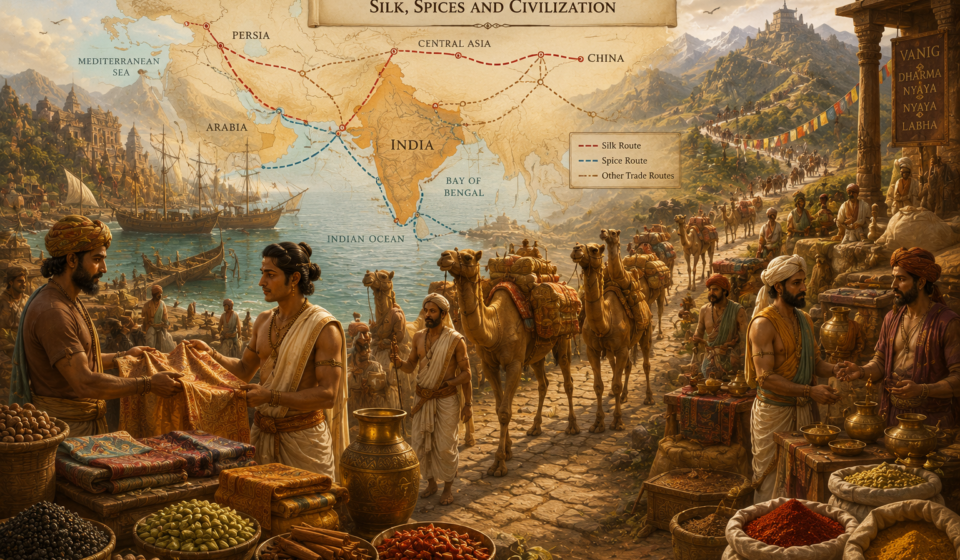
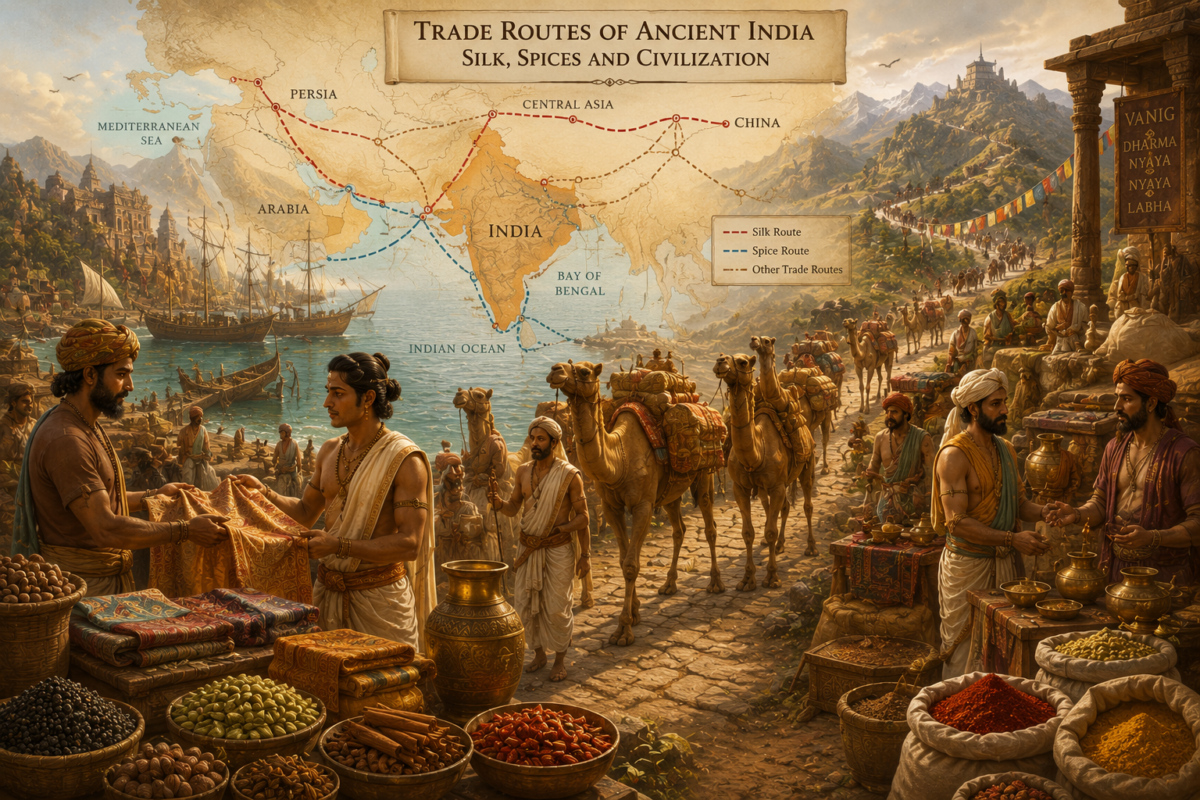
By the time of the Mauryan Empire, overland trade routes connecting India to Central Asia and the Mediterranean world had grown substantially more developed. A major highway, sometimes called the Uttarapatha or northern route, connected the northwestern frontier regions near modern Afghanistan through the Gangetic plains to the eastern reaches of the empire, facilitating both military logistics and merchant caravans carrying goods across the subcontinent. This route eventually connected, through intermediary regions, to what would later become known as the Silk Road, linking Indian markets to Central Asia, Persia and ultimately China itself, exchanging textiles, spices and gemstones for silk, horses and various luxury goods from further east.
Maritime trade proved equally significant to ancient India’s commercial prosperity, particularly along its extensive coastlines bordering the Arabian Sea and the Bay of Bengal. Ports along India’s western coast maintained regular commercial contact with the Arabian Peninsula, the Persian Gulf and eventually the Roman Empire following the discovery of the monsoon wind patterns, which allowed sailors to navigate directly across the open ocean between India and the Red Sea rather than hugging the coastline, dramatically reducing travel time. Roman demand for Indian spices, particularly black pepper, along with precious gemstones, fine cotton textiles and exotic animals, generated substantial wealth flowing into Indian ports, a trade so significant that Roman writers like Pliny the Elder complained about the enormous quantities of gold being drained from the empire to pay for these luxury imports.
Eastern maritime trade routes connected India to Southeast Asia, carrying not only goods but also profound cultural and religious influence. Indian merchants, along with Buddhist and later Hindu religious missionaries, traveled to regions including modern day Myanmar, Thailand, Cambodia and Indonesia, contributing to the spread of Indian religious traditions, artistic styles, writing systems and political concepts that would deeply shape Southeast Asian civilization for centuries, producing magnificent architectural achievements such as the temple complexes at Angkor and Borobudur that still stand as testament to this ancient cultural exchange.
The goods flowing through these vast trade networks tell their own story of ancient India’s economic sophistication. Fine cotton textiles, prized throughout the ancient world for their quality and craftsmanship, spices including pepper, cinnamon and cardamom, precious and semiprecious stones such as diamonds, sapphires and beryls, along with ivory, pearls and finely worked metalwork, all moved outward from Indian production centers toward distant markets, while gold, silver, wine, glassware and horses flowed inward in exchange.
This extensive commercial activity required sophisticated supporting infrastructure, including standardized weights and measures, organized merchant guilds that regulated trade practices and quality standards, and financial instruments allowing for credit and long distance commercial transactions without requiring merchants to physically transport large quantities of precious metal across dangerous routes. These ancient trade networks did far more than simply enrich merchants and rulers. They served as conduits for the exchange of religious ideas, artistic styles, technological innovations and scientific knowledge, weaving ancient India into a broader tapestry of interconnected civilizations whose echoes continue to shape our understanding of the ancient world’s remarkable interconnectedness even today.
Related Reading
- After Ashoka: The Slow Twilight of the Mauryan Dynasty
- The Aryan Question: What Genetics Now Tells Us
- Vedic Society: Caste, Family and Faith in Early India
Official context: Readers can compare this story with public information from Archaeological Survey of India.
Ancient India - Batch 1
Part 17 of 20 in this chapter.