 In 30 Seconds




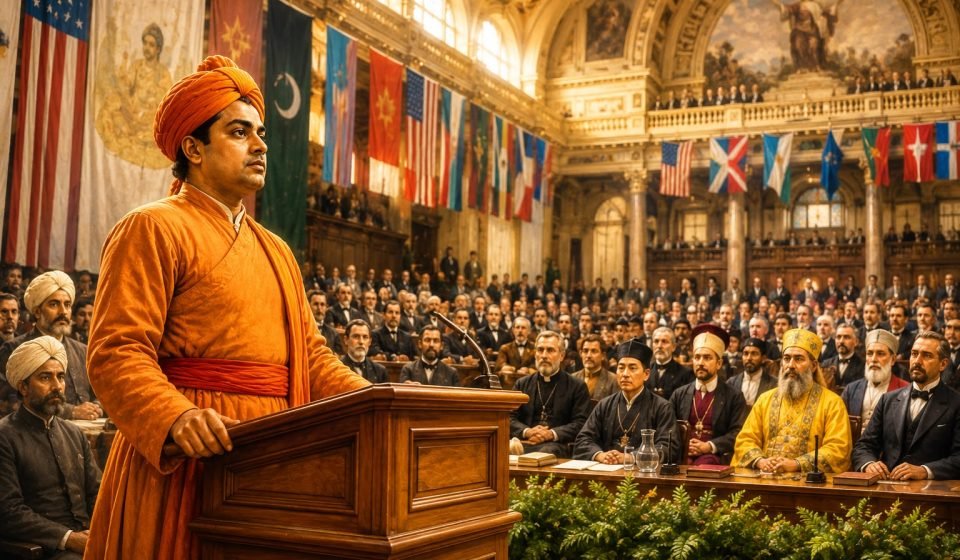
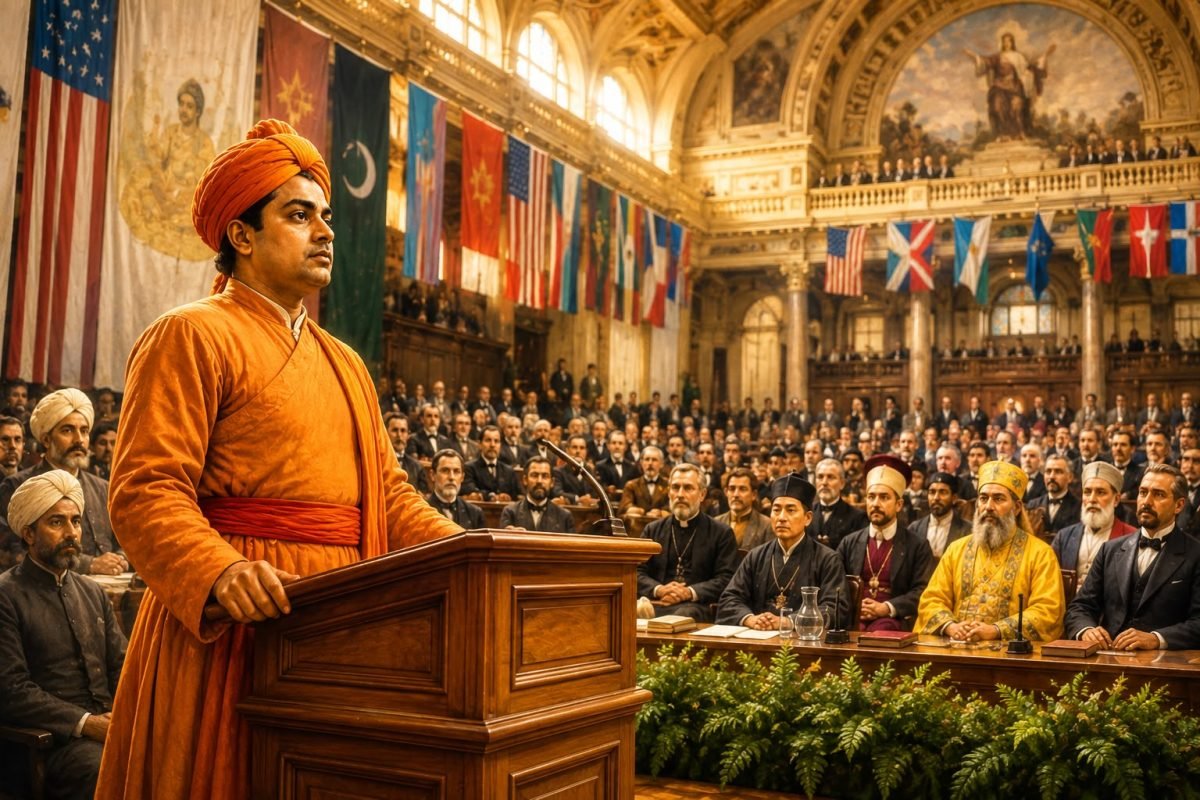
On 11 September 1893, at the World’s Parliament of Religions in Chicago, an unknown Hindu monk in an ochre robe rose to speak and opened with five words of address, sisters and brothers of America, that brought the assembly of several thousand to its feet before he had uttered a sentence of doctrine. By the Parliament’s end the American press was calling Swami Vivekananda its greatest figure, and India, reading the reports, experienced something it had not felt in a century of being lectured, the sensation of being heard. The Chicago addresses belong to religious history, but their deepest work was political, the restoration of a conquered civilisation’s confidence in itself.
The monk was thirty years old. Born Narendranath Datta in Calcutta in 1863, university educated, musical, sceptical, wrestling with the Brahmo rationalism of his class, he had been captured in his youth by the one teacher his scepticism could not survive, Ramakrishna Paramahamsa, the temple priest of Dakshineswar whose God intoxicated simplicity and direct experience answered questions that argument could not. After the master’s death in 1886, Narendranath led his young brother disciples into monastic vows, then vanished alone for years as a wandering sannyasi across the length of India, an itineracy that became his real education. He saw the country whole, its sanctity and its starvation together, and at the journey’s end, meditating on the last rock off Kanyakumari, he arrived at the conviction that fused his two inheritances, that India’s spirit was the world’s need, and India’s people, sunk in poverty and self contempt, were his God to be served. Madras disciples and the Raja of Khetri found the money, and he sailed for America to speak for Hinduism at Chicago and, as he wrote, to find means for his motherland’s millions.
What he preached there and across four years in the West was Vedanta as he had lived it, the divinity of every soul, the harmony of all religions as paths to one truth, and, in the teeth of the missionary portrait of heathen India, the dignity of the civilisation that had produced such doctrine. His Chicago plea against sectarianism, fanaticism and its horrors, spoken into an age of confident religious imperialism, gave the modern interfaith movement its founding text, and his lectures, gathered into the yogas of work, devotion, mind and knowledge, planted Vedanta in the Western vocabulary permanently. India followed his triumph in the newspapers, and when he returned in 1897, the journey from Colombo to Calcutta was a coronation, princes drawing his carriage and crowds at every station greeting the man who had made the conquerors’ world listen.
He spent the six years that remained to him converting prestige into institutions and self respect into a program. The Ramakrishna Mission, founded in May 1897, yoked the monastery to the famine camp and the school, declaring service to man the worship of God, and its monks went that same year into famine relief, then plague work in Calcutta, beginning a century of educational, medical and disaster service that continues. His Indian lectures, published as from Colombo to Almora, hammered a single theme, strength. Weakness was the only sin, fear the only enemy, and the nation’s regeneration must begin with faith in itself, with the education of the masses, and with what he called man making, each Indian recovering the divinity within. He gave the awakening its social conscience too, thundering against the tyranny of caste in matters of the kitchen and the well, and coining for the oppressed the name daridra narayana, God in the form of the poor.
He died in 1902, thirty nine years old, worn out, and became at once what he has remained, the patron saint of Indian self assertion. The swadeshi generation marched under his sentences, revolutionaries from Bengal to the Punjab were arrested with his books in their trunks, and leaders as opposed as Gandhi, Nehru, Subhas Bose and the ideologues of Hindutva have all claimed his lineage, a breadth of inheritance that itself measures the man. The empire was never mentioned in the Chicago addresses. It did not need to be. A civilisation that could stand up and speak as an equal had already, in the only register that finally matters, ceased to be a subject one.
1885 to 1905 - Moderates and Awakening
Part 8 of 10 in this chapter.