

 In 30 Seconds




A rocket launch, a lunar orbit and a soft landing are not interchangeable accomplishments. Chandrayaan is India’s lunar exploration programme, and understanding its successive missions means asking what each spacecraft was built to do and what it actually achieved.
The programme also shows why the value of a space mission cannot be reduced to the day of launch or landing. Instruments collect measurements; scientists may continue analysing them and testing interpretations years later.
Chandrayaan-1: studying the Moon from above
Launched on 22 October 2008, Chandrayaan-1 carried instruments to study the lunar surface and also released a Moon Impact Probe. An impact probe deliberately strikes the surface; that is different from a controlled landing intended to leave a spacecraft operating intact. NASA’s mission history records its objectives and scientific contribution.
One of its instruments was NASA’s Moon Mineralogy Mapper. Measurements helped identify signatures associated with water and hydroxyl on the Moon. This was important evidence about lunar material, not the discovery of rivers or lakes. The instrument was American, the spacecraft Indian: crediting the result accurately means recognising both.
Chandrayaan-2: separate the orbiter from the landing attempt
Chandrayaan-2 launched on 22 July 2019 with an orbiter, the Vikram lander and the Pragyan rover. The mission reached lunar orbit, but the lander did not complete a successful soft landing. The orbiter was a distinct part of the mission, carrying scientific instruments to study the Moon from above. ISRO’s mission account describes that separation and the loss of communication during descent.
Calling the whole mission either an unqualified success or a complete failure obscures those different outcomes. A more useful assessment distinguishes the orbital science from the attempted surface operations. It also avoids treating a projected spacecraft lifetime, given in an older mission description, as a fresh confirmation of its present operating condition.
Chandrayaan-3: landing, roving and local experiments
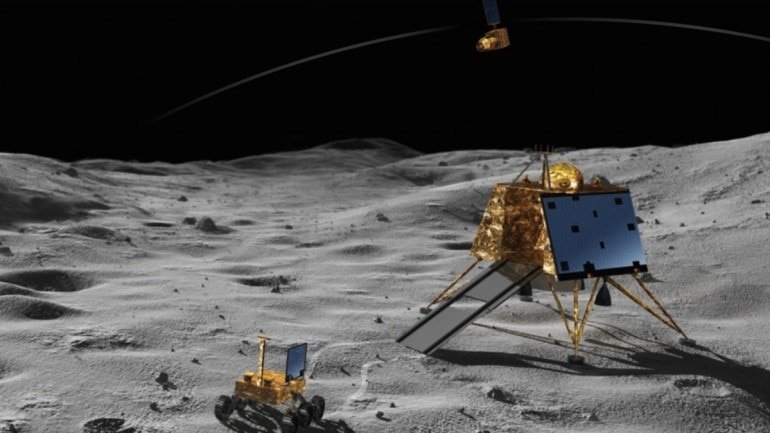
On 23 August 2023, Chandrayaan-3’s Vikram lander completed a soft landing, followed by deployment of the Pragyan rover. ISRO describes India as the fourth country to achieve a lunar landing and the first to land near the southern polar region. “Near” matters: this was not a landing at the geographic South Pole. ISRO’s National Space Day account records the milestone.
The mission’s objectives included demonstrating controlled landing and rover movement, alongside experiments at the site. Its lander carried instruments concerned with surface thermal properties, seismic activity and near-surface plasma. The rover’s APXS and LIBS instruments investigated elemental composition. The mission specifications set out the roles of these payloads.
These capabilities answer different questions. A camera reveals appearance and context; a composition instrument provides evidence about the materials present. Neither should be described as having measured something outside its actual function.
What did later analysis add?
A useful example came in an ISRO science update dated 3 July 2026. Researchers compared the rover’s APXS measurements with lunar meteorites found on Earth and reported a close chemical resemblance to meteorite ALHA 81005.
The same update explicitly cautions that the similarity does not establish that the meteorite originated at the landing site. That distinction captures how science develops: measurements can support a connection without proving every possible explanation for it.
What should the next Chandrayaan headline tell you?
First, identify the milestone. Approval of a proposed mission is not a launch; reaching lunar orbit is not a landing; collecting data is not the same as a peer-reviewed conclusion. Second, check whether a finding concerns one instrument’s sampling area or a broader claim about the Moon.
Our assessment is that the programme’s strongest story combines engineering capability with careful interpretation of evidence. Celebrating the landing and explaining the limits of a scientific result are compatible. Readers gain more from that distinction than from either exaggerated claims or a dismissal of everything short of a perfect mission.