
 In 30 Seconds




Story
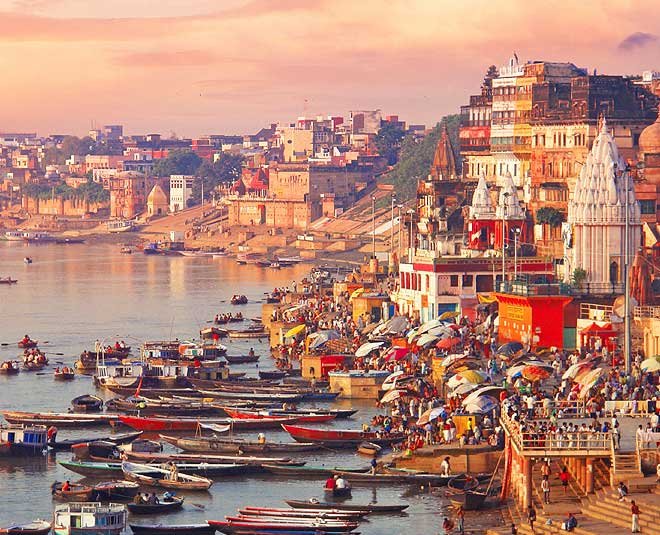
Cities usually turn their backs to their rivers or their fronts to them. Banaras did something stranger. It built a stone staircase seven kilometres long and invited the whole human condition to sit down on it. The ghats of Kashi, nearly ninety named flights of steps descending the high western bank to the Ganga, are the most concentrated public space in India and perhaps in the world, a single continuous stage on which bathing, dying, trading, mourning, wrestling, teaching, performing, and simply watching have gone on side by side for centuries, each activity a few steps from its opposite.
The crescent runs from Assi ghat in the south, where the Assi stream once met the river and students and morning walkers now gather for the sunrise recitations, to Adi Keshava in the north by the Varuna confluence, the two streams that gave Varanasi its formal name. Between them the bank unrolls its famous roll call. Dashashwamedh, the ghat of the ten horse sacrifice, is the ceremonial heart, where the evening Ganga aarti sends walls of flame and bells across the water to boats packed gunwale to gunwale. Panchganga, where five rivers are said to converge unseen, carries the great mosque of Aurangzeb’s era on the skyline above it, the bank’s most visible palimpsest. Kedar ghat serves the southern, Shaiva, South Indian quarter whose priests keep a different liturgical accent. Tulsi ghat preserves the house where the poet of the Ramcharitmanas lived, and hosts the akhara where wrestlers still swing their clubs at dawn in the mud pits of tradition.
And then there are the two that make Banaras unlike anywhere else. Manikarnika and Harishchandra are the burning ghats, the mahashmashan, the great cremation ground that in every other Indian city is banished beyond the walls and in Kashi sits at the centre of the riverfront, upwind of the tea stalls. The fires burn around the clock, tended by the Dom community whose hereditary keepers hold, by tradition, the flame from which every pyre must be lit, an arrangement that has made the Dom Raja a figure of paradoxical eminence, ritually indispensable and socially outcast, a contradiction this series returns to in its caste batches. To be cremated here, within Shiva’s city, is held to confer liberation itself, and so the dying and the dead travel to these steps from across the country, and the city has never pretended otherwise. Death in Banaras is not hidden. It is scheduled, priced, staffed, and performed in public, and the visitor who watches a pyre collapse while a wedding band passes behind and boys leap from the next ghat into the river has understood the city’s essential teaching without a word of Sanskrit. Everything is happening at once. It always is.
Most of the stone the pilgrim touches is younger than it looks, and the ledger of patronage tells its own Indian story. The riverfront as it stands was overwhelmingly built in the eighteenth century, when the Marathas, the Bhonsles, Scindias, Holkars, and Peshwas, along with Rajput and other princes, competed in piety after the disorders of the previous era, Ahilyabai Holkar of Indore rebuilding Manikarnika and the Vishwanath temple itself. The ghats are thus a federal monument, every state of India holding a deed on the bank of the Ganga, with palaces and hospices above them built by kings from Rajasthan to the Deccan so their subjects could die well in Kashi.
The steps have also carried the city’s intellectual and artistic life. Sanskrit was disputed on these ghats, the Banaras gharana’s music seasoned in the temples above them, and the Ramlila of Ramnagar, staged across the river by the Kashi Naresh, still empties the bank each autumn. The modern era added its own rituals, the photographers and filmmakers for whom the ghats became India’s most shot location, the boat economy, the corridor project that opened the Vishwanath precinct to the river, and the floodlit aarti that has turned dusk itself into infrastructure.
The river, meanwhile, rises and falls through it all, burying the steps under monsoon silt each year, the city digging its stage back out each autumn in a cycle as old as the stone. The ghats endure because they were never a monument to be preserved but a verb to be continued, and every dawn, when the first bathers descend through the mist and the first pyre catches, Banaras performs itself again, the steps between life and death holding both, as they were built to.