 In 30 Seconds




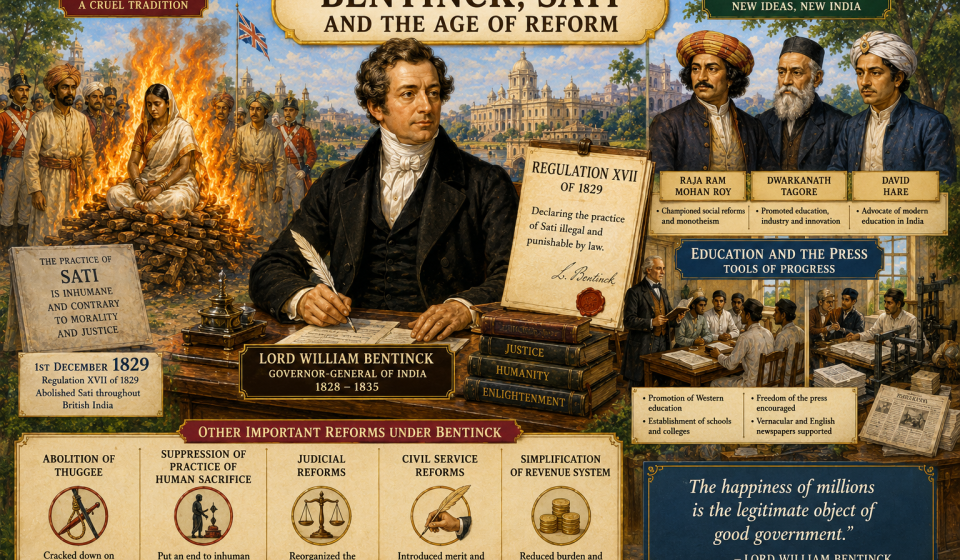
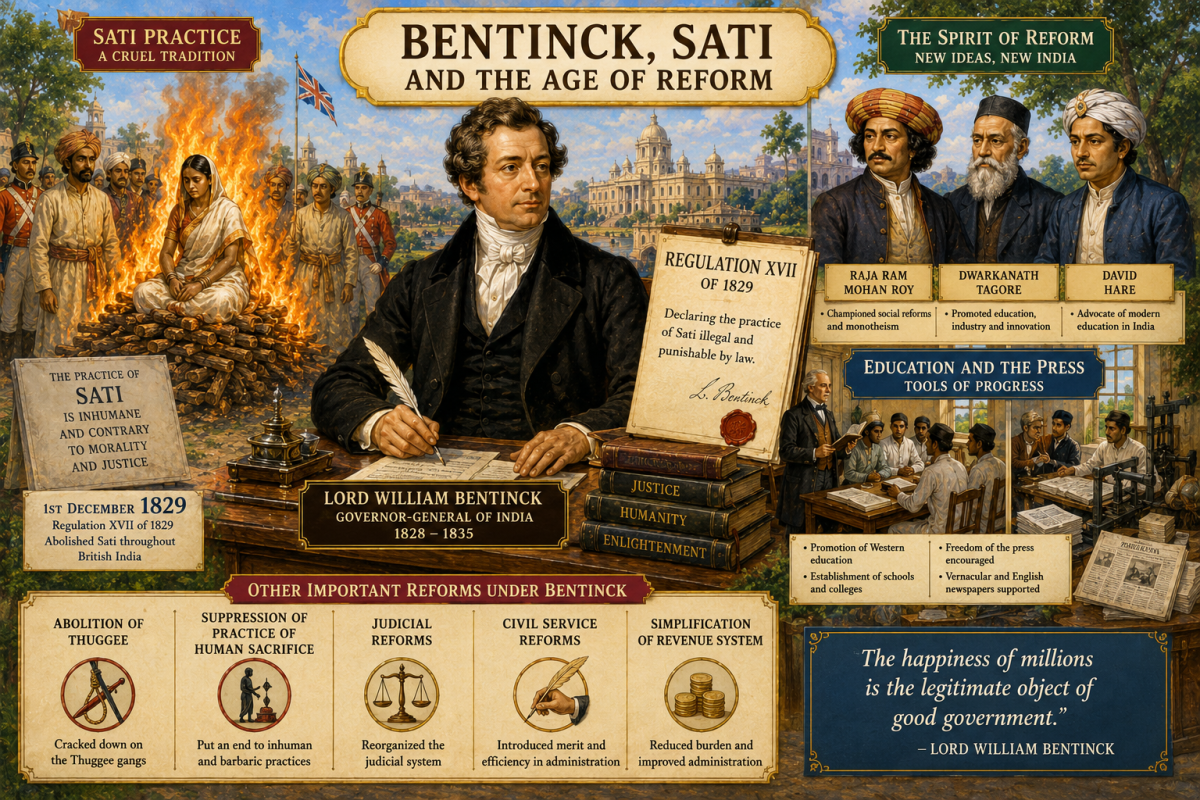
On 4 December 1829 the Governor General of India signed Regulation XVII, declaring the burning or burying alive of widows culpable homicide, and the East India Company, which had spent two centuries carefully touching nothing sacred, crossed the most dreaded line in its policy. The abolition of sati was the signature act of Lord William Bentinck’s government and of the reforming generation he represented, and the story of how it was done, and of what was and was not done besides, is the story of the age.
Sati, the immolation of a widow on her husband’s pyre, was never universal in Hindu society, being concentrated by region and caste, and its incidence in early nineteenth century Bengal, where Company records counted several hundred burnings a year, appears to have been fed by peculiarly Bengali circumstances of property law and social pressure as much as by piety. The Company had long regulated what it feared to prohibit, requiring official presence at burnings to certify that the widow was adult, undrugged and willing, a procedure that scandalised reformers precisely because it made the state a licensing witness of the fire. Within Indian society itself the attack had been opened by Ram Mohan Roy, whose pamphlets argued from the shastras that the scriptures nowhere commanded the rite and everywhere preferred the widow’s ascetic life, and whose polemics with the orthodox party made the question a public one in Calcutta years before government moved.
Bentinck arrived in 1828 an avowed reformer, a friend of the utilitarians and a believer, as he wrote, that England owed India good government by Indian improvement. He proceeded with the caution of a man defusing a mine. He canvassed the army’s officers on the temper of the sepoys, consulted judges and Indian notables, weighed Roy’s own counsel, which was, remarkably, that quiet discouragement might be safer than open law, and concluded that a government which watched women burn under its certificates could not be innocent of them. The regulation of December 1829, extended soon after to Madras and Bombay, made all assistance at sati punishable as homicide. The orthodox party of Calcutta, organised as the Dharma Sabha, petitioned to London against the invasion of religion, Roy travelled to England in part to oppose them, and in 1832 the Privy Council dismissed the appeal. The predicted convulsion never came. The fires, in British territory, went out with scarcely a spark of resistance, though the princely states extinguished them only over following decades, and the last embers of the practice would flare rarely and scandalously even into independent India.
Around the central act gathered the wider program of the reforming decade. Female infanticide, long prohibited on paper, was pursued into the clans that practised it. Human sacrifice among the Konds of Orissa was suppressed in the following years. Bentinck’s government opened the higher judicial offices to Indians for the first time since Cornwallis had closed them, made English the language of higher courts and, in the education resolution of 1835 that followed Macaulay’s Minute, of state supported higher learning. His finances were ruthless, halving batta allowances to the army’s fury, and his economies together with his reforms made him the most disliked Governor General among his own countrymen and the most praised among Indians of the improving generation. The inscription Macaulay wrote for his statue in Calcutta caught the self image of the era, the ruler who never forgot that the end of government was the welfare of the governed.
Posterity’s judgment is necessarily more mixed than Macaulay’s marble. The abolition of sati was a genuine deliverance, demanded by Indians as well as Englishmen, and it is right to remember that the first and greatest campaigner against the burning of Hindu widows was a Hindu. It was also, unmistakably, the founding precedent for a style of rule that claimed moral guardianship over Indian society, a claim that would license much interference, sincere and otherwise, and would feed among Indians the counterconviction that their civilisation was under siege. The age of reform planted both the humanitarian conscience of the Raj and the cultural defensiveness that met it, and the two grew together toward the explosion of 1857, in which the fear that religion was in danger, gathered over a generation of such acts, would arm a rebellion.
1818 to 1856 - Consolidation and Reform
Part 3 of 10 in this chapter.