 In 30 Seconds




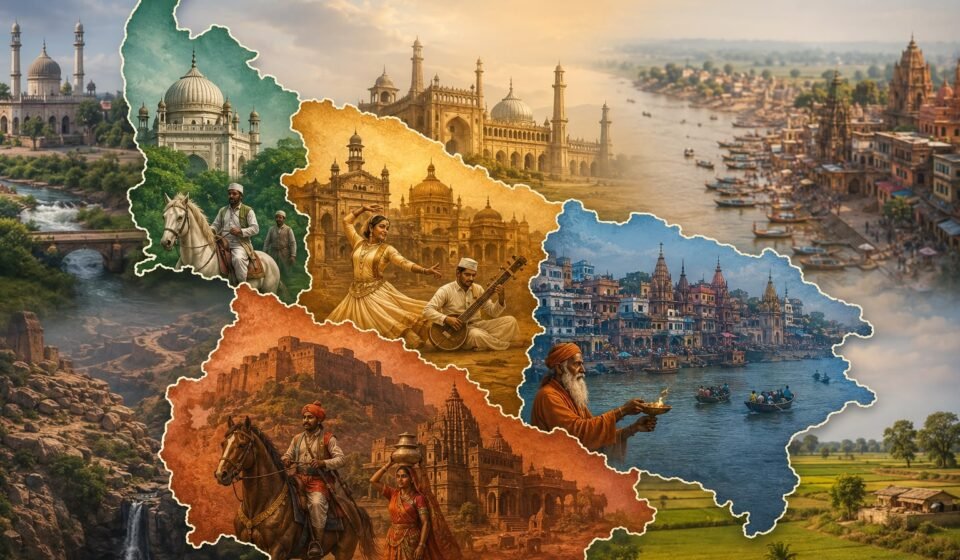
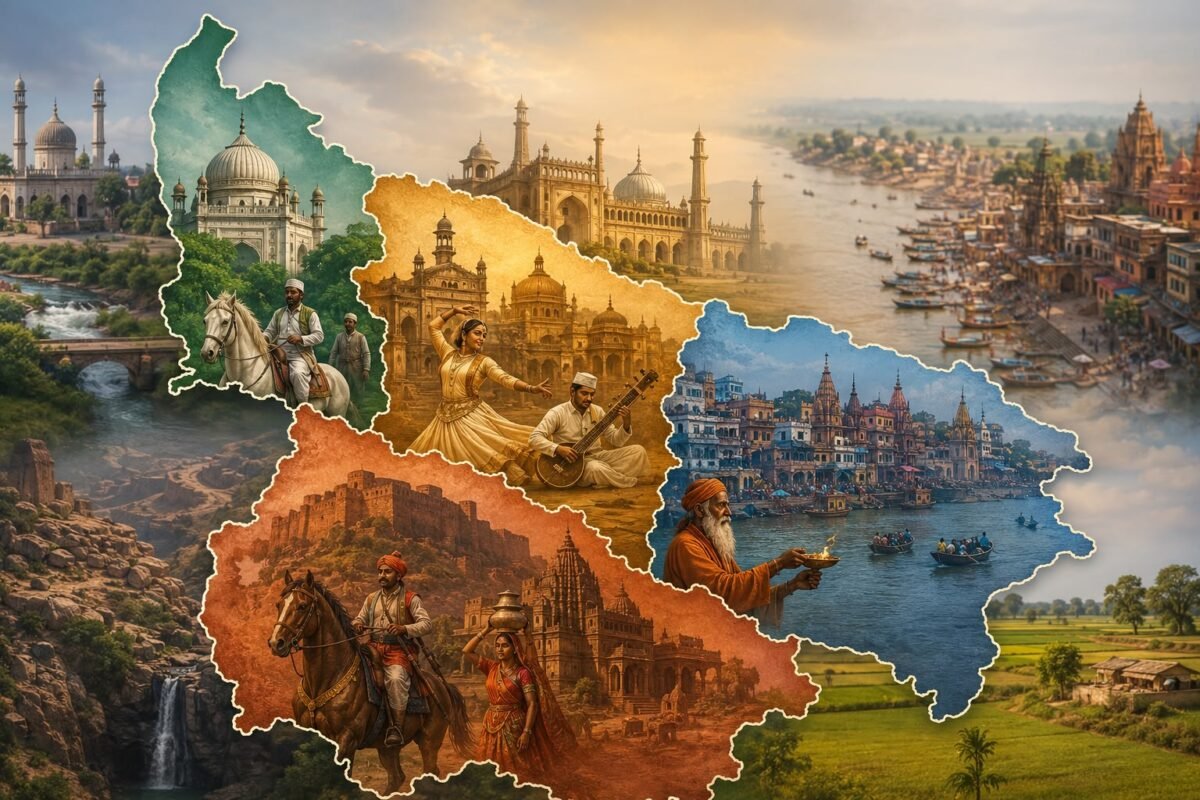
Officially, Uttar Pradesh is one state with one capital and one government. Practically, it is a union of regions so distinct in speech, economy, temperament, and history that its own people navigate it as a map of countries. The names are not on any constitutional document, but everyone in UP knows them. The west, often called Paschim or the Harit Pradesh belt. Rohilkhand around Bareilly. Awadh at the centre. Purvanchal in the east. Bundelkhand below the Yamuna. To understand any UP election, any policy, any crime story or cultural argument, the first question is always the same. Which UP are we talking about?
Western UP is the state’s economic engine and its most distinct society. Canal irrigated since the colonial era, it is sugarcane country, a landscape of prosperous villages, sugar mills, and the assertive Jat peasantry whose khap councils and farm politics have shaped the region since Charan Singh’s time. Its towns look toward Delhi rather than Lucknow, and its western edge has fused into the national capital region, where Noida and Ghaziabad generate a share of state revenue wildly out of proportion to their size. The west is also the state’s most communally combustible zone, home to Meerut’s repeating wounds and Muzaffarnagar’s 2013 rupture, subjects this series will treat in full.
Rohilkhand, centred on Bareilly, Moradabad, and Rampur, carries the name of the Rohilla Afghans who ruled it in the eighteenth century. It is a region of dense Muslim populations, brass and mentha economies, and the Barelvi school of Islam that took its name from its principal city. Politically it swings, and its swings have often decided who governs Lucknow.
Awadh is the state’s heart in every sense. The old Nawabi kingdom around Lucknow, Faizabad, and Rae Bareli gave UP its capital, its courtly culture, its most famous cuisine, and its deepest political symbolism, for Ayodhya sits in Awadh, and so do the Nehru family boroughs. The region’s speech is Awadhi, the language of Tulsidas’s Ramcharitmanas, and its social structure still remembers the taluqdars, the great landlords the British cultivated after 1857. Awadh is where UP performs its politics of memory, whether the memory is of Nawabs, of 1857, or of a temple.
Purvanchal, the east, is the state’s demographic ocean and its hardest luck region. Gorakhpur, Varanasi, Azamgarh, Jaunpur, Ballia, districts of enormous population, tiny landholdings, and thin industry. Bhojpuri is its language, migration its central economic fact, and its labour built Mumbai and the Gulf as surely as it built anything at home. Purvanchal’s poverty incubated the state’s most notorious strongman politics, from the Gorakhpur wars of the 1980s through the careers of Mukhtar Ansari and his rivals, and its monasteries produced the state’s current ruler, for Yogi Adityanath’s Gorakhnath math is Purvanchal’s most powerful institution. The east is also the state’s spiritual core, holding both Kashi and Sarnath.
Bundelkhand is the smallest and starkest of the countries. South of the Yamuna, sharing its identity with districts across the Madhya Pradesh line, it is a land of granite outcrops, medieval forts, chronic drought, and out migration. Jhansi’s warrior queen and the dacoits of the ravines both belong to its legend. Its distress, farmer suicides, water scarcity, and the emptying of villages, has made it the strongest moral case for statehood and the weakest political one, for it lacks the numbers to force anyone’s hand.
Language draws the same map in sound. The west speaks Khari Boli shading into Haryanvi cadences, the Braj country around Mathura keeps the tongue of Surdas, Awadh speaks Awadhi, the east speaks Bhojpuri, and Bundelkhand its own Bundeli, each with its songs, its proverbs, and its unmistakable accent that any UP ear can place within a district or two. Standard Hindi sits over all of them as the language of school and state, but the regions live in their mother dialects, and politicians who can move between them, switching register from a Meerut rally to a Ballia one, hold an advantage no manifesto can buy.
The regions are not merely colour. They are the operating system of UP politics. Parties build separate strategies for each, tickets are balanced region by region, and governments rise or fall on regional swings, as when Purvanchal’s shift decided 2017 or the west’s farm anger reshaped 2024’s contests. Administrators speak of the state’s development gradient, which runs downhill from west to east and collapses in Bundelkhand. One state, four countries, and the permanent question that has haunted every government in Lucknow: how do you govern them all at once?
UP Files - Batch 1
Part 8 of 10 in this chapter.