 In 30 Seconds




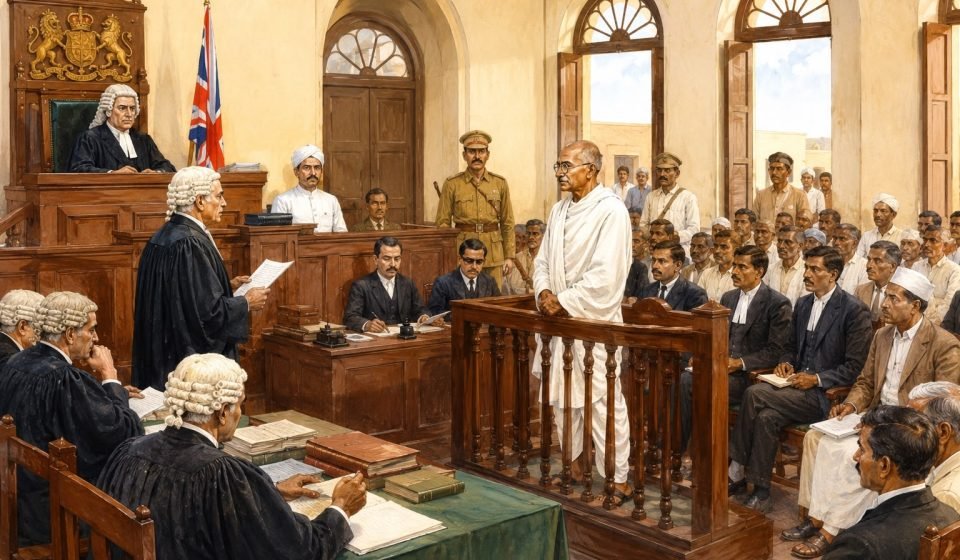
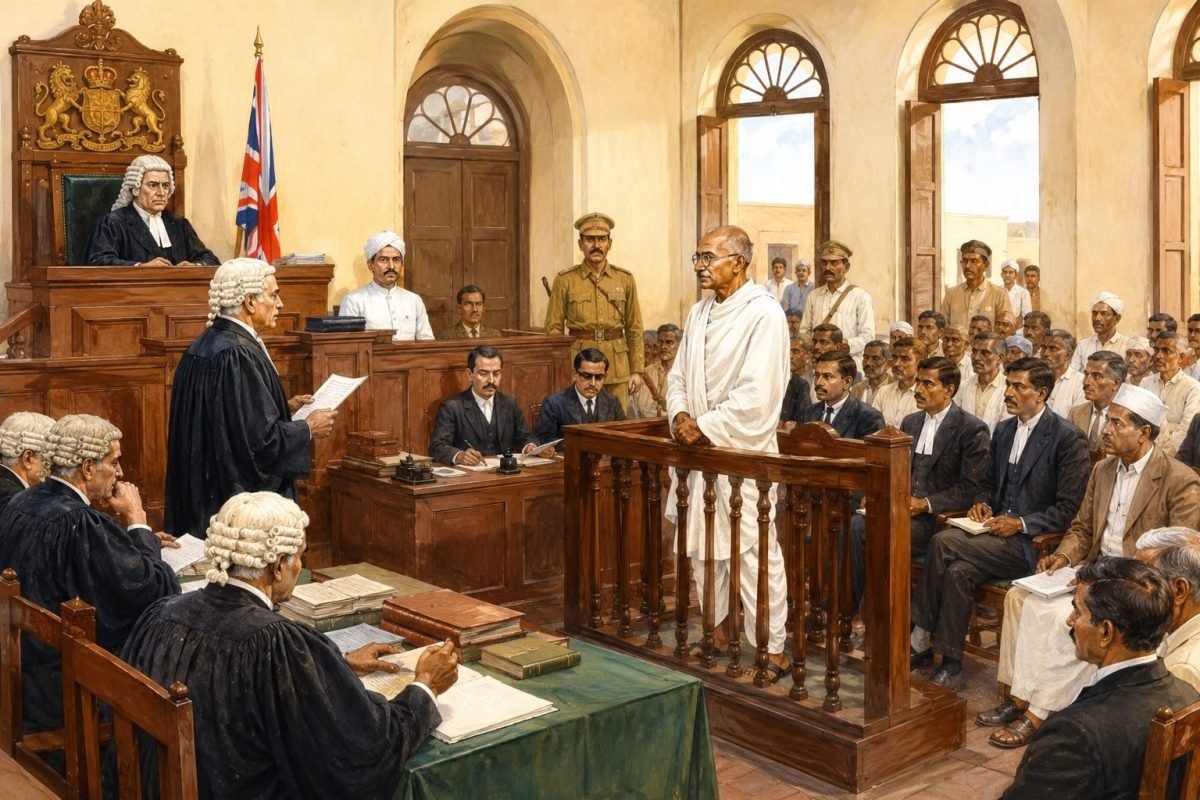
On 18 March 1922, in the Circuit House at Ahmedabad, the Government of India tried Mohandas Gandhi for sedition, and the proceeding lasted a hundred minutes because the defendant conducted the prosecution’s case better than the prosecutor. The Great Trial, as India named it at once, produced no suspense and two immortal documents, the prisoner’s statement and the judge’s sentence, and stands in the national memory as the day the empire’s law and the movement’s conscience took each other’s measure with complete courtesy and complete understanding.
The charge rested on three articles in Young India, Tampering with Loyalty, A Puzzle and Its Solution, and Shaking the Manes, in which Gandhi had written that it was sinful for anyone to serve the government, and section 124A of the Penal Code, the sedition law under which Tilak had twice stood, needed nothing more. Arrested at Sabarmati on 10 March, a month after Chauri Chaura and the Bardoli retreat, when the government judged the movement’s ebb safe for the stroke, Gandhi came to court in his prisoner’s loincloth, described his profession to the registrar as farmer and weaver, and pleaded guilty with a completeness that dismantled the ritual, desiring, he said, to invite and submit cheerfully to the highest penalty for what in law was deliberate crime and appeared to him the first duty of a citizen.
The statement he then read remade the courtroom into the empire’s audit. He rehearsed his own record as the empire’s friend, Boer War ambulance man, Zulu rebellion stretcher bearer, wartime recruiter decorated for it, and dated his conversion by the empire’s own acts, Rowlatt, the Punjab, the Khilafat betrayal, until he had concluded that the connection had made India more helpless and more poor than ever before, the peasantry bled by a system contrived to exploit them, and that the law itself was not the people’s protector but the exploiter’s instrument. Section 124A he saluted with the sentence every law student learns, the prince among the political sections of the Penal Code designed to suppress the liberty of the citizen, observing that affection cannot be manufactured or regulated by law, and that to preach disaffection toward a government that had forfeited affection was a virtue. He asked the judge for the only two consistent courses, the severest penalty if the law was right, resignation if the judge knew it wrong, and sat down having converted his own conviction into the government’s.
Justice C N Broomfield’s reply matched the occasion and entered the anthologies beside the statement it answered. Bowing to the prisoner, he pronounced the sentencing of such a man the hardest duty a judge in India could face, acknowledged that in the eyes of millions of his countrymen the defendant was a great patriot and a great leader, and that even those who differed from him looked upon him as of high ideals and noble and even saintly life. The law being the law, he took Tilak’s case as precedent, imposed the same term, six years’ simple imprisonment, and added that if the government later saw fit to reduce it, no one would be better pleased than he. Gandhi thanked him for the courtesy and called the sentence, by that precedent, an honour. The empire had behaved perfectly and lost everything, for the trial’s transcript, reprinted across the world, fixed the moral positions permanently, the saint at the bar, the apologetic judge, the law with nothing to say for itself but procedure.
The sequel was quieter than the scene. Gandhi served his term in Yeravda jail reading, spinning and writing until acute appendicitis brought his release in February 1924, into a political landscape transformed for the worse, the movement lapsed, the Swarajists in the councils, Hindu Muslim unity dissolving into the riot decade, and his own energies turned for years to the constructive program and the twenty one day fast for communal peace. But the trial’s capital never depreciated. It established the satyagrahi’s courtroom method, the plea of guilty as accusation, that Bhagat Singh’s generation would adapt to fiercer purposes, and it left in the record, between a weaver’s statement and a judge’s bow, the freedom struggle’s most exact self portrait, a movement that accepted the penalty and disputed the law, and an empire reduced to sentencing a man it could no longer answer.
1919 to 1929 - The Gandhian Storm
Part 5 of 10 in this chapter.