 In 30 Seconds




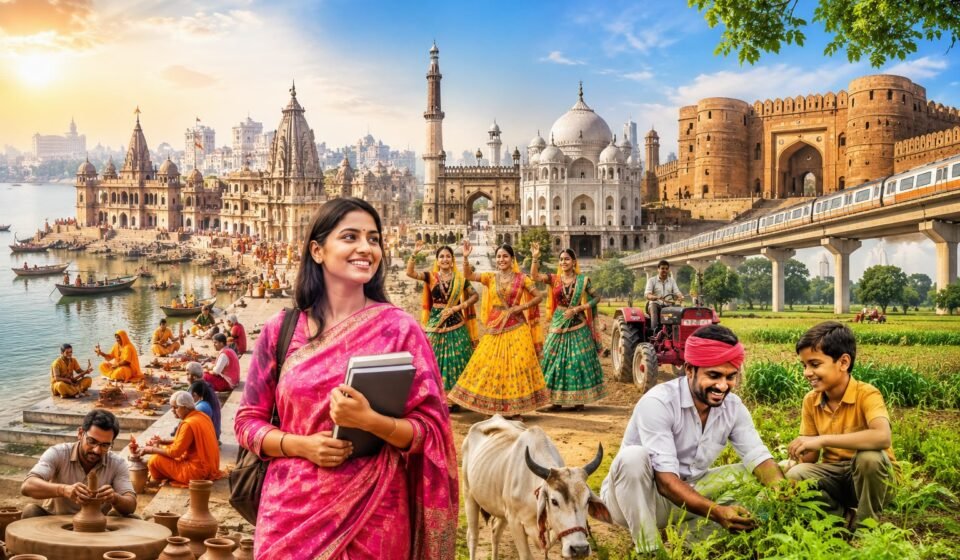
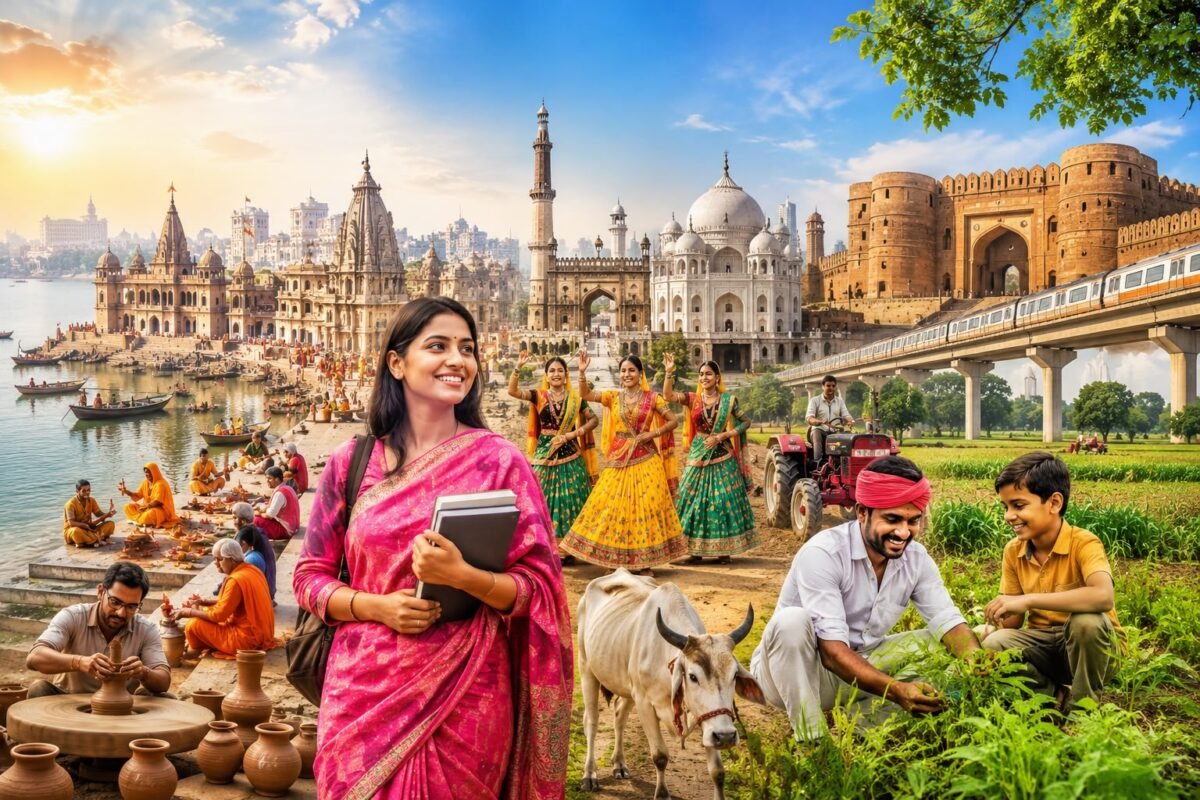
There is an India of the atlas, a union of twenty eight states, and there is an India of the imagination, and in the second India one region has long stood in for the whole. When Hindi cinema wants an everyman, it gives him a UP accent. When national politics is discussed, the heartland is assumed as the arena. When foreigners picture India, they picture the Taj Mahal and the ghats of Varanasi. Uttar Pradesh became, without any formal decision, the default India, and the story of how is a story about language, cinema, politics, and the quiet power of numbers.
The foundation was linguistic. The dialects of the Gangetic plain, Braj, Awadhi, Bhojpuri, and the Khari Boli of the Delhi Meerut region, formed the cradle of both Hindi and Urdu. When the new republic adopted Hindi as its official language, it adopted, in effect, the speech of the UP plain in its standardised form, and the state’s institutions, from Banaras and Allahabad’s universities to Lucknow’s publishing houses, became the language’s establishment. The literary canon taught to every Hindi student, Tulsidas, Kabir, Premchand, Nirala, Mahadevi Varma, is overwhelmingly a UP canon. To learn the national language was, in a sense, to learn Uttar Pradesh.
Politics compounded the effect. With the largest parliamentary delegation and a run of prime ministers from Nehru onward, UP’s concerns became national concerns by sheer institutional gravity. The phrase Hindi heartland, and its blunter cousin the cow belt, entered the political vocabulary to describe the bloc of northern states whose verdicts settled general elections, and UP sat at that bloc’s centre. National movements adopted the same logic. Gandhi’s mass politics found its defining rural moments in the United Provinces. The JP movement, the Mandal upheaval, and the Ayodhya campaign all understood that to win India’s argument you staged it in the heartland.
Cinema sealed the image. The Hindi film industry, though based in Bombay, drew endlessly on the UP and Bihar plains for its idea of authentic India, from the village epics of the 1950s through the Awadhi refinement of the Muslim socials to the angry migrant of the 1970s. In the streaming era the pull has only strengthened, with the heartland crime saga, set in Mirzapur or Gorakhpur or the Chambal fringe, becoming the dominant national genre. The default Indian of the screen speaks with the cadence of the Gangetic plain, and audiences from Kerala to Assam have absorbed that cadence as the sound of the general Indian, whatever their feelings about it.
The default status has always had its resisters, and their case deserves honest statement. The south, the east, and the northeast have long objected that the heartland’s centrality erases India’s actual plurality, that Hindi’s official promotion carried a UP idiom into everyone’s schoolroom, and that the coming delimitation, by rewarding the north’s population growth with more seats, will constitutionally entrench what culture already over weights. From Tamil Nadu’s language agitations to today’s federalism debates, a substantial part of Indian politics is, at bottom, an argument against the default India.
The news media completed the circuit. India’s national press and its Hindi giants, several of them born in the towns of the plain, staffed Delhi’s newsrooms with editors and reporters whose formative beat was UP, and the state’s convulsions became national front pages by default while equivalent events elsewhere ran inside. Television deepened the habit, and the digital era industrialised it, for the Hindi internet’s enormous audience made heartland stories the safest commercial bet in Indian media. Coverage begets familiarity, familiarity begets salience, and salience begets more coverage. The default India is, among other things, a feedback loop with a broadcast tower.
There is also an irony the heartland knows intimately. To stand for India in imagination brought UP no premium in fact. The state that supplied the language, the leaders, and the imagery trailed the country it symbolised on nearly every measure of income, health, and education for decades. The default India was, by the numbers, the deprived India, and the gap between symbolic centrality and material lag is among the deepest patterns this series will trace.
Still the idea endures, because the numbers that created it endure. A state holding one in six Indians will always tilt the country’s self image toward itself. The Hindi heartland idea was never a conspiracy and never an accident. It was arithmetic wearing the clothes of culture, and in Uttar Pradesh, arithmetic always gets its way eventually.
UP Files - Batch 1
Part 9 of 10 in this chapter.