 In 30 Seconds




Story
India’s hydrogen mobility push, pilot bus and truck corridors, a now-operating hydrogen train, and a national electrolyser build-out, is easiest to misread as a climate initiative. The more useful reading treats it as a response to two arithmetic problems that happen to share one solution.
The first is electricity allocation. The IEA’s Electricity 2026 report projects Indian electricity demand will grow roughly 6.4% annually through 2030, the fastest sustained rate of any major economy, adding over 570 TWh of annual consumption in five years. Cooling alone accounts for more than a fifth of that growth, with industry, data centres, and transport electrification making up most of the rest.
The second is hydrocarbon exposure. India’s crude import dependence, once commonly cited at 85%, has climbed further still. EY’s FY26 analysis puts full-year dependence above 90%, up from about 55% in FY99. Monthly PPAC data through mid-2026 shows the figure running just under that milestone, 88.7% in July, with Russia’s share of imports rising to 55.5% that month, alongside the UAE, Saudi Arabia, Venezuela, and Brazil. Five countries together supplied over 80% of India’s crude in July, concentrating exposure geographically even as the exact mix shifts month to month.
Put together, the logic sharpens: every unit of electricity or diesel heavy transport doesn’t draw from the grid or the import bill is a unit available to something else: a data centre, a fab, or the current account. Hydrogen converts renewable electricity into a storable, transportable fuel that can substitute for both simultaneously.
The Electricity Side: Why “Just Add Capacity” Isn’t Enough
India is building generation capacity at scale; its 500 GW non-fossil target for 2030 is broadly on track, and solar PV generation grew roughly 24% YoY in Q4 FY 2025-26. But capacity additions and reliable, dispatchable capacity aren’t the same thing. The Central Electricity Authority’s resource adequacy analysis finds most states face meaningful shortfalls by 2034 even with planned capacity commissioned on schedule, because additions skew heavily toward intermittent solar and wind. Projected 2030 shortfalls include roughly 38 TWh (about 15% of demand) in Uttar Pradesh, 20 TWh in Tamil Nadu, and 30% of demand in Assam.
Data centres are the clearest new claimant on that constrained supply. Estimates vary, but the direction is consistent: capacity is projected to grow from roughly 1.2-1.4 GW in 2025 to 9-10 GW by 2030, with associated demand rising to somewhere between 40 and 57 TWh, lifting data centres’ share of national electricity demand from under 1% to roughly 2.6-3%. The CEA has begun directing states to build this demand explicitly into planning, given its concentration around Mumbai, Hyderabad, Delhi NCR, Bengaluru, and Chennai.
Heavy transport’s (less than 3% of India’s vehicle fleet) current grid draw is small next to this. But any megawatt that freight, buses, or non-electrified rail draw from off-grid or otherwise-curtailed renewable hydrogen, rather than the interconnected grid, is a megawatt not competing with AI infrastructure or households during a period the CEA itself expects to be tight.
The Hydrocarbon Side: A Volatile Bill, Still Climbing
Union Minister Nitin Gadkari has repeatedly cited India’s total fuel import bill at roughly Rs.22 lakh crore annually, arguing for cost-effective, domestically sourced substitutes. The volatility behind that number played out visibly in 2026: the Indian crude basket jumped from a stable $62-70/barrel range to over $117 in March amid Middle East tensions, then eased back to $82.04 by July, still 16% above the $70.99 recorded a year earlier. India’s July crude import bill rose 41% year-on-year to $13.7 billion, driven by both the higher price and a 13% rise in import volumes. Brent was trading near $91.84 in August. The pattern illustrates the underlying risk better than any single data point: even after a spike fades, the baseline cost keeps ratcheting upward, and dependence keeps climbing alongside it: full-year FY26 dependence now sits above 90% by EY’s measure.
Within this bill, heavy-duty road transport remains a disproportionate consumer. Road transport accounts for more than 80% of the transport sector’s total energy use, and trucks and buses alone have historically consumed roughly half of that despite being a minority of the fleet, a concentration that makes heavy freight a high-leverage substitution target, even though it’s also the hardest segment to electrify with batteries because of payload, range, and refuelling-time constraints. Diesel still commands roughly 78% of India’s truck market, and CEEW forecasts suggest the broader road-transport fuel mix stays fossil-heavy for decades absent a dedicated heavy-duty pathway, precisely the gap hydrogen targets.
From Pilot to Operating: What’s Actually Running Now
The gap between pilot and rollout has narrowed since early 2026, most visibly on rail.
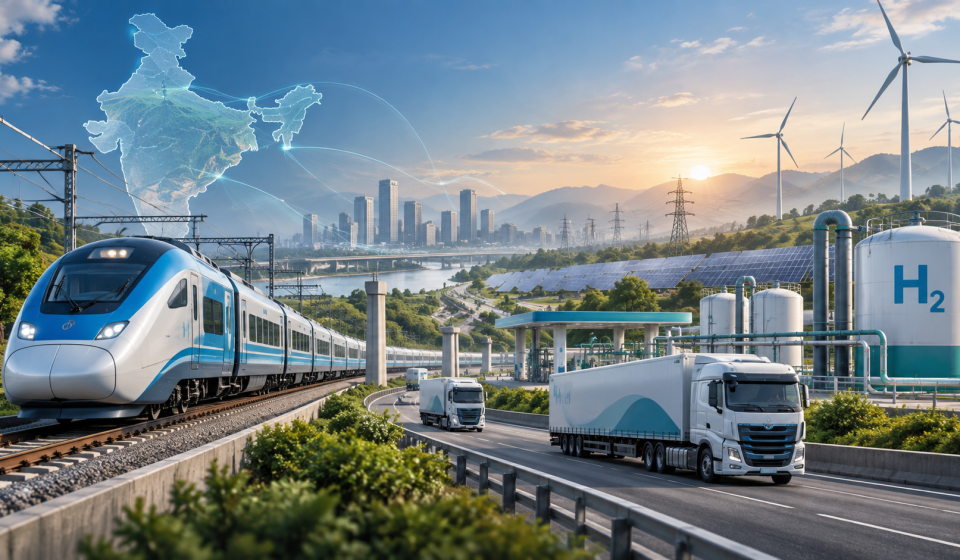
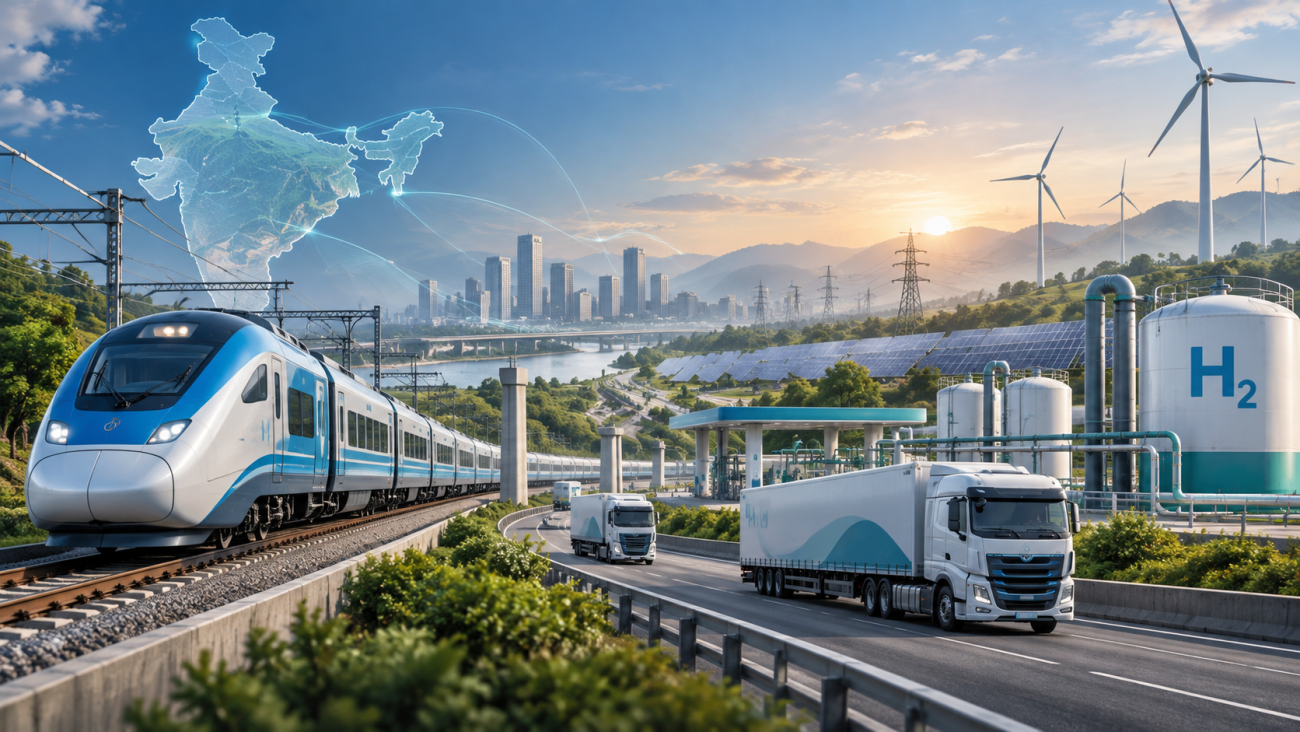
Rail: India’s first hydrogen-powered train launched on schedule, not “planned for mid-2026” but actually inaugurated by Prime Minister Modi on 17 July 2026, running the 89-km Jind-Sonipat section in Haryana under Northern Railway. Branded “Namo Green Rail,” the 10-coach train (2 driving power cars, 8 passenger coaches) was built domestically by the Integral Coach Factory in Chennai, integrated by Medha Servo Drives, and uses fuel-cell stacks from Canada’s Ballard Power Systems. It runs on a 1,200 kW PEMFC propulsion system, carries roughly 2,600 passengers across about a dozen stops, and consumes approximately 360 kg of hydrogen for a complete 180-kilometre round trip. A dedicated production and refuelling facility at Jind, licensed by the Petroleum and Explosives Safety Organisation, produces 420-430 kg of hydrogen per day. India now joins Germany, Japan, China, and the US in running hydrogen-powered passenger rail, though its stated purpose remains narrow: serving routes where full electrification isn’t immediately economical, not replacing rail electrification generally. Recently, after the successful trials at 120 kmph, Indian Railways is working to increase the speed of hydrogen trains from the current 75 kmph to 110 kmph.
Road: The Ministry of Road Transport and Highways continues trials across 10 corridors, including Greater Noida-Delhi-Agra, Ahmedabad-Vadodara-Surat, and the Mumbai-Pune Expressway, with refuelling stations planned at eight sites. A more advanced Nagpur pilot, combining on-site production with direct bus fuelling, has been described by Gadkari as a template for wider replication, with Tata Motors, Ashok Leyland, Reliance Industries, and NTPC participating.
The Supply Side: Ambitious Targets, Unresolved Tensions
None of the demand-side progress matters without credible supply, and here the picture stays more mixed. The National Green Hydrogen Mission targets 5 MMTPA of production by 2030, backed by roughly 125 GW of dedicated renewable capacity and over Rs.8 lakh crore in investment. As of late 2025, 18-19 companies held allocated production capacity of 862,000 tonnes/year, commitments still running well ahead of realised output.
Two tensions persist. First, the Mission’s 125 GW renewable requirement sits outside India’s headline 500 GW non-fossil target, so unless additional capacity is built specifically for hydrogen, the programme risks competing with grid electricity for the same scarce renewable megawatts, potentially pushing marginal generation back toward coal. Second, the cost gap remains wide: green hydrogen costs an estimated $4-5/kg against $2.3-2.5 for grey hydrogen, with even optimistic 2030 projections landing around $3-3.75/kg, still above grey hydrogen. Near-term adoption will depend on subsidy and blending mandates rather than unassisted cost competitiveness. Measures like competitive tenders and policy support have shown some results in price reduction as per the claims of Union Petroleum and Natural Gas Minister Hardeep Singh Puri. Nevertheless, ICRA estimates the capital requirement to hit the 2030 target at Rs.9 lakh crore.
Reading the Numbers Together
Three conclusions hold, each more modest than a “hydrogen revolution” framing but more defensible:
First, the electricity-reallocation argument is directionally sound but still small in magnitude. One operating train and ten road pilots are a rounding error against the 40-57 TWh data centres alone are expected to add by 2030. Hydrogen’s electricity-saving value becomes material only if pilots scale well beyond their current footprint, and only if the renewable capacity producing that hydrogen is genuinely incremental rather than diverted from the grid.
Second, the hydrocarbon-substitution argument sits on firmer ground, and 2026’s price volatility has reinforced it. With dependence above 90% and diesel demand from heavy trucks and buses persistently high, even partial hydrogen penetration would measurably affect the import bill, though the Rs.22 lakh crore figure covers all fuel imports, not the heavy-transport-diesel slice specifically, and current substitution volumes remain small relative to national consumption.
Third, supply-side constraints, not vehicle technology or, any longer, operational proof-of-concept, remain the binding limitation. The Jind-Sonipat train demonstrates the technology works; it doesn’t resolve whether 125 GW of hydrogen-dedicated renewable capacity gets built on top of the grid target, or whether green hydrogen costs converge with grey hydrogen on any realistic timeline.
A More Cautious Framing
A diversified transport-fuel architecture, batteries for urban and passenger mobility, hydrogen for heavy freight and non-electrified rail, continued grid electrification for dense corridors, remains sound and consistent with NITI Aayog’s Net Zero scenarios, which show petroleum’s share of transport energy falling to around 21% under a genuine net-zero pathway, met by electricity, biofuels, and hydrogen together.
What’s changed since early 2026 is that India has moved from announcing pilots to running one. That’s a genuine milestone, but it doesn’t yet constitute large-scale forex or grid relief. The Jind-Sonipat train and the ten road corridors are best read as infrastructure and cost-discovery exercises, proof that the engineering works, ahead of the harder question of whether the renewable capacity, cost curve, and scale needed to make hydrogen matter at a national level actually materialise by 2030.