

 In 30 Seconds




Story
Religions tend to place their founders’ deaths at the centre of the world, in capitals and on holy mountains. Buddhism’s founder died in a grove of sal trees outside a small town of the Malla republic, in what is now a quiet district of eastern Uttar Pradesh, and the tradition has always understood the modesty of the setting as the last teaching. Kushinagar, ancient Kushinara, is where the Buddha, eighty years old and worn out by half a century of walking and teaching across the Gangetic plain, lay down between two trees, spoke his final words, and passed into the mahaparinirvana, the great final release.
The Pali canon preserves the last journey in extraordinary detail in the Mahaparinibbana Sutta, and it reads less like scripture than like reportage. The old teacher, already ill, accepts a meal at the home of Cunda the smith, falls gravely sick afterward, and continues on foot toward Kushinara, resting repeatedly, asking Ananda to fetch water, to prepare a couch between the twin sal trees with its head to the north. He takes care, with his remaining strength, to absolve Cunda of all blame, declaring the final meal an offering of the highest merit. He receives one last seeker, Subhadda, and admits him to the order. And when Ananda protests that the master should not die in this insignificant mud walled town in the middle of the jungle, the Buddha corrects him with a history of the place’s former greatness, as if to say that no place is insignificant. His final words to the assembled monks were a summary of everything. All conditioned things are subject to decay. Strive on with diligence.
The Mallas of Kushinara gave the body a chakravartin’s funeral, and the cremation, the tradition records, took place at the spot marked today by the great brick mound of the Ramabhar stupa. What followed nearly became the faith’s first war. Eight claimants, kings and clans, demanded the relics, and armies gathered before a brahmin named Drona brokered the division of the remains into eight portions, each carried home to be enshrined under a stupa. In that settlement lies the origin of the entire relic and stupa culture of Asia, the architecture of the faith from Sanchi to Borobudur descending from a funeral negotiation in eastern UP.
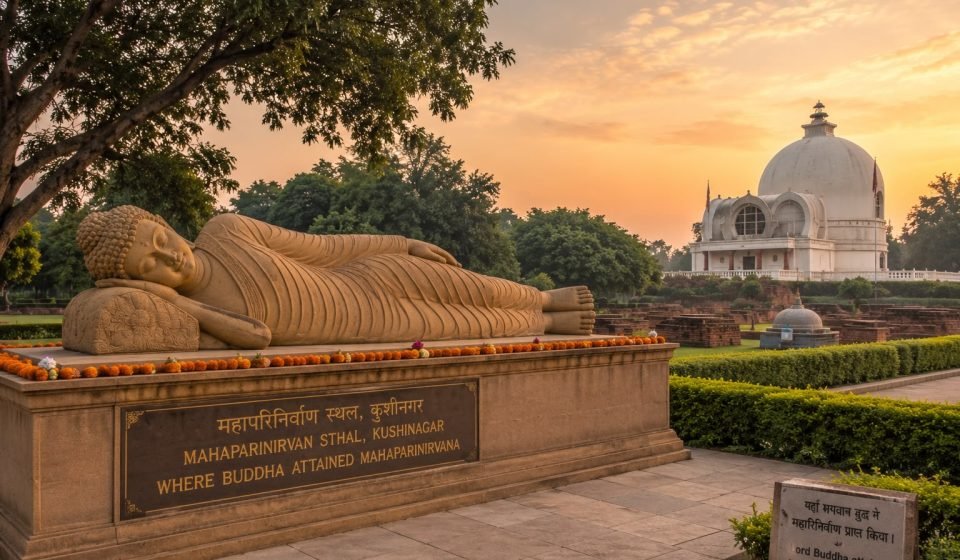
Kushinagar flourished as a pilgrimage centre for well over a millennium. Ashoka built here, the Guptas built more, and the site’s crowning image belongs to their era, the six metre reclining Buddha carved from red sandstone in the fifth century, the teacher on his right side in the posture of the final passing, an image so tender that pilgrims have draped it in robes of silk continuously since its recovery. The Chinese travellers Faxian and Xuanzang both came, the latter finding the place already declining, and after the twelfth century the story repeats Sarnath’s. Collapse of patronage, dispersal of monks, and the slow burial of the stupas under grass and forgetting, the very name of the town lost.
The recovery was a detective story of the colonial archive. Cunningham’s surveys matched the texts to the mounds near the village of Kasia, his assistant Carlleyle cut into the main stupa in 1876 and found the great reclining image broken and buried, and the identification was sealed by inscribed finds naming the mahaparinirvana monastery. Restoration followed through the early twentieth century, much of it driven by Burmese Buddhist patronage, and the modern town grew back around its recovered heart, monasteries of the Buddhist nations rising along the road as they did at Sarnath.
The republic has lately rediscovered the town’s potential. Kushinagar was given an international airport in 2021, inaugurated with a planeload of monks from Sri Lanka, and sits on the Buddhist circuit that the tourism ministries of India and its eastern neighbours promote from Lumbini across the border in Nepal through Bodh Gaya and Sarnath. The faithful of Thailand, Myanmar, Japan, and Sri Lanka now arrive by air to stand in the sal grove, and their devotion sustains an economy in one of UP’s poorer districts, sacred geography functioning, as it so often does in this state, as infrastructure.
What the pilgrim finds, in the end, is a stillness unusual even among holy places. The reclining figure in the dim shrine, wrapped in gold cloth, the mound of the cremation stupa in its lawn, the sal trees replanted where the originals stood. The town where the Buddha died makes no claim except the one his last words made, that everything passes, and the visitor walking back to the road tends to walk more slowly than they came.