 In 30 Seconds




The Modi Seychelles visit that concluded this week was never going to be just a courtesy call between old partners. Prime Minister Narendra Modi spent three days in Victoria, from the twenty seventh to the twenty ninth of June, and by the time he left, the outlines of a far more deliberate Indian Ocean strategy had become visible to anyone willing to look past the ceremony.
Modi was the guest of honour at Seychelles’ Golden Jubilee National Day celebrations, marking fifty years of the island nation’s independence. He met President Patrick Herminie and held talks on the sidelines with Mauritius Prime Minister Navinchandra Ramgoolam, a reminder that India’s outreach in the region rarely happens in isolation. Small island states across the Indian Ocean tend to coordinate, and a visit to one nearly always becomes a conversation with several.
Why the Modi Seychelles Visit Matters Beyond the Ceremony
It would be easy to read the Modi Seychelles visit as symbolic, another stop on a long list of diplomatic itineraries. The substance tells a different story. The two countries used the occasion to advance what officials are now calling the Ocean of Opportunity initiative, a bilateral roadmap built around maritime security, the blue economy, digital connectivity and climate resilience.
This is not new vocabulary for India’s foreign policy establishment. It sits inside the broader MAHASAGAR doctrine, an approach that ties together maritime security, financial assistance and infrastructure investment across the Indian Ocean region. The roughly twelve hundred and fifty crore rupees in financial assistance pledged alongside the visit, paired with commitments on UPI integration and space technology cooperation, reads less like a one off gesture and more like the next instalment in a strategy India has been building for over a decade.
Modi himself drew attention to that arc during the visit, noting that Seychelles was the first country in the Indian Ocean region he visited as Prime Minister back in 2015, and also his first visit to Africa in that role. Eleven years later, the relationship has moved from introductory diplomacy to something closer to institutional partnership.
The Indian Ocean Stakes India Is Actually Playing For
To understand why a small island nation with a population under one hundred thousand commands this much attention from New Delhi, it helps to step back and look at the map. Seychelles sits along some of the busiest maritime trade corridors in the world, the same corridors through which a significant share of global energy shipments and container traffic pass. For a country like India that depends heavily on secure sea lanes for trade and energy imports, influence in these waters is not optional.
China’s growing presence in the wider Indian Ocean region, from port investments to naval visits, has sharpened New Delhi’s interest in shoring up relationships with island states that might otherwise drift toward Beijing’s orbit. India’s answer has consistently been to offer something China struggles to match at the same scale, which is genuine capacity building. Coastal radar stations, patrol vessels, hydrographic surveys and now AI enabled cyber security centres have all featured in India’s outreach to Seychelles and its neighbours over the past decade.
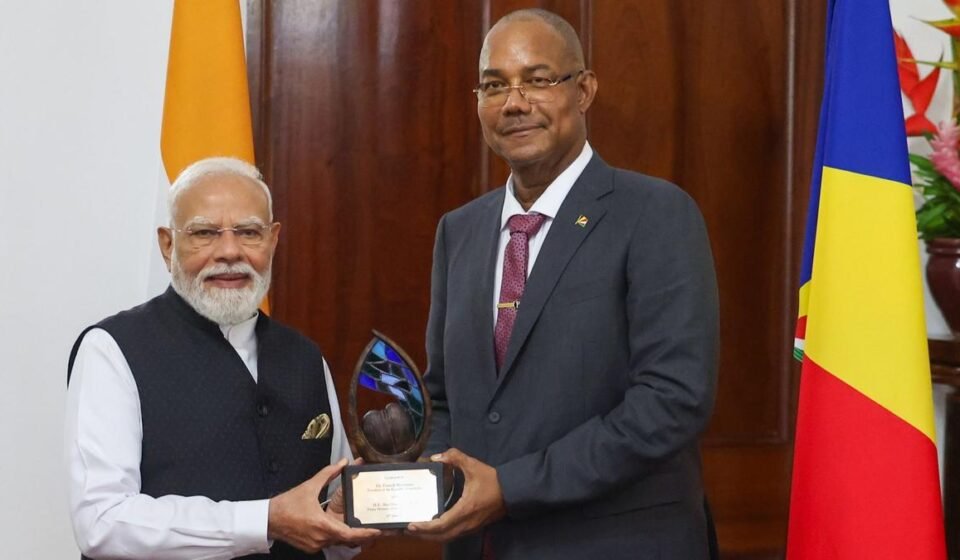
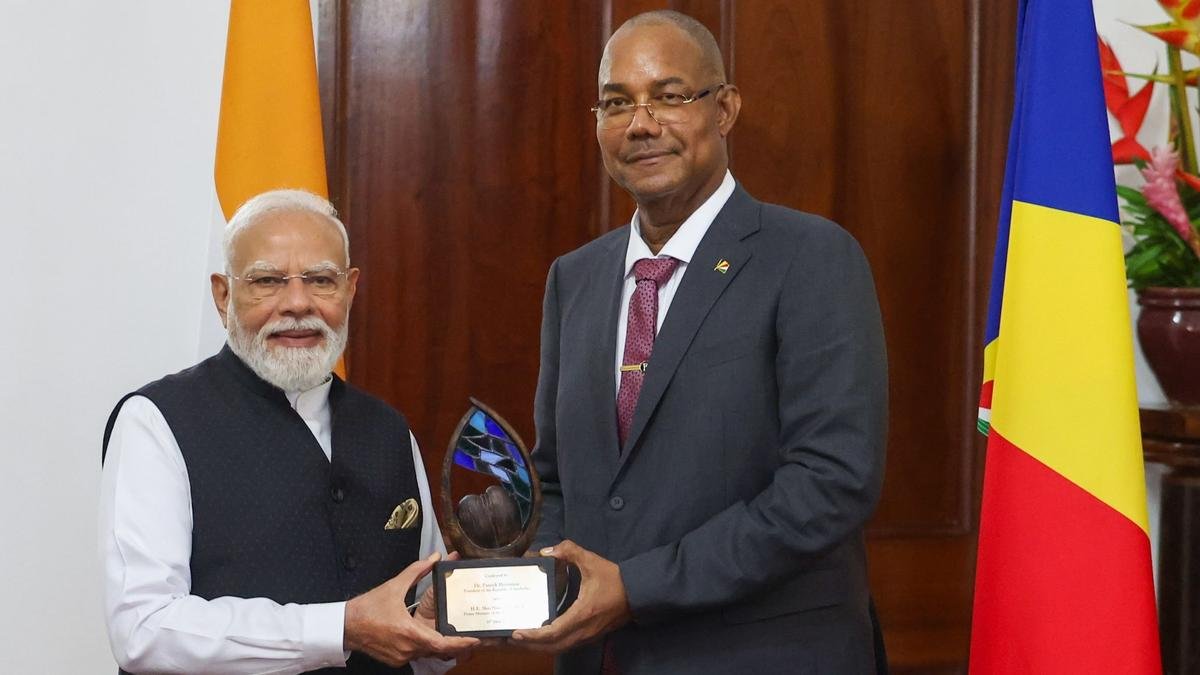
Modi was also conferred the Guardian of the Blue Horizon award during the visit, in recognition of environmental conservation efforts, a moment he was careful to frame as recognition for the country rather than for himself, dedicating the honour to what he called the one point four billion people of India.
What Comes Next After the Modi Seychelles Visit
The real test of any state visit lies in what follows it rather than what happens during it. India has a track record of announcing ambitious frameworks in the Indian Ocean region that take years to translate into delivered infrastructure. The Ocean of Opportunity initiative will likely face the same scrutiny.
What makes this moment slightly different is the timing. Modi recently became India’s longest continuously serving democratically elected Prime Minister, a milestone that has given his government’s foreign policy team unusual continuity to plan multi year commitments without the disruption of a change in leadership. Whether that continuity translates into faster execution on the ground in Seychelles, Mauritius and other Indian Ocean partners is the question worth watching over the coming year.
For now, the Modi Seychelles visit stands as a clear signal of where Indian diplomacy intends to spend its attention next, and a useful reminder that the most consequential foreign policy moves do not always happen in the capitals that make the loudest headlines.
How Seychelles Fits Into India’s Wider Africa Outreach
It is worth placing the Modi Seychelles visit inside the larger pattern of India’s engagement with the African continent, since Seychelles, despite its small size, has often served as something of a gateway for that relationship. India’s naval cooperation with Seychelles, including hydrographic surveys and joint patrols, predates much of its more publicised partnerships elsewhere in Africa, and officials in New Delhi have at times described the island nation as a model for what deeper maritime partnerships across the continent could eventually look like.
This matters because India’s broader Africa strategy has historically struggled to match the scale of Chinese investment on the continent. Beijing’s Belt and Road financing has built ports, railways and power plants across multiple African nations over the past decade, often dwarfing what India has been able to offer in pure capital terms. India’s answer has been to compete on a different axis altogether, emphasising training programmes, defence cooperation, digital public infrastructure exports like UPI, and a framing of partnership that avoids the debt heavy structures critics have associated with some Chinese financing arrangements.
Seychelles becomes a useful test case for that approach precisely because its small population and limited absorptive capacity for capital make grand infrastructure financing less relevant than the kind of capacity building India has offered instead. If the model succeeds visibly in Seychelles, expect Indian officials to point to it as a template when negotiating with larger African partners in the years ahead.
The Domestic Political Dimension Back Home
Foreign visits by an Indian Prime Minister rarely exist purely in the realm of foreign policy, and the Modi Seychelles visit was no exception. Coverage of the trip inside India leaned heavily on the symbolism of Modi attending Seychelles’ Golden Jubilee celebrations as Guest of Honour, a framing that domestic commentators were quick to connect to India’s own ambitions of playing a larger leadership role among smaller nations in the Global South.
This domestic dimension also intersects with Modi’s recent milestone of becoming India’s longest continuously serving democratically elected Prime Minister. Government communications around the Seychelles trip made repeated reference to the arc of the relationship since 2015, a framing clearly intended to present foreign policy continuity as one of the tangible benefits of long tenured leadership. Whether voters at home register this kind of diplomatic narrative as a meaningful achievement, separate from more immediate economic concerns, remains an open question, but it is unmistakably part of the political messaging accompanying the visit.
A Relationship Likely to Keep Compounding
Diplomatic relationships of this kind tend to compound rather than spike, and there is little reason to expect a dramatic single announcement to define the years ahead for India and Seychelles. Instead, expect incremental additions, another patrol vessel delivered, another training programme expanded, another round of UPI integration rolled out to more merchants on the islands. It is unglamorous work compared to a state visit, but it is precisely the kind of accumulation that determines whether a partnership announced with fanfare in Victoria actually changes daily life on the ground a decade from now.
Related Reading
- What Is Strategic Autonomy? India’s Foreign Policy Idea Explained
- What Is BRICS? Why the Group Matters for India and the West
- Kuwait and Bahrain say Iran targeted them with drone and missile strikes
Official context: Readers can compare this story with public information from Ministry of External Affairs.