 In 30 Seconds




Story
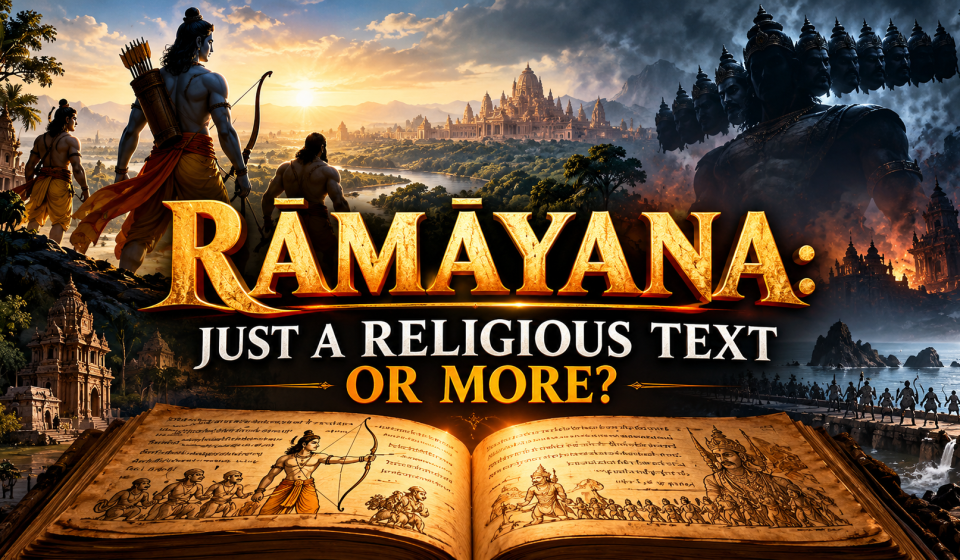
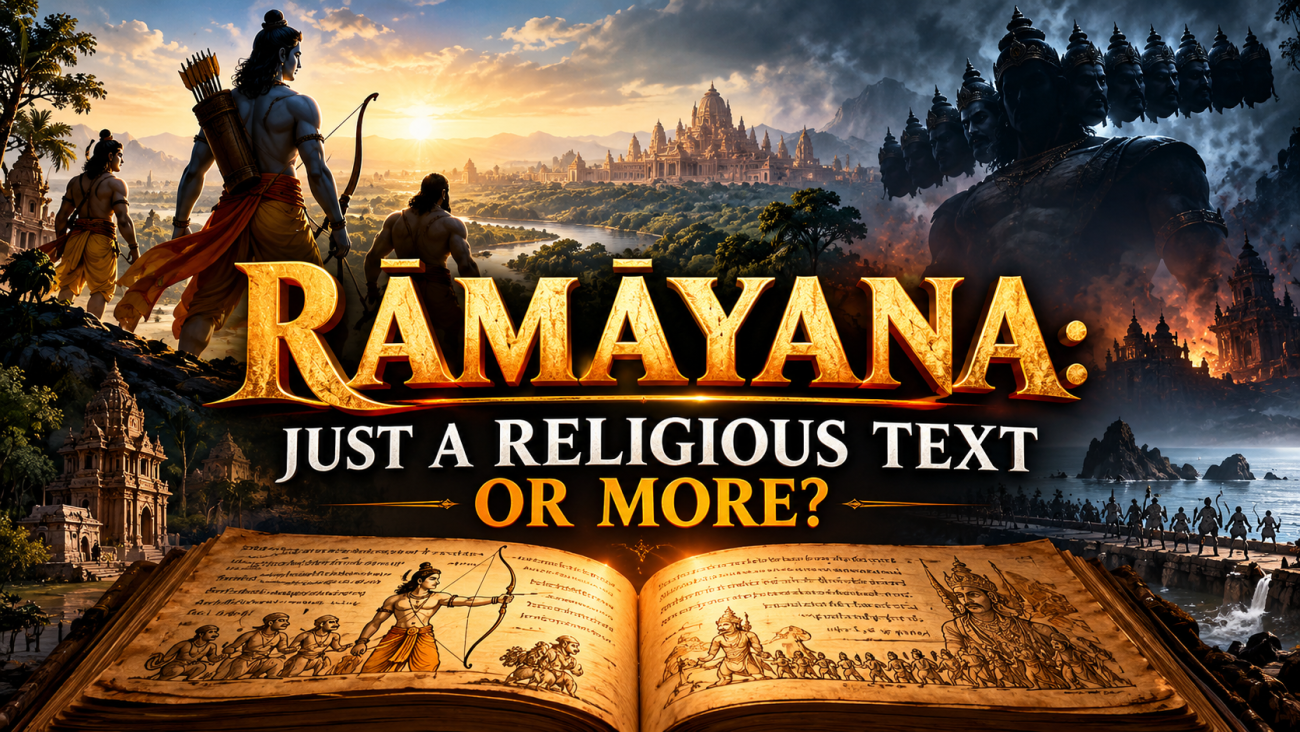
What is Rāmāyaṇa? To most of the Hindus it is the epic story of Lord Rama, the prince of Ayodhya and the son of Dashrath. A tale of how he endured the exile in the forest for 14 years with an unparalleled calm and how he struck down Ravana with his might. To some it is a moral code. It is a book which tells the code of conduct. And it wouldn’t be wrong to say that for some it is a book that comes even above the foundational works of Hinduism i.e., the Vedas.
So, who is right among them? All of them! Because none of them is actually wrong. Purushottama does convey the code of conduct, whether in luxury or in exile. Raghava does show us the proper way to honor our Pitrs and conduct rituals through service and his unmatched obedience towards his father. And surely he also projects his might with which he vanquished evil Asuras. But Rāmāyaṇa in itself is more than just a biography of Lord Rama. A large part of it is actually the biography of Aryavarta.
The text includes so many various stories which are either directly or indirectly related to Rama or the land itself. Our granthas have a habit of conveying historical information in the form of stories, some being genuine while the others constructed to include other areas and aspects, all of these mixed with the favourite poetic device of our ancestors ‘Atishayokti’.
Rāmāyaṇa in that way can also be called the architectural record of Ayodhya back then due to the fact that how meticulously it describes the construction of Ayodhya city.
“That glorious city with well-devised highways is twelve yojana-s lengthwise and three yojana-s breadth wise.” [1-5-7]
“That city shines forth with well-laid great royal highways that are always wetted with water, and with flowers strewn and scattered on them.” [1-5-8]
“That city is surrounded with gateways and archways; the front yards of buildings are well laid; it is lodges all kinds of machinery, weaponry and craftsmen, and king Dasharatha dwells in such a city.” [1-4-10]
“That city Ayodhya accommodates groups of danseuses and theatrical personnel, and she is surrounded everywhere with the gardens and brakes of mango trees, and her wide fort-wall is like her cincture ornament.” [1-5-12]
“With the throngs of provincial kings who come hither to pay dues pervade that city, and she is verily lustrous with residents of various other countries, and with traders, too. In such a city Dasharatha dwells.” [1-5-14]
The text here clearly describes the architecture of Ayodhya, though exaggerated at some instances, it still does tell us about its architecture. There are so many other verses that describe it in even more detail, but for the sake of our topic, we must refrain ourselves from diverging too far from our main premise. The text explains its dimensions and the excellent city planning of that time and it describes Dashratha as the all powerful king of Kosala empire.
Ahead in the Bala Kanda, a story is mentioned of the conflict between Vashistha and Vishvamitra, in which Vishvamitra tries to forcefully take away the divine cow ‘Sabla’ from Vashistha and in defense Sabla summons an entire army of Shakas, Pahlavas, Yavanas and Kambojas from its various body parts.
Now a point to consider before we move ahead is that a lot of stories in our religious texts are not meant to be taken literally. Back then, as per the oral tradition the guru had a humongous task of memorizing all verses of various texts with their meanings and passing them down to his disciples exactly. To make this easy, they started including a set of exaggerations to make this gigantic task easier.
The story of Shakas, Pahlavas, Yavanas and Kambojas summoning from various parts of Sabla is not meant to be taken literally as we discussed and proved this in our previous article. Foreigners did come and the text specifically mentions this conflict between Vashistha and Vishvamitra in an exaggerated and epic way. This qualifies Ramayan to be considered an historical record as well, even if it is not accurate enough at moments.
More than that, it is also a geographical record. There is a story of Indra mentioned in Bala Kanda which explains the formation of two provinces, Malada and Karusha.
As per the story, Indra upon defeating Vṛtra had incidentally committed the sin of Brahma-hatya. He was completely entrenched in mortal impurities of filth and hunger. The gods hence washed him with their divine vessels to rejuvenate his true form. The hunger and filth finally fell away from Indra’s body. Relieved, he blesses the land where all that fell to become great provinces named Malad and Karusha.
“On giving filth and hunger emerged out of the body of Mahendra here on the earth then the gods were gladdened. [1-24-20b, 21a]
“As and when Indra was without desecration and hunger as well, and thus purified, then gladdened about this place he gave it an unexcelled boon. [1-24-21b, 22a]
“These provinces that bear the impurity of my body shall become resourceful and they shall attain renown in world as Malada and Karusha.” Thus Indra gave boon to this place. [1-24-22b, 23a]
As we see, the fight of Indra and Vṛtra was deliberately included to register these two provinces of ancient India, i.e Malada and Karusha. There are other similar regions mentioned as well, such as Kekaya desh etc. This shows that these stories indeed were used to register the ancient Hindu provinces and to legitimize their place under the vedic system.
More than all of that, Rāmāyaṇa is also a political record. At times it clearly explains the political landscape of that time and records the opinions of various key figures.
For example, in Ayodhya Kand upon hearing about the news of exile and Dashrath’s helplessness, Laksman advises Rama to imprison Dashrath and seize the throne. He goes as far as to speak of killing Dashrath and to slaughter the entirety of Ayodhya if they opposed Rama’s ascension.
“Oh, Rama, the best of men! If the city of Ayodhya turns against you, I shall make it desolate of men with sharp arrows”[2-21-10]
“I shall kill all those who are siding Bharata ,and are favourable to him. Soft person indeed gets disgraced!” “[2-21-11]
“If our father with an evil mind behaves like our enemy with instigation by Kaikeyi. I shall keep him imprisoned without personal attachment or if necessary, kill him.”[2-21-12]
And Laksman did not say all this privately to Rama, but in the presence of Kausalya. This shows us the glimpse of human nature and political landscape back then.
Dashrath in the start too warns Rama about the corrupting nature of power and how Rama must ascend to the throne before Bharat returns from his uncle’s.
“It is my opinion that your coronation function should occur, while Bharata is away from the city.”[2-4-25]
“Oh, Rama! It is my opinion that minds of men are inconstant. But the ever righteous, endowed with goodness, sometimes may act unexpectedly on impulse.”[2-4-27]
Not just this, but previously Dashrath also asked Rama to speed things up before his mind gets changed.
“Oh, Rama! Hence, before my mind gets changed, get you anointed to the crown. Are not the minds of men unstable?[2-4-20]
But, why would Dashrath’s mind change? Well we can tell, maybe because of external pressure. Kekaya is the princess of Kekaya Desh. And they would naturally favour Bharat’s ascension to the throne of Kosala. Dashrath is asking him to speed things up before he comes under the overwhelming pressure of the Kekaya Desh and is forced to stop the coronation.
All of this shows us that Rāmāyaṇa is much more than just a highly revered religious text. So what is it actually? How do we define it?
It is a commingling of many things, but it can be best defined as ‘Itihasa’. Our Itihasa. Aryavarta’s Itihasa with a touch of religion, culture, and a mesmerizing example of Indic Culture.
Sources and Citations:
ValmikiRamayanam: https://sanskritdocuments.org/sites/valmikiramayan/vr_index.htm