
 In 30 Seconds




In the 1830s the government of India waged and won a war against an enemy it declared to be a secret nation of hereditary murderers, and the campaign against thuggee became one of the founding legends of the Raj, retold in memoirs, novels and eventually Hollywood as the archetype of enlightened power destroying exotic evil. The truth beneath the legend, which modern historians have spent decades excavating, is more complicated, and its most durable product was not the ending of a cult but the beginning of a machinery, the colonial system of surveillance and hereditary criminality whose consequences ran far past the last thug.
That gangs of stranglers preyed on India’s roads is not in doubt. Travellers in the disturbed decades after the Maratha wars moved through a countryside full of demobilised soldiers and displaced men, and among the robber bands were groups, known by the old word thag, deceiver, who worked by infiltration, befriending parties of travellers for days before strangling them at a chosen camp, plundering and burying the bodies. Cases and confessions establish the method, the specialised roles, the argot called Ramasi, and rituals invoking the goddess Bhavani, practised, the records show, by Muslim as well as Hindu gang members, brigandage wearing the religious dress that most Indian trades wore.
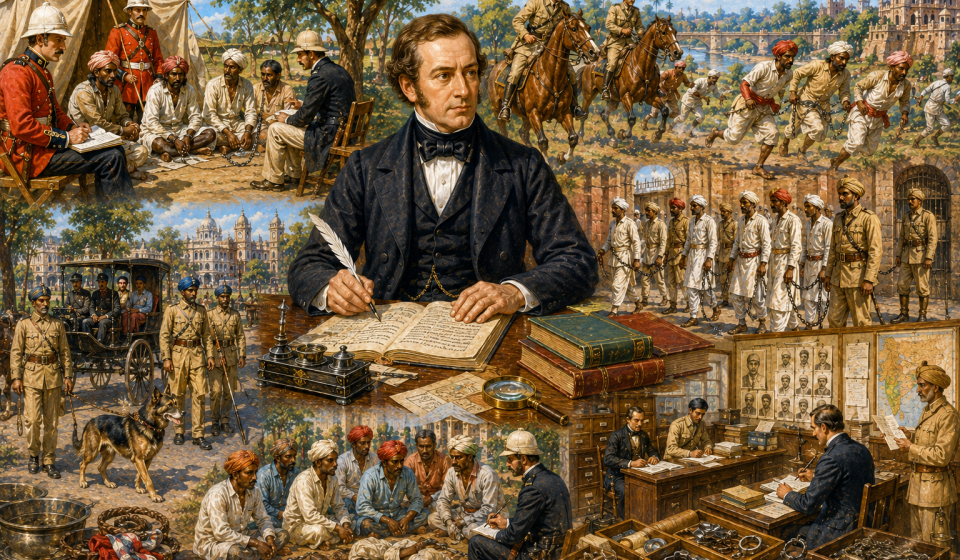
The transformation of these gangs into a discovery that gripped the world was the work of William Henry Sleeman, an officer of scholarly bent serving in the newly annexed territories of central India. From captured members who turned approver, informers trading testimony for their lives, Sleeman assembled in the late 1820s a picture of a vast hereditary fraternity, genealogies of murder running back generations, and maps of the beles, the traditional killing grounds along the great roads. His reports persuaded Bentinck’s government, and from 1830 a special establishment under Sleeman, the Thuggee and Dacoity Department, hunted the fraternity across British and princely India alike, unhindered by ordinary jurisdiction. The method was the approver system itself. Informers identified accomplices, special courts tried them under laws framed for the purpose, Act XXX of 1836 making the mere fact of belonging to a gang of thugs, anywhere, a crime punishable with life imprisonment, with no need to prove a particular murder. Over some fifteen years more than three thousand men were convicted as thugs, hundreds hanged, hundreds more transported, and the remainder, with their families, settled at a reformatory village at Jabalpur, where a School of Industry set the sons of stranglers to weaving tents and carpets, an institution whose descendants worked into the twentieth century. By the 1840s Sleeman could report the fraternity extinct, and the roads were, in fact, safer.
Modern scholarship, rereading Sleeman’s own archive, has questioned nearly every element of the grand theory while confirming the gangs themselves. The confessions that built the hereditary cult were produced by men bargaining for life, shaped by the questions asked, and harmonised by the department that recorded them. The numbers of victims attributed to thuggee, running in popular accounts to many thousands yearly and in the wildest to a million across history, rest on no enumeration at all. And the sharp line between a religious murder cult and the ordinary armed banditry of a disordered countryside looks, in the records, far blurrier than the legend requires, leading some historians to argue that thuggee as a system was in large measure a colonial construction, an interpretation imposed on scattered criminality, though others reply that the core evidence of organised strangler gangs survives every deconstruction. What is certain is that the campaign served the conquering state well, justifying intervention in princely territories, advertising British rule as India’s protector against India’s darkness, and pioneering techniques of power.
Those techniques were the lasting inheritance. The registration of suspect communities, the doctrine that crime could be a hereditary profession, the approver, the special tribunal and the police file matured over the following decades into the Criminal Tribes Act of 1871, which declared whole communities criminal by birth, subjecting millions to registration, restriction and stigma that independent India repealed only in 1952 and whose social shadow endures. The war on thuggee ended in the 1840s. The machinery it built, and the habit of ruling by category and suspicion, proved very much harder to bury than the thugs.
1818 to 1856 - Consolidation and Reform
Part 5 of 10 in this chapter.