 In 30 Seconds




There is a saying in Indian politics so old that nobody remembers who coined it, and so accurate that nobody has managed to retire it. The road to Delhi runs through Lucknow. It has been true under the Congress, true under the Janata experiments, true under the Mandal parties, and true under the BJP. Whoever wishes to govern India must first reckon with Uttar Pradesh, and whoever loses Uttar Pradesh begins, sooner or later, to lose India.
The numbers explain part of it. Uttar Pradesh sends 80 members to the Lok Sabha, the largest bloc by a wide margin, nearly a sixth of the entire lower house. Its assembly has 403 seats, larger than the legislatures of most countries. Around 240 million people live within its borders, which means that if Uttar Pradesh were a nation it would rank among the five most populous on earth, ahead of Brazil, ahead of Pakistan by some projections, behind only the giants. One in every six Indians is from UP. No electoral arithmetic in Delhi survives contact with that fact.
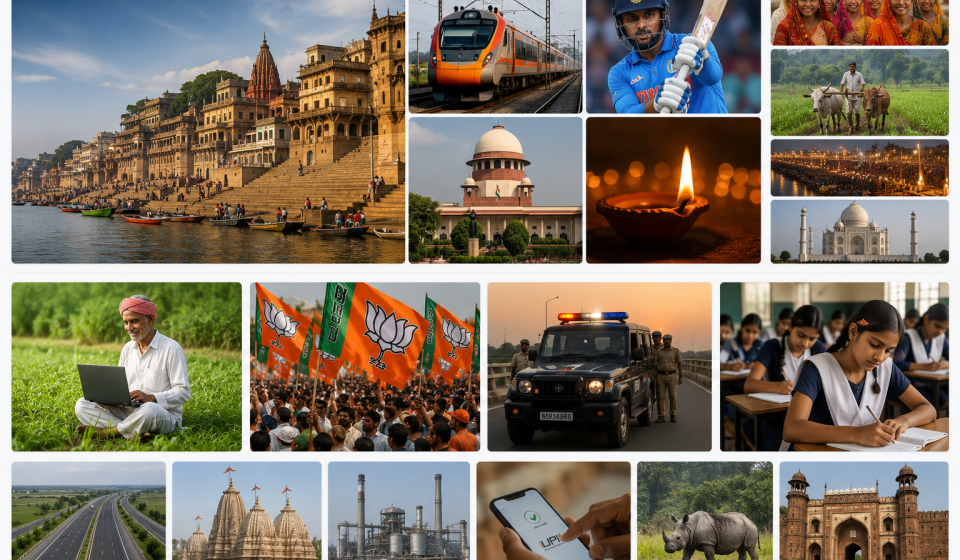
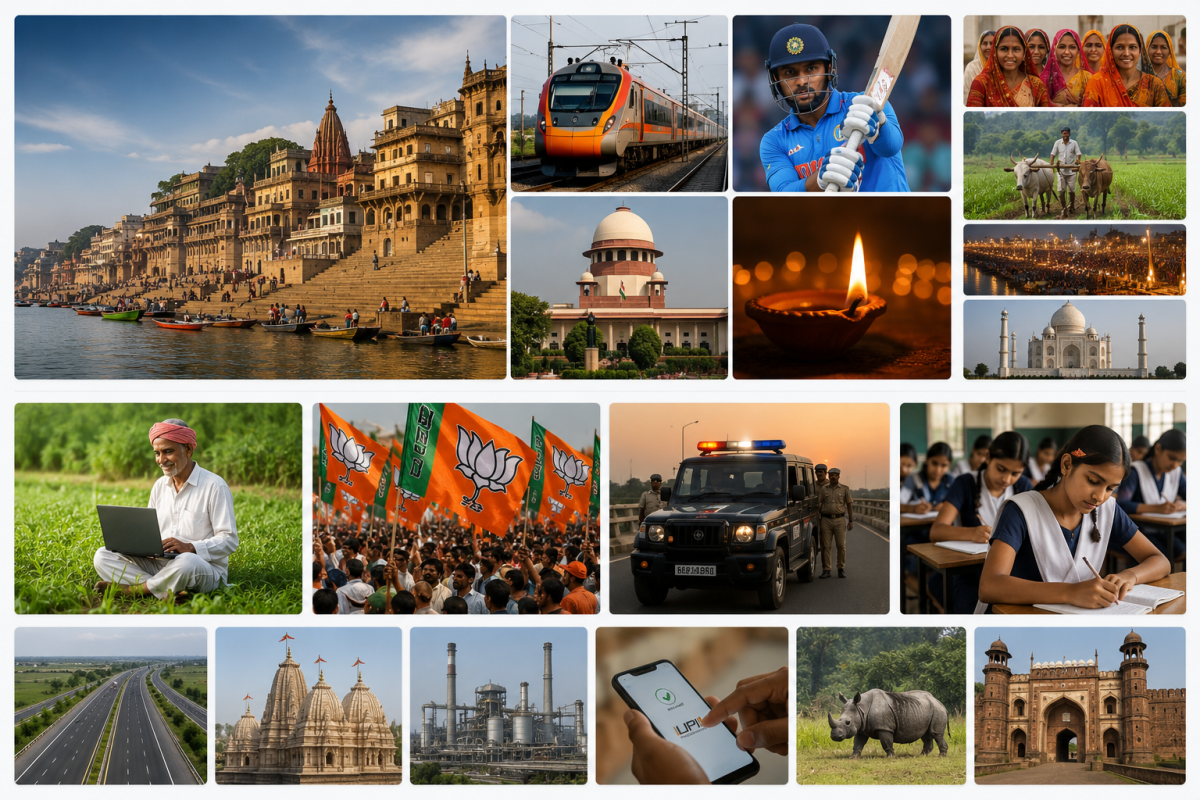
But arithmetic alone does not explain the state’s grip on the Indian imagination. Uttar Pradesh is also the country’s civilisational core in a way no other state can claim. Rama’s Ayodhya, Krishna’s Mathura, Shiva’s Kashi, and the Buddha’s Sarnath all sit within a few hours of each other on its plains. The Ganga and the Yamuna meet at Prayagraj in the confluence that has gathered pilgrims for longer than recorded history. The Taj Mahal, the single image by which the world recognises India, stands on the Yamuna at Agra. When India argues about its past, it is usually arguing about something that happened in Uttar Pradesh.
The state has supplied the republic with its leadership to a degree that borders on monopoly. Nine prime ministers have been elected to the Lok Sabha from constituencies in Uttar Pradesh, from Jawaharlal Nehru at Phulpur to Narendra Modi at Varanasi. The Nehru family’s boroughs of Rae Bareli and Amethi, the socialist strongholds of the east, Vajpayee’s Lucknow, and the current prime minister’s adopted Kashi form a political geography that the rest of the country has learned to read like a weather map.
Every great convulsion of independent India has either begun in Uttar Pradesh or found its decisive theatre there. The abolition of zamindari was tested on its fields. The Emergency’s worst excesses of forced sterilisation played out in its districts. The Mandal upheaval of backward caste politics and the Mandir movement that culminated at Ayodhya on December 6, 1992 both made UP their battlefield, and between them they demolished the old Congress order and built the party system India lives with today. The Dalit assertion under Kanshi Ram and Mayawati achieved in UP what it achieved nowhere else, a Dalit led government ruling India’s largest state.
Yet the state that decides India’s politics has long trailed India’s progress. Its per capita income sits far below the national average. Its districts fill the bottom ranks of health and education indices. Its young people board trains for Mumbai, Surat, and Delhi in numbers that have made the UP migrant a figure in every Indian city’s story. The paradox is brutal and instructive. Power flows from Uttar Pradesh, but prosperity has famously flowed around it.
The state is also India’s most reliable bellwether in a subtler sense. Political weather forms in UP before it reaches the rest of the country. The collapse of single party dominance, the rise of caste parties, the return of majoritarian consolidation, and the arrival of welfare delivery as the currency of elections all appeared on the Gangetic plain a cycle or two before they became national patterns. Analysts read UP’s by elections the way sailors read barometers, not because the state is typical, for it is not, but because its scale makes every national current visible there first and largest.
This series, the UP Files, is an attempt to read the whole ledger of this immense place. The sacred cities and the mafia dons. The Nawabs of Awadh and the encounter squads of the STF. The weavers of Banaras and the strongmen of Purvanchal. The riots and the reconciliations, the famines and the expressways, the poets and the politicians. None of it cancels the rest. All of it is Uttar Pradesh.
To understand why India votes as it votes, prays as it prays, argues as it argues, and remembers as it remembers, there is no substitute for understanding this one state. The series begins, as it must, with the ground itself, the great river plain that made everything else possible.
UP Files - Batch 1
Part 1 of 10 in this chapter.