 In 30 Seconds




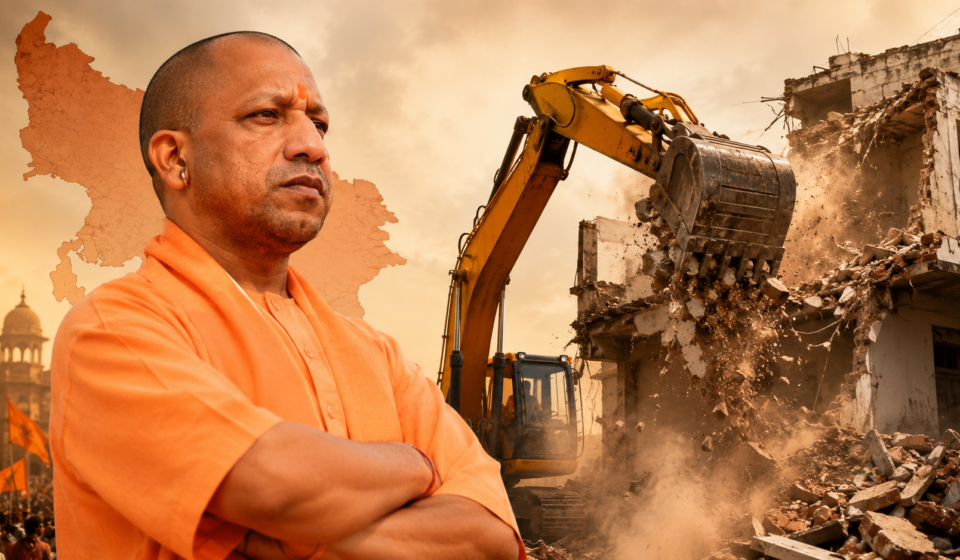
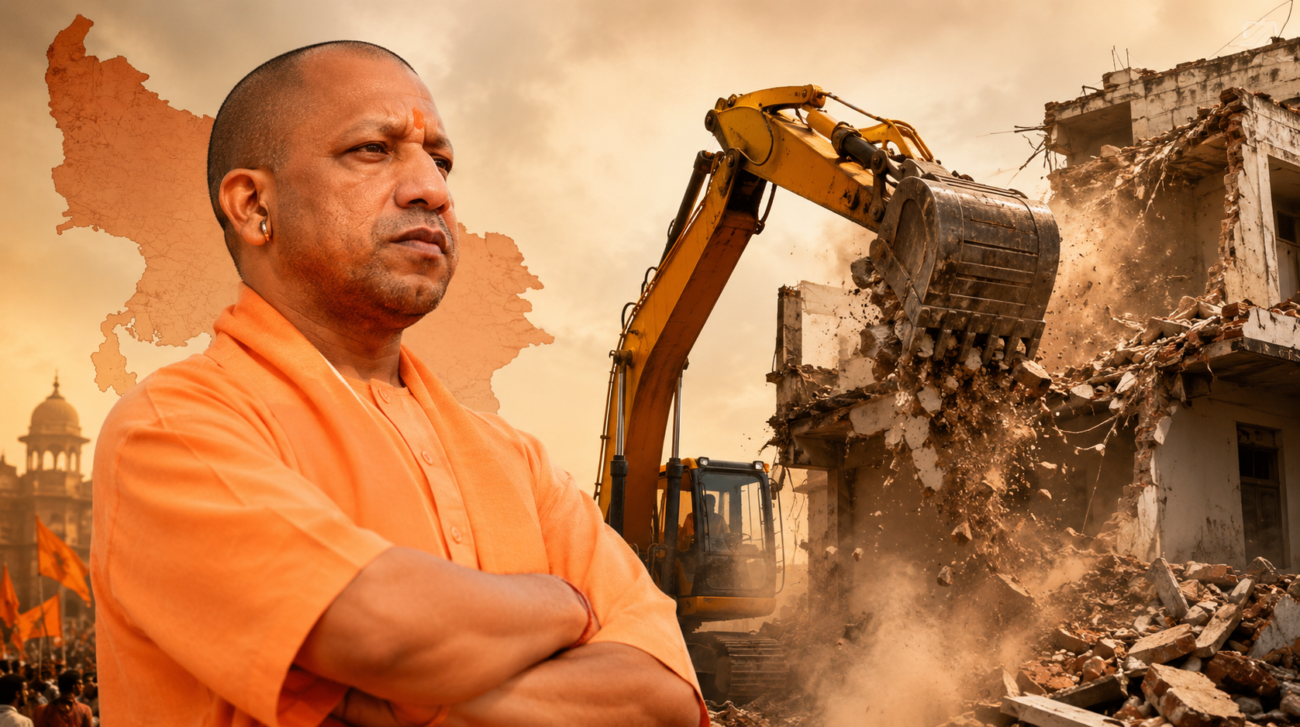
Few pieces of construction equipment have entered Indian political vocabulary quite like the bulldozer has under Uttar Pradesh Chief Minister Yogi Adityanath. The Yogi Adityanath bulldozer policy, now eight years into its existence, has evolved from an administrative tactic into something closer to a brand, complete with a nickname that has outgrown the man himself. Adityanath is now widely known as Bulldozer Baba, a title that draws as much affection from supporters as it does criticism from opponents.
The policy in its simplest form involves using municipal and police authority to demolish properties linked to individuals accused of criminal activity, often citing unauthorised construction as the technical justification. What began as a law and order tool in the early years of Adityanath’s tenure has since expanded into a broader symbol of his administration’s approach to governance.
The Land Recovery Cases Behind the Bulldozer Policy
Adityanath has increasingly used specific, named examples to illustrate the policy’s results rather than relying on abstract claims. Speaking earlier this month at a digital democracy programme in Lucknow, he described how a parcel of land that had remained under the control of a mafia figure for years was recovered after the bulldozer policy came into force, and how that same site now houses the State Forensic Institute.
He went further, recounting that nearly one hundred and twenty acres of land legally belonging to the Uttar Pradesh Police had gone unrecovered for years despite the department’s own efforts, until the bulldozer policy gave the state government the tools to reclaim it. The detail matters because it shifts the narrative away from demolition as punishment and toward demolition as a form of asset recovery, land that the state argues rightfully belonged to public institutions all along.
Why the Bulldozer Has Become a Political Brand
Defence Minister Rajnath Singh, addressing an event in Lucknow earlier this year, offered perhaps the clearest articulation of how the BJP wants the bulldozer policy understood. He argued that the machine does not only demolish, it also prepares the ground for development, pointing to projects like Lucknow’s Green Corridor as evidence that the same administrative energy directed at mafia properties has also driven infrastructure growth in the state.
This reframing is deliberate. Academic researchers who have studied the policy’s reception note that it has taken on a cultural life of its own, appearing in folk songs played at weddings and circulating widely on social media, often celebrating Adityanath directly by name. Field research conducted ahead of recent state elections found that the bulldozer is widely perceived among poorer and middle class voters, both Hindu and from marginalised communities, as a source of suraksha, a Hindi term that carries connotations of both security and safety.
The Criticism the Bulldozer Policy Continues to Face
Not every account of the bulldozer policy is celebratory. Critics, including civil liberties organisations and opposition politicians, have argued that demolitions frequently target the homes of individuals before any conviction, raising due process concerns that go well beyond the specific cases the state highlights in public events. The disputes around Sambhal, where a court ordered survey of a mosque led to violent clashes, have become a flashpoint in this debate, with Adityanath defending the state’s actions as operating within legal boundaries while critics describe the underlying approach as selectively applied.
Adityanath has responded to these criticisms directly on multiple occasions, asserting that minorities are safer in Uttar Pradesh under his government than they were previously, a claim he supports by pointing to a decline in communal rioting since the BJP took office in 2017. Independent verification of comparative safety claims across different time periods remains difficult, and the assertion continues to be contested by opposition voices who argue that the policy’s enforcement pattern tells a different story.
What the Bulldozer Policy Signals About Governance in Uttar Pradesh
The durability of the Yogi Adityanath bulldozer policy as both a governing tool and a campaign symbol suggests it is unlikely to fade regardless of legal challenges it continues to face in various courts. Its political utility, demonstrated again in Adityanath’s recent election performance, gives the state government every incentive to continue framing demolitions as decisive action rather than as a practice requiring restraint.
Whether the policy ultimately strengthens or undermines the rule of law in Uttar Pradesh will likely remain a matter of perspective rather than consensus, shaped as much by where a voter sits politically as by the legal merits of any individual case.
The Legal Challenges Still Working Through the Courts
The bulldozer policy has not gone unchallenged in India’s judicial system, and several cases touching on demolitions linked to the policy have made their way to higher courts over the past few years. Judicial scrutiny has generally focused on a narrower question than the policy’s overall legitimacy, namely whether individual demolitions followed due process, including proper notice periods and adherence to municipal building regulations, rather than ruling on the broader practice itself.
This distinction matters a great deal in practice. Courts examining specific demolition cases have at times found procedural lapses and ordered compensation or, in rarer instances, reconstruction, without striking down the underlying policy framework that allows demolitions to proceed in the first place. The net effect has been a kind of partial check rather than a wholesale judicial reversal, which has allowed the Uttar Pradesh government to continue using bulldozer action as a tool while making incremental adjustments to its procedural execution in response to specific adverse rulings.
Legal observers expect this pattern to continue. Absent a definitive Supreme Court ruling that addresses the practice at a systemic level rather than case by case, the bulldozer policy is likely to keep operating much as it has, with individual instances occasionally facing correction while the broader approach remains intact.
How Other States Have Responded to the Bulldozer Model
Uttar Pradesh’s approach has not gone unnoticed by other state governments, several of which have adopted similar demolition linked enforcement tactics against individuals accused of criminal activity. Madhya Pradesh, among other BJP governed states, has at various points used comparable measures, suggesting that what began as a distinctly Adityanath associated tactic has started to function as something closer to a template available to BJP state governments more broadly.
This spread carries its own political logic. A tactic that proves popular with a meaningful section of the electorate in one state becomes difficult for neighbouring state leaderships to ignore, particularly within the same party, where successful approaches tend to circulate quickly through shared political networks. Whether this broader adoption strengthens or dilutes the original Adityanath brand associated with the bulldozer remains to be seen, since the nickname Bulldozer Baba is, after all, specific to one leader even as the underlying policy tool becomes more generalised across BJP run states.
The Question of Long Term Institutional Reliance
One underexamined aspect of the bulldozer policy’s eight year run is what it signals about the relative weight given to administrative and police led enforcement compared to the ordinary judicial process in Uttar Pradesh. Critics worried about due process have pointed out that a state’s reliance on demolition as a primary enforcement signal, however popular it proves electorally, risks normalising executive action as a substitute for trial based justice in the public imagination.
Supporters counter that the ordinary judicial process in India moves slowly enough that visible, immediate state action against individuals widely regarded locally as criminals fills a credibility gap that courts alone have struggled to address. That tension, between speed and process, popularity and due rights, is unlikely to resolve in the near term, and it will likely remain the defining fault line in how the bulldozer policy is debated for as long as Adityanath remains in office.
Related Reading
- Iran Rejects Trump’s ‘One Shot’ Threat Amid Funeral Rites
- Chandrima Bhattacharya Resigns from TMC Posts in West Bengal
- Open Channels FM: Open Source as Foundation, Not Final Answer
Official context: Readers can compare this story with public information from Election Commission of India.