 In 30 Seconds




Every civilisation has a first book. Greece has the Iliad, Israel has Genesis, and India has the Rigveda. It is older than both of the others, and unlike them it was never lost, never rediscovered, never reconstructed from fragments. It has been recited without interruption from the Bronze Age to the present morning, and when a priest in Varanasi chants the Gayatri mantra today, he is pronouncing syllables composed while the pyramids of Egypt were still young monuments.
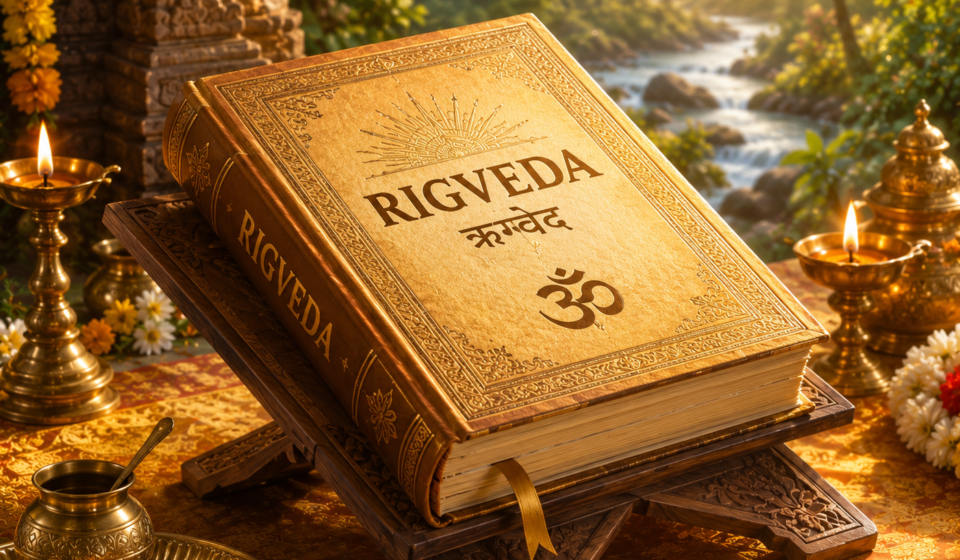
The Rigveda is a collection of 1,028 hymns, called suktas, containing a little over ten and a half thousand verses. The name joins two words: ric, a verse of praise, and veda, knowledge. It is therefore the knowledge of the verses, the great anthology of praise poetry addressed to the gods of the early Indo Aryan tribes who lived in the land of the seven rivers, the Sapta Sindhu, corresponding broadly to the Punjab and its surroundings. The hymns invoke Indra the storm warrior, Agni the fire who carries offerings to heaven, Soma the deified ritual drink, Varuna the guardian of cosmic order, Ushas the radiant dawn, and dozens of others.
The ten mandalas
The collection is arranged in ten books called mandalas, or circles. The arrangement tells its own story. Mandalas two through seven are the family books, each preserved by a single priestly lineage: the houses of Gritsamada, Vishvamitra, Vamadeva, Atri, Bharadvaja and Vasishtha. These are the oldest core of the text. The first and tenth mandalas are later additions, larger and more miscellaneous, and the tenth in particular opens onto new worlds of thought. The ninth mandala is unique, devoted entirely to Soma Pavamana, the purified soma, its hymns meant to accompany the pressing and straining of the sacred drink.
The poets of the Rigveda were not anonymous. The tradition remembers their names and families, and among them are women, the rishikas, such as Lopamudra, Ghosha and Apala. The hymns themselves are works of high verbal art, built in precise metres such as the gayatri, tristubh and jagati, dense with wordplay, riddle and image. This is not primitive babbling but a sophisticated court poetry of praise, composed by professionals competing for the patronage of chieftains, and it preserves in passing an entire world: cattle raids and chariot races, rivers in flood, dice games that ruin men, and the famous Battle of the Ten Kings on the river Parushni, the earliest war in Indian memory.
From praise to philosophy
Had the Rigveda been only praise poetry it would still be precious. What makes it inexhaustible is the turn it takes in its tenth mandala, where the poets begin to ask questions no one had asked in quite that way before. The Nasadiya Sukta, the hymn of creation, wonders what existed before existence and non existence, and ends with the astonishing admission that perhaps even the highest god does not know how the world arose. The Purusha Sukta describes the cosmos as the body of a primal being, and contains the earliest reference to the four social orders. The funeral hymns, the wedding hymn, the gambler’s lament, the dialogue of Yama and Yami, all open windows into a mind discovering itself.
The text was fixed with a rigour unmatched in the ancient world. The padapatha, a word by word analysis attributed to Shakalya, dissected every verse so that the tradition could check itself, and elaborate recitation patterns locked the syllables in place. When European scholars in the nineteenth century, led by Max Muller, finally printed the Rigveda, they found that manuscripts and reciters separated by a thousand miles agreed with one another almost perfectly. The transmission had worked.
For the later tradition, the Rigveda became the fountainhead. Its verses were rearranged into the Samaveda for singing and drawn upon by the Yajurveda for sacrifice. Its gods evolved, merged and gave way to Shiva and Vishnu, yet its mantras remained the sound of sanctity itself. Every sacred thread ceremony, every fire ritual, every recitation of the Gayatri, that verse of the poet Vishvamitra from the third mandala, renews a chain of sound stretching back some three and a half thousand years. The Rigveda is not a document of Indian civilisation. It is the moment Indian civilisation began to speak.
The Four Vedas
Part 2 of 10 in this chapter.