
 In 30 Seconds



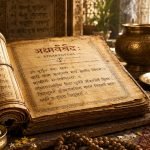
Every medical tradition begins somewhere, and Indian medicine begins in song. Centuries before Charaka wrote of humours and Sushruta of surgery, the healers of the Vedic age stood over their patients and chanted, and the chants they used are preserved in the Atharvaveda. The classical physicians themselves acknowledged the debt. Ayurveda, the science of life, is counted as the upaveda, the auxiliary knowledge, of the Atharvaveda, and the Charaka Samhita instructs the physician to declare his allegiance to the Atharvan tradition, for the Atharvaveda, it says, deals with the curing of disease. This article follows that road from charm to clinic.
The enemy called takman
The most vivid medical portrait in the Atharvaveda is of takman, the fever demon, almost certainly the malaria that arrived with the monsoon. The hymns describe it with clinical precision wrapped in poetry: the fever that comes on alternate days or every third day, the fever that makes the patient now burning hot, now shivering cold, yellow eyed and trembling. The charms beg it to depart, to seek other lands, and they pair it with its brothers cough and its sister balasa, perhaps consumption. Around takman gathers a whole nosology in embryo: jaundice, sent away into yellow parrots and the yellow sun while the patient receives the red of healthy cows; worms, visible and invisible, crushed by the charm as by a millstone; wounds and fractures, over which the healer sings, let marrow join marrow, let bone grow with bone, flesh with flesh, skin with skin, a verse that is effectively the first Indian description of the healing process.
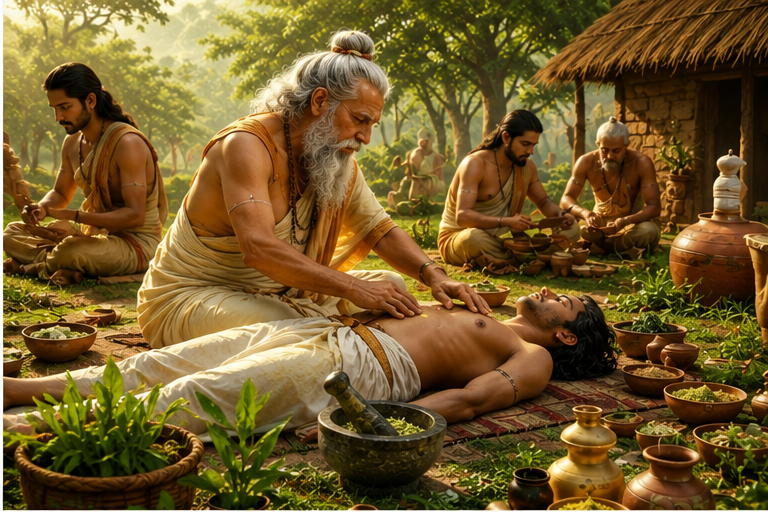
The healer of the Atharvaveda was not working with words alone. The hymns constantly invoke plants, and some can be identified. The kushtha herb, praised as the remedy for takman, is generally taken to be costus, brought from the high mountains; jangida, worn as an amulet against every ailment, was a cultivated protective plant; apamarga, the ritual cleanser, remains in ayurvedic use today. One entire hymn is a hymn to the plants collectively, addressing them as mothers and as goddesses, hundred formed, and declaring that the physician who knows them defeats disease. Water and fire complete the pharmacy: the waters are called the great healers, medicine for everything, and their praise flows straight into later Indian ideas of therapeutic bathing and purity.
From sacred charm to systematic science
What separates the Atharvavedic healer from the classical vaidya is theory. The charms know symptoms and remedies but explain disease as demons, sin or sorcery; classical Ayurveda would replace the demons with the three doshas, the bodily humours of wind, bile and phlegm, and build upon them a rational system of diagnosis, diet and treatment. Yet the continuity is everywhere. The Atharvaveda already gropes toward anatomy, counting the bones of man in a hymn that arrives at a figure close to the classical count, and its interest in breath, prana, as the carrier of life becomes a foundation of all later Indian physiology and yoga. Its amulets and its herbs pass into the ayurvedic pharmacopoeia, its blessings survive in the rites that still accompany Indian medicine, and its fundamental stance, that healing addresses the whole person, body, mind and circumstance together, remains the self declared ideal of Ayurveda now.
The historians of medicine draw the line simply. In the Atharvaveda, Indian medicine is magico religious; in Charaka and Sushruta it becomes empirical and rational; but the second grew inside the first, as the physician slowly separated from the priest. One can watch the separation beginning in the texts themselves, where the healer is already a specialist, the man of the herbs, called to the bedside for his knowledge. It took perhaps a thousand years for that figure to become the trained physician of the classical age, examining the patient, prescribing the diet, wielding the scalpel. But when he arrived, he did not disown his ancestor. He called his science the limb of the Atharvaveda, and in doing so he told the truth: the oldest voice of Indian medicine is a chant against fever, sung in the rains, three thousand years ago.
It is worth adding that the debt runs in both directions. Modern historians of medicine read the Atharvaveda for the earliest Indian evidence of disease itself, of malaria in the river plains, of epidemics and their seasons, and modern Ayurveda returns to its verses in search of forgotten plants. The old fever charms, in other words, are still working, no longer as spells but as sources, which is perhaps the most honourable retirement any medicine can hope for.
The Four Vedas
Part 9 of 10 in this chapter.