 In 30 Seconds




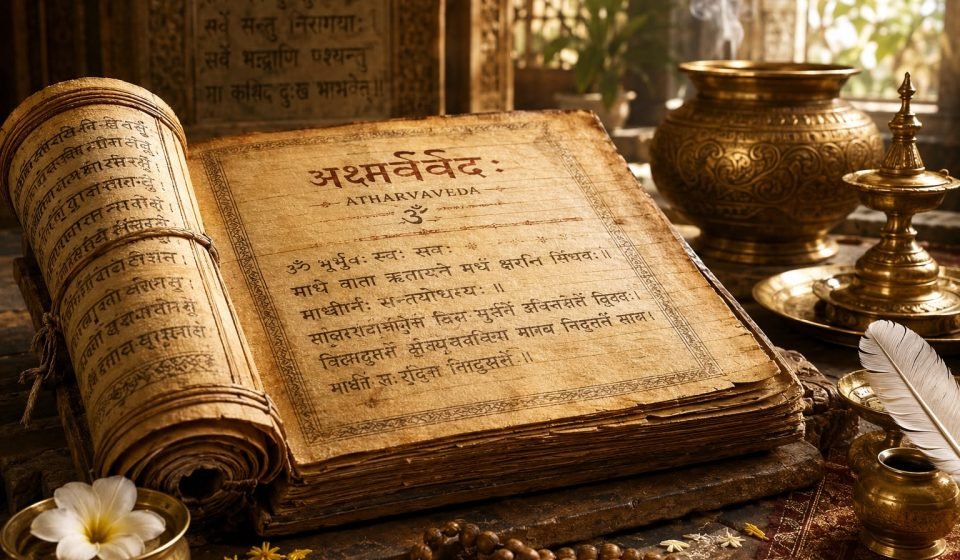
The first three Vedas look upward, toward the gods and the great public sacrifice. The fourth looks around, at the village, the household, the sickbed, the field, the marriage bed and the throne. The Atharvaveda is the Veda of everyday life, and precisely because of that it is the most startlingly human document of the ancient world. In its pages people are afraid of fever and snakebite, jealous of rivals, anxious for children, desperate for love, ambitious for power, and they reach for the tools their culture gave them: the charm, the herb, the amulet and the spoken word.
The collection takes its name from Atharvan, an ancient fire priest, and is associated also with the sage Angiras; its older name, Atharvangirasa, joins the two, and the tradition sometimes read into the pairing the two faces of the text, the healing charms of Atharvan and the sharper sorceries of Angiras. It contains around six thousand verses in twenty books, roughly a sixth of them shared with the Rigveda, the rest its own. Two recensions survive: the Shaunaka, the standard text, and the Paippalada, preserved remarkably in Odisha and in a famous birch bark manuscript from Kashmir.
Medicine, marriage and the king
The healing hymns are the glory of the Atharvaveda. Here are charms against fever, the takman that comes with the rains, against jaundice, which the poet transfers to yellow birds and the yellow sun, against cough, worms, wounds and poison. The remedies name herbs and waters, and the physician appears as a figure with his bag of plants. The later tradition drew the natural conclusion and attached Ayurveda, the science of life, to the Atharvaveda as its upaveda. Indian medicine, which would flower into the great compendia of Charaka and Sushruta, traces its lineage to these verses sung over the sick three thousand years ago.
Around the sickbed spreads the whole of life. There are wedding hymns, adapting and expanding the marriage hymn of the Rigveda, and funeral hymns. There are charms for a safe pregnancy and the birth of sons, for harmony in the household, for luck in dice, for the growth of barley, for the safety of cattle and the success of merchants setting out with their caravans. There are love charms of frank intensity, and their darker twins, spells against rivals. And there is politics. The Atharvaveda is the most royal of the Vedas, rich in hymns for the consecration of the king, for victory in battle, for the restoration of an exiled ruler, and the royal chaplain, the purohita, was ideally an Atharvavedin, for this Veda held the arts of protection and the arts of harm. Later statecraft remembered; Kautilya’s Arthashastra prescribes Atharvan rites among the instruments of the state.
From spells to the highest philosophy
It would be easy to stop at the charms and call the Atharvaveda a book of folk magic, and for a long time European scholarship did. But the same collection contains speculative hymns of the first rank. The hymn to the earth, the Prithvi Sukta, sixty three verses of tenderness toward the land that bears all peoples, is the earliest environmental poetry in the world: whatever I dig from you, earth, may it grow back again, may I not pierce your vitals or your heart. The hymns to Kala, time, make time itself the first god, and the skambha hymns seek the pillar that supports all worlds. The Veda that dealt with breath and body pressed naturally toward the breath of the cosmos.
Fittingly, three of the most important Upanishads belong to the Atharvaveda: the Mundaka, source of the national motto satyameva jayate, truth alone triumphs; the Prashna, the book of six questions; and the Mandukya, the shortest and perhaps deepest of all, twelve verses on Om and the four states of consciousness. The Veda of the village healer thus carries the summit of Indian metaphysics. That is the paradox and the charm of the Atharvaveda: it never chose between the body and the spirit, between the fever charm and the absolute. It treated the whole human being, and it remains the best single window we possess into how the people of the Vedic age, not only its priests, actually lived, feared, loved and hoped.
The Four Vedas
Part 8 of 10 in this chapter.