 In 30 Seconds




Of all the skills of the Vedic age, none was more demanding than that of the udgatri, the singer priest of the Samaveda. The hotri recited verses he had memorised; the adhvaryu performed actions he had rehearsed; but the udgatri had to hold in his head not only thousands of verses but thousands of melodies attached to them, together with the rules for fitting one to the other, and he had to sing them faultlessly at the centre of rituals on which, the texts insist, the welfare of the patron and the order of the cosmos depended. This article looks at how that singing actually worked.
The five limbs of the chant
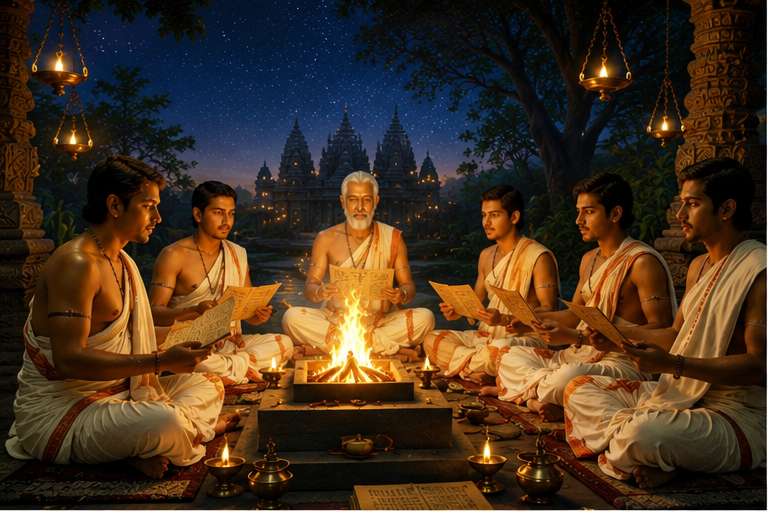
A saman in full performance was a structured composition with named parts, sung by three specialists of the Samaveda: the udgatri, chief singer, the prastotri who intoned the opening, and the pratihartri who took up the response. The classical texts describe the chant in five limbs. The prastava, the prelude, was begun by the prastotri with the sacred hum. The udgitha, the high chant and heart of the saman, belonged to the udgatri and began with Om. The pratihara, the response, was seized by the pratihartri; the upadrava followed from the udgatri; and the nidhana, the finale, was sung by all three together. The Chandogya Upanishad builds meditation upon meditation on these five limbs, mapping them onto the sun’s course, the breath, the worlds, so that the structure of the song became a map of the universe.
Within the chant, the plain words of the Rigvedic verse underwent systematic transformation. Vowels were stretched over many notes, consonant clusters were broken open, syllables were repeated, and into the stream were dropped the stobhas, the pure song syllables, hau hau hau, bha, om, ida, that fill out the melody. Some samans consist of little more than stobhas, verse dissolved entirely into sound. The tradition preserved the recipes exactly: which verse, sung to which melody, with which modifications, at which moment of which sacrifice. Nothing was improvised. The freedom of Indian music came later; the Samaveda is the discipline that made it possible.
Schools, notation and survival
The Puranas claim the Samaveda once had a thousand schools. Three survive. The Kauthuma school, the most widespread, flourishes in Gujarat, Tamil Nadu and Varanasi; the Ranayaniya, closely related, in Maharashtra and Karnataka; and the Jaiminiya, the most archaic and most precious, in small pockets of Kerala and Tamil Nadu. The Jaiminiya singing of the Nambudiri brahmins of Kerala is regarded by scholars as perhaps the oldest continuously performed music in the world, its melodies unlike anything else surviving, and it stands today on the edge of extinction, maintained by a handful of families.
Each school developed notation. Kauthuma manuscripts mark the chant with numerals one to five above the syllables, tracing the descent of the melody; other traditions used syllable letters or, in Kerala, hand gestures and head movements taught from father to son, the body itself serving as the score. Alongside notation grew a full science of song: treatises on the correct production of each note, the seven svaras and their deities, the faults of a singer and the virtues of a voice. Long before India wrote treatises on secular music, the Samavedins had created musicology.
Why such labour over melody? Because for the Vedic mind the saman was not decoration but power. The Brahmanas say that the gods conquered heaven by the chant, and that the saman is the essence squeezed from the verse as butter from milk. Correct song sustained the ritual, and the ritual sustained the world. One may take the metaphysics or leave it, but the historical result is beyond argument: a civilisation that treated exact melody as a sacred duty preserved its music across three millennia without recording devices, and anyone who has stood in a Kerala courtyard at dawn while three old men sing syllables their ancestors sang before the Buddha was born knows that the achievement is not merely technical. It is one of the great acts of fidelity in human history.
That fidelity now needs help. Scholars estimate that the Jaiminiya tradition rests on fewer active singers than a village cricket team, and every year the number falls. Documentation projects, temple endowments and a small number of dedicated students are all that stand between the oldest music in the world and silence. Whoever cares for Indian heritage should know these names, Kauthuma, Ranayaniya, Jaiminiya, while all three can still be heard.
The Four Vedas
Part 7 of 10 in this chapter.