
 In 30 Seconds




Story
Rivers meet everywhere on earth, and nowhere else does the meeting mean what it means here. At the eastern edge of Prayagraj, the brown Ganga and the green Yamuna flow into each other in a broad, shifting seam of water, and the tradition adds a third partner, the Saraswati, the vanished river of the Vedas, flowing invisibly beneath. This is the Sangam, the Triveni, the confluence of three, and for something on the order of three thousand years human beings have been walking, riding, sailing, and now flying across the subcontinent for the specific purpose of standing in it.
The tradition ranks the place without embarrassment. Prayag is tirtharaja, the king of pilgrimage sites, the sacrifice ground where, the Puranas say, Brahma himself performed the first offering, which is what the name records, the place of the prayaga, the great sacrifice. The Mahabharata already recommends the bath at the confluence, and the seventh century Chinese pilgrim Xuanzang left an eyewitness account of the emperor Harsha’s colossal giving ceremonies on these sands, where the ruler of North India periodically distributed the entire contents of his treasury. The site’s essential ritual has not changed in the interval. One enters the water where the rivers join, preferably at dawn, and the tradition holds that the bath dissolves the accumulated weight of wrongdoing, a promise that ordinary people have found worth a journey of a thousand miles for a hundred generations.
Beside the water stands the Akshayavat, the indestructible banyan, the tree that the tradition says survives even the dissolution of the cosmos, and around these anchors grew the pilgrimage city, its pandas keeping genealogical registers in which families can trace their visiting ancestors across centuries, a parallel archive of the Indian people maintained on the riverbank.
Empire, as ever in Uttar Pradesh, planted itself squarely on the sacred site. Akbar, recognising the confluence’s strategic command of the river routes, built one of his greatest forts directly above the Sangam in the 1580s and founded the city he called Ilahabas, which time smoothed into Allahabad. The Mughal city and the pilgrim city lived braided together for four centuries, and it says something about the place that the fort’s walls enclose the Akshayavat itself, with pilgrim access negotiated across every regime from the Mughals through the British and the republic to the present.
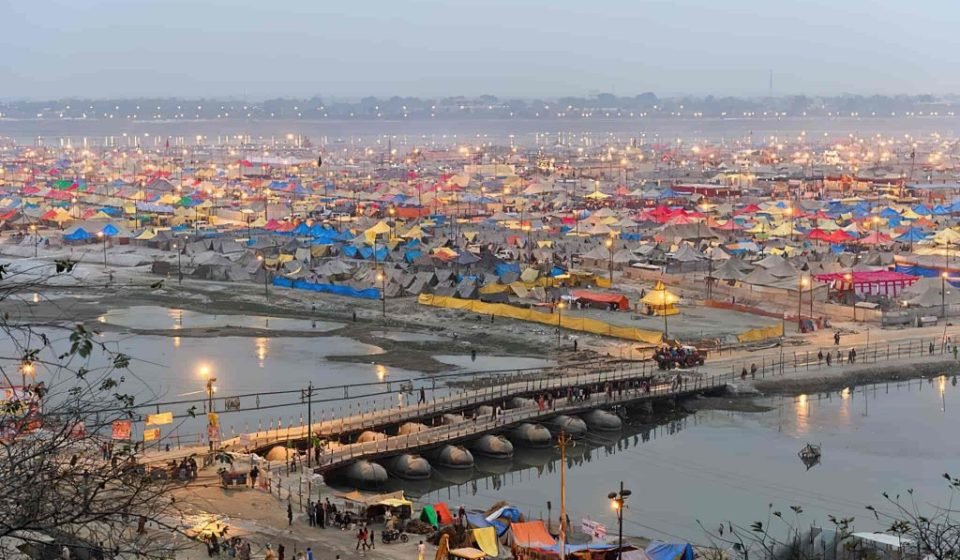
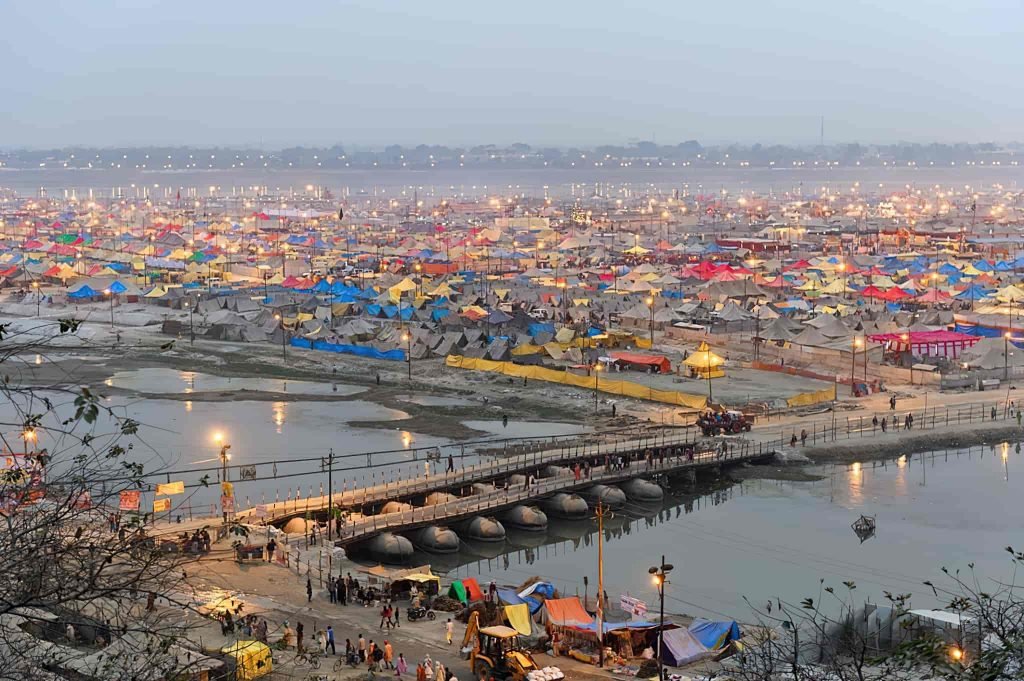
The annual rhythm of the place is the Magh Mela, held each winter in the month of Magha, when a temporary township of tents rises on the floodplain and lakhs of kalpavasis, the ones who vow the full month, settle by the water to live in austerity, bathe daily, and hear discourses. The Magh Mela is the confluence’s ordinary heartbeat, and its extraordinary one, the Kumbh, when the gathering swells from lakhs into crores and becomes the largest assembly of human beings on the planet, receives the closing article of this batch in full.
Around the sacred city, the colonial and national city grew into a capital of consequence, seat of the Allahabad High Court, the university once called the Oxford of the East, and the Anand Bhavan household that supplied the republic its first family, matters this series treats in their own articles. For a century the city held a double eminence, the holiest water and the sharpest lawyers in North India within a single municipality, and its renaming to Prayagraj in 2018, restoring the old sacred name to the whole city, belongs to the politics of memory examined later in the series. What is worth noting here is that the pilgrim never needed the notification. On the riverbank, the place had never been called anything but Prayag.
What distinguishes the confluence among the world’s holy places is its radical openness. There is no idol here, no sanctum, no priesthood that can bar the door, because there is no door. The object of veneration is moving water, available to every caste, every faith, every degree of wealth, and the ritual is the simplest the species knows, immersion. Perhaps that is why the gathering here became the largest on earth. The Sangam asks nothing of the pilgrim but arrival.
The rivers, meanwhile, keep their own counsel. The Ganga arrives thinner than she should, the Yamuna dirtier, and the engineering of barrages upstream now determines the depth of the world’s holiest bath, a dependence of the eternal on the administrative that is, as this series keeps finding, the permanent condition of Uttar Pradesh. The confluence gathers humanity. Humanity, in turn, must now keep the confluence alive.