 In 30 Seconds




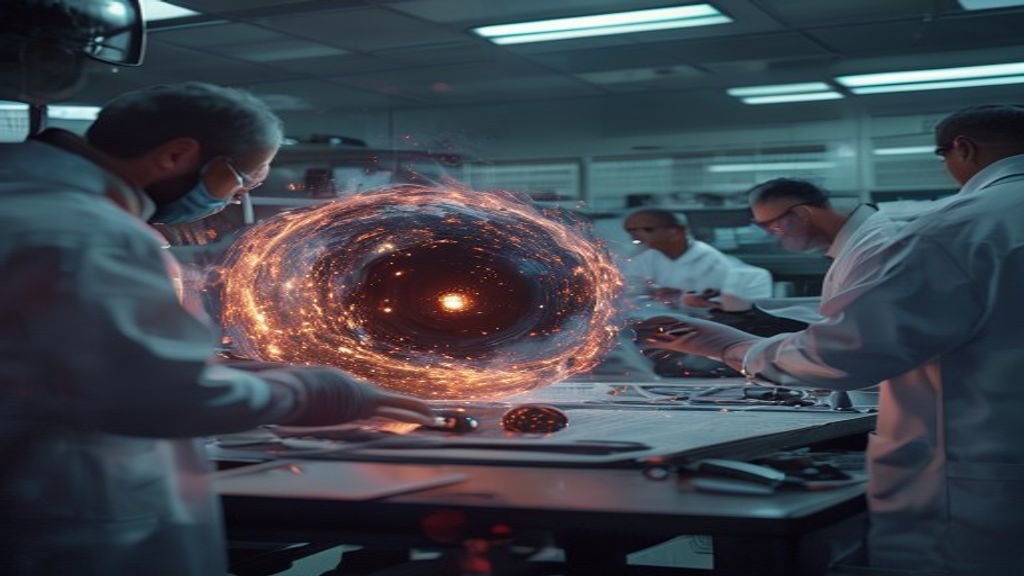
Scientists have recently achieved a groundbreaking feat in experimental physics, successfully creating a system that mimics a black hole’s energy extraction capabilities within a controlled laboratory environment. This significant development, spearheaded by researchers at CUNY ASRC, not only demonstrates a novel approach to energy systems but also provides compelling experimental validation for a theoretical concept proposed over fifty years ago by the eminent physicist Sir Roger Penrose. According to reports, this intricate setup managed to recreate the Penrose process, a method for extracting energy from rotating black holes, marking a pivotal moment in our understanding of these cosmic phenomena. The innovation involved generating what is described as a black hole like energy system, importantly achieving this without any physical movement of components, relying instead on ingenious techniques like synthetic rotation to amplify waves. This pioneering work brings a long standing astrophysical theory from the realm of abstract mathematics into tangible experimental reality, promising profound implications for both fundamental physics and potential future technologies.
Background
The theoretical underpinnings of this recent experimental breakthrough trace back to 1969, when the visionary British mathematician and physicist Sir Roger Penrose first put forth his remarkable hypothesis regarding energy extraction from black holes. Penrose’s theory, often referred to as the Penrose process, posited that it might be possible to glean energy from a rotating black hole. This process theoretically involves an object entering a specific region around a rotating black hole, known as the ergosphere, and then splitting into two parts. One part would fall into the black hole, while the other would escape with more energy than the original object possessed. The additional energy would essentially be borrowed from the black hole’s rotational energy. For decades, this elegant concept remained purely theoretical, a fascinating thought experiment without any direct observational or experimental proof. The immense gravitational forces and extreme conditions associated with actual black holes made any attempt at direct verification seemingly impossible. Despite the absence of empirical evidence, Penrose’s theory became a cornerstone of black hole physics, offering profound insights into the mechanics of these enigmatic cosmic giants and the potential for their energy to be harnessed, even if only theoretically. The sheer difficulty of simulating such an extreme environment in a terrestrial laboratory posed an enormous challenge, making the recent achievement all the more extraordinary.
Timeline of Events
On July 12, 2026, the world received news of a profound scientific achievement, as reports emerged detailing the successful creation of a black hole like energy system in a laboratory. This pivotal announcement, first circulated at approximately 7:31 PM, highlighted the collaborative efforts of scientists, particularly those affiliated with CUNY ASRC. The core of this revelation was the successful recreation of black hole energy extraction, an experimental validation that simultaneously confirmed Sir Roger Penrose’s theoretical predictions from 1969. The reporting of this story marked the public unveiling of a breakthrough that brought a long standing astrophysical theory into the realm of tangible experimental proof, signaling a new chapter in the study of black holes and energy systems.
Why It Matters
The successful experimental validation of the Penrose process carries immense significance across several domains of scientific inquiry. Foremost, it serves as a powerful testament to the enduring accuracy and predictive power of theoretical physics, affirming a concept that has captivated scientists for over half a century. To take a complex astrophysical phenomenon like energy extraction from a rotating black hole and replicate its fundamental principles in a lab, even in an analogue system, is a monumental intellectual and engineering triumph. This achievement deepens our understanding of black hole mechanics and the general theory of relativity, providing empirical grounding for previously abstract ideas.
Furthermore, the method employed in this experiment, utilizing synthetic rotation to amplify waves without any physical movement, opens up entirely new avenues for research into energy systems. The ingenuity of creating a system that behaves like a black hole’s ergosphere, yet is entirely controllable and terrestrial, showcases advanced experimental design. It could inspire novel approaches to energy generation or manipulation, though any practical applications remain far in the future and highly speculative.
Beyond potential technological spin offs, the discovery reignites curiosity about the universe’s most mysterious objects. It demonstrates that even the most extreme cosmic phenomena might have their underlying principles replicated and studied in controlled environments, allowing physicists to probe fundamental questions about gravity, spacetime, and energy in ways previously unimaginable. The validation also underscores the importance of interdisciplinary research, bridging theoretical astrophysics with experimental condensed matter physics.
What Could Happen Next
The successful demonstration of a black hole like energy extraction in a laboratory setting paves the way for a cascade of future scientific endeavors. Immediate next steps will likely involve further refinement and exploration of the experimental setup. Scientists will undoubtedly seek to enhance the efficiency of the energy extraction process within these analogue systems, pushing the boundaries of what is possible with synthetic rotation and wave amplification. This could involve exploring different materials, configurations, or parameters to optimize the system’s performance and gather more detailed data.
Beyond improving the current experimental model, this breakthrough could inspire the development of new types of laboratory analogues for other extreme astrophysical phenomena. Researchers might investigate how similar principles could be applied to study other aspects of black hole physics, such as Hawking radiation or the behavior of matter near event horizons, all within controlled environments.
On a theoretical front, the experimental validation will spur new theoretical work. Physicists will likely develop more sophisticated models of the Penrose process, incorporating the insights gained from the lab experiment. This interplay between experiment and theory is crucial for advancing scientific understanding.
While any direct application for energy generation is highly futuristic, the underlying principles of energy extraction from non moving systems could have long term implications for energy science. Research might explore how these concepts could one day contribute to developing more efficient energy harvesting or amplification technologies, albeit through indirect pathways and after many years of fundamental research. The discovery serves as a catalyst, propelling both theoretical and experimental physics into exciting new territories.
Frequently Asked Questions
What is the Penrose process?
The Penrose process is a theoretical mechanism, proposed by Sir Roger Penrose in 1969, for extracting energy from a rotating black hole. It posits that energy can be drawn from the black hole’s rotational energy by sending an object into its ergosphere, a region where spacetime itself is dragged around by the black hole. The object would then split, with one part falling in and the other escaping with increased energy.
How was this black hole like system created in the lab?
Scientists at CUNY ASRC created this system without physically moving anything. They used a technique involving “synthetic rotation” to create an environment that mimics the conditions around a rotating black hole. This allowed them to amplify waves, effectively recreating the energy extraction process predicted by Penrose’s theory in a controlled laboratory setting.
What is the significance of this discovery?
This discovery is highly significant because it provides the first experimental validation of Sir Roger Penrose’s 1969 theory of energy extraction from black holes. It confirms a long standing theoretical concept, deepening our understanding of black hole physics and general relativity. Furthermore, it demonstrates a novel approach to creating energy systems using synthetic rotation, potentially opening new avenues for future research in energy and fundamental physics.