
 In 30 Seconds




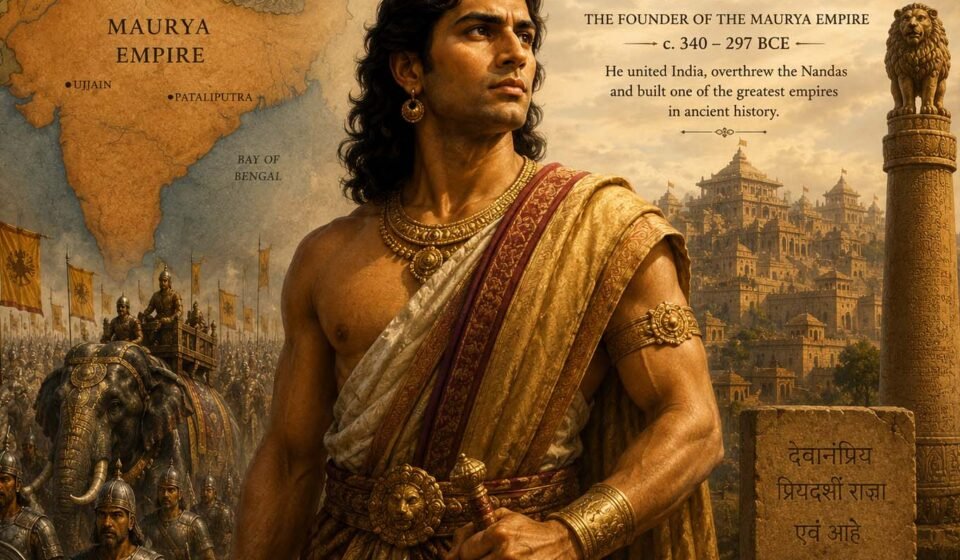
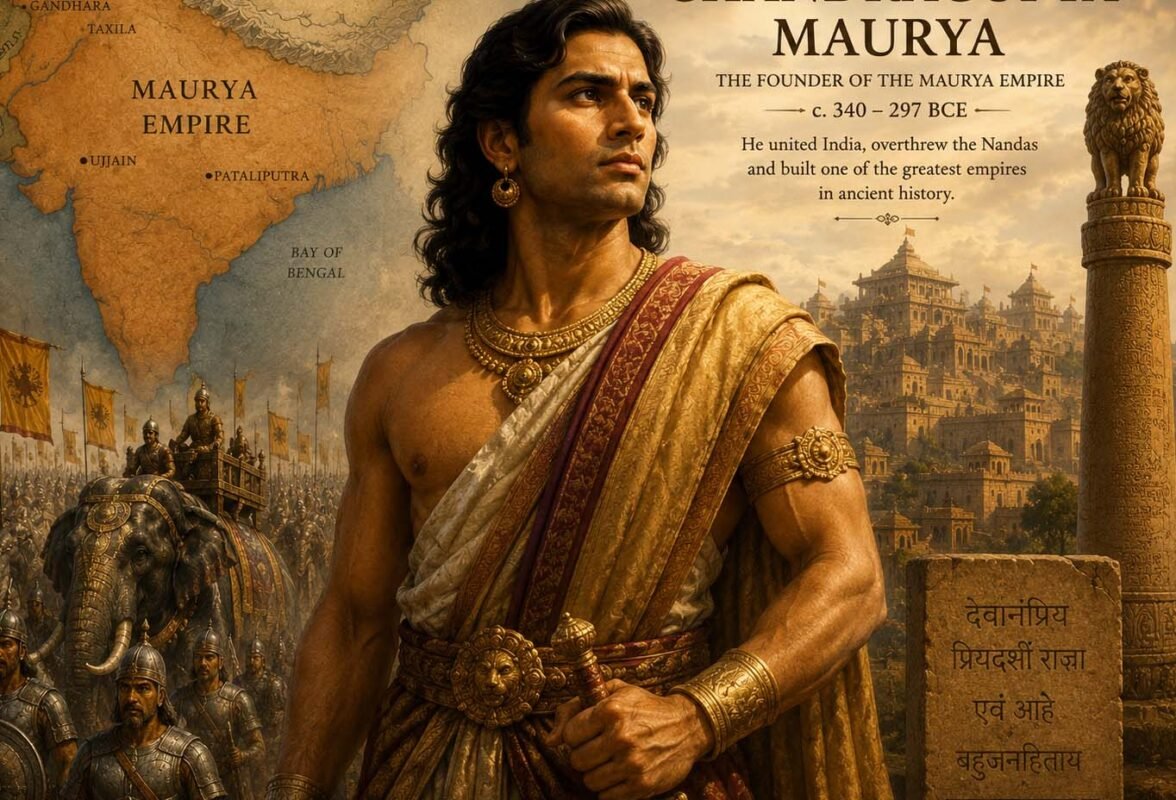
Few figures in ancient Indian history embody the sheer power of ambition and strategic brilliance quite like Chandragupta Maurya. Born around 340 BCE into circumstances that remain debated among historians, some accounts suggesting humble origins and others linking him to a minor royal lineage, Chandragupta rose from relative obscurity to found the Mauryan Empire, the first political entity to unify nearly the entire Indian subcontinent under a single centralized authority.
The world Chandragupta entered was one of political fragmentation and opportunity. Northern India was dominated by the Nanda dynasty, ruling from the powerful city of Pataliputra in Magadha, but the Nandas had grown deeply unpopular due to heavy taxation and what many contemporary accounts describe as oppressive governance. Meanwhile, in the northwest, Alexander the Great’s invasion of the Indian subcontinent in 326 BCE had shattered existing regional power structures, leaving a patchwork of weakened satrapies and local rulers in its wake after Alexander’s forces withdrew.
It was in this environment of upheaval that Chandragupta crossed paths with a figure whose brilliance would prove just as consequential as his own, the scholar and political strategist known as Chanakya, also called Kautilya. According to tradition, Chanakya had been humiliated by the Nanda king and swore revenge, seeking out a capable young leader through whom he could topple the dynasty. Finding Chandragupta, whether as a gifted young warrior or a promising student, Chanakya became his mentor, tutor and chief strategist, guiding him through years of careful preparation before launching a campaign against the Nandas.
The conquest of Magadha was not accomplished through a single decisive battle but through a patient, multi pronged strategy of building alliances, weakening Nanda authority through subversion and gradually assembling a military force capable of taking Pataliputra itself. By around 321 BCE, Chandragupta had successfully overthrown the Nanda dynasty and installed himself as ruler of Magadha, immediately inheriting one of the most powerful and wealthy states in the subcontinent as the foundation for further expansion.
Chandragupta’s ambitions did not stop at Magadha. He turned his attention to the northwest, where the successors of Alexander the Great still held territory. In a series of campaigns, Chandragupta confronted Seleucus Nicator, one of Alexander’s most capable generals who had inherited the eastern portion of his empire. The resulting conflict ended not in prolonged warfare but in a negotiated settlement around 305 BCE, through which Chandragupta gained control of vast territories including much of what is now Afghanistan, in exchange for five hundred war elephants that Seleucus would later use in his own campaigns in the west. This treaty was sealed with a marriage alliance, and Seleucus even sent an ambassador, Megasthenes, to the Mauryan court, whose written observations remain one of our most valuable sources for understanding Mauryan society.
Under Chandragupta’s rule, the Mauryan Empire developed a sophisticated administrative system, heavily influenced by the political philosophy Chanakya articulated in his treatise, the Arthashastra. This remarkable text laid out detailed principles of statecraft, economics, espionage and law, describing a highly centralized bureaucracy with officials overseeing taxation, trade, agriculture and public works across the vast empire.
Toward the end of his life, according to Jain tradition, Chandragupta abdicated his throne to his son Bindusara and became an ascetic, eventually traveling south to Shravanabelagola in modern Karnataka, where he is said to have practiced fasting unto death in accordance with Jain religious principles. Whether every detail of this account is historically verifiable remains debated, but it adds a poignant final chapter to the story of a man who rose from uncertain beginnings to build an empire, only to ultimately renounce worldly power in pursuit of spiritual liberation. His legacy, however, endured far beyond his own lifetime, laying the foundation upon which his grandson Ashoka would build one of the most celebrated reigns in all of ancient world history.
Related Reading
- After Ashoka: The Slow Twilight of the Mauryan Dynasty
- The Aryan Question: What Genetics Now Tells Us
- Vedic Society: Caste, Family and Faith in Early India
Official context: Readers can compare this story with public information from Archaeological Survey of India.
Ancient India - Batch 1
Part 8 of 20 in this chapter.