 In 30 Seconds




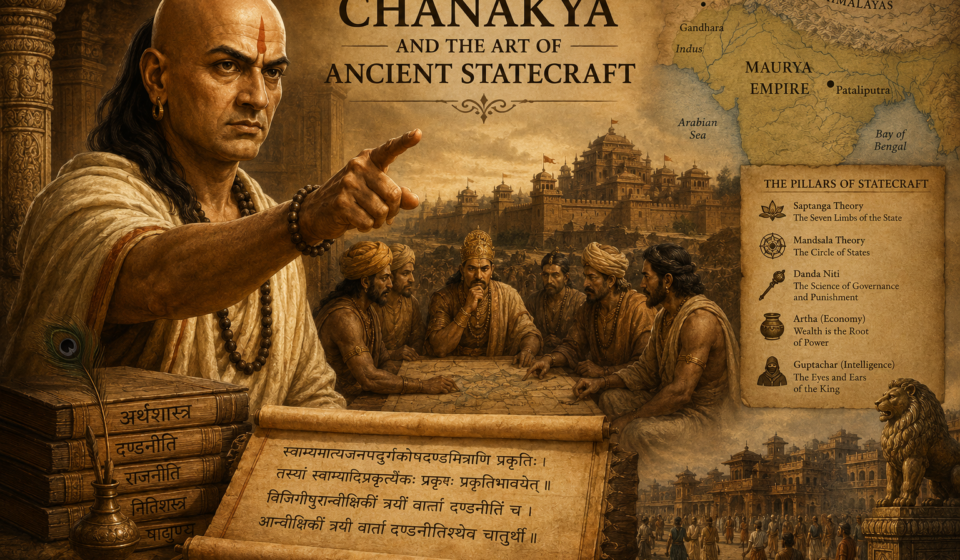
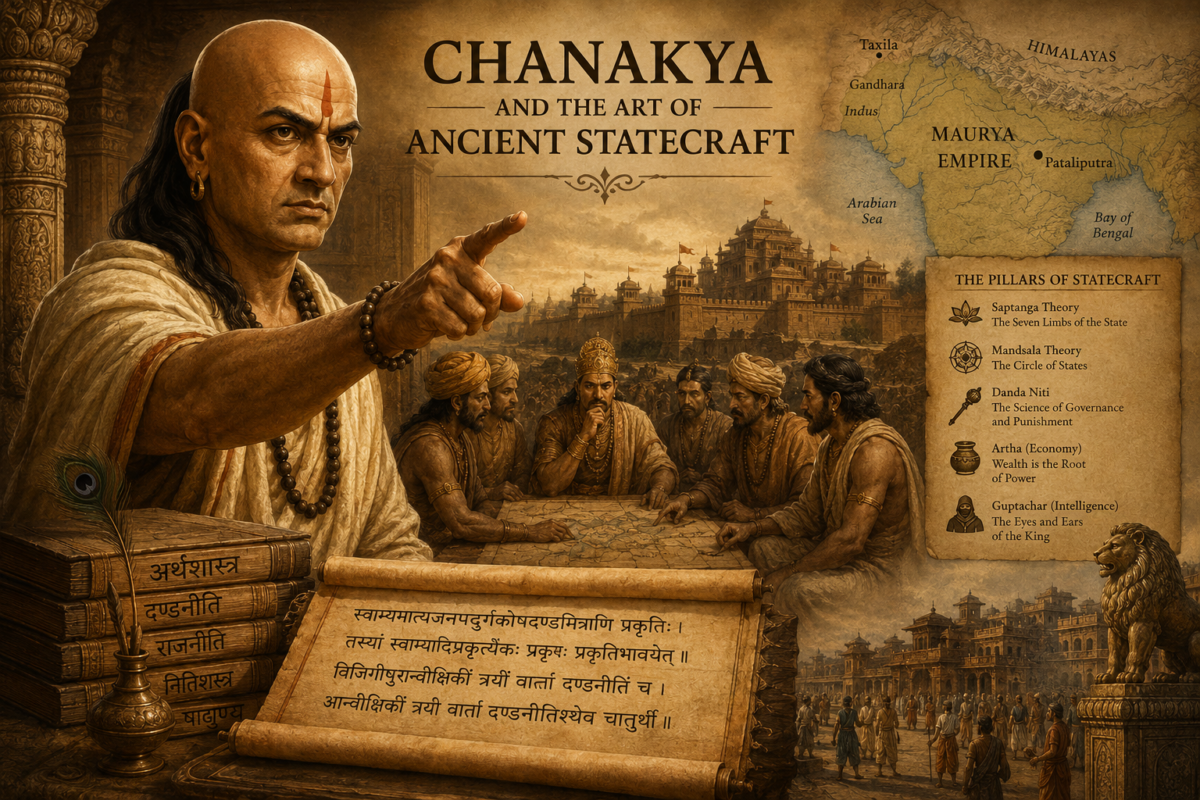
Long before Machiavelli put quill to parchment in Renaissance Italy, a scholar in ancient India had already composed a treatise on power so comprehensive, so unflinchingly practical, that it continues to be studied by political scientists, business strategists and historians today. His name was Chanakya, also known as Kautilya or Vishnugupta, and his masterwork, the Arthashastra, remains one of the most remarkable documents to survive from the ancient world.
Chanakya’s origins are wrapped in legend as much as history. Traditional accounts describe him as a Brahmin scholar teaching at the ancient university of Takshashila, renowned throughout the region for its rigorous education in subjects ranging from medicine to military strategy. According to popular narratives, Chanakya was deeply insulted by the ruling Nanda king of Magadha, and swore that he would not tie his hair back into its customary knot until the Nanda dynasty had been destroyed. This personal vendetta, whether entirely factual or embellished by centuries of storytelling, set in motion one of the most consequential political partnerships in Indian history, as Chanakya sought out and mentored the young Chandragupta Maurya, guiding him toward the eventual conquest of Magadha and the founding of the Mauryan Empire.
Beyond his role as kingmaker, Chanakya’s enduring legacy rests on the Arthashastra itself, a sprawling text covering statecraft, economics, military strategy, law, diplomacy and administration in extraordinary detail. Unlike many ancient political texts that dwell primarily on moral philosophy, the Arthashastra approaches governance with unsentimental pragmatism. It describes in precise detail how a king should organize taxation, manage agricultural production, regulate markets, maintain a network of spies to monitor both enemies and his own officials, and even how to conduct covert operations against rival states.
The text divides the science of statecraft into distinct domains, addressing everything from the qualities a king should cultivate, including self discipline, patience and decisiveness, to the intricate mechanics of diplomacy, described through a theory of concentric circles of allies and enemies known as the mandala theory. According to this framework, a king’s immediate neighbor is naturally considered a potential rival, while the neighbor beyond that rival becomes a natural ally, a geopolitical logic that echoes remarkably similar reasoning found in modern international relations theory more than two thousand years later.
Chanakya’s treatment of economics was equally sophisticated for its time. The Arthashastra details methods for assessing agricultural yields for taxation purposes, regulating weights and measures, managing state owned industries such as mining and textile production, and even establishing welfare provisions for widows, orphans and the elderly, suggesting a surprisingly comprehensive vision of state responsibility toward its citizens beyond mere revenue extraction.
What makes the Arthashastra particularly striking to modern readers is its candid acknowledgment that political power sometimes requires morally difficult choices. Chanakya writes openly about the use of espionage, misinformation and calculated deception as legitimate tools of statecraft when the security and prosperity of the kingdom are at stake, a perspective that has led some to compare him unfavorably to later political theorists associated with ruthless pragmatism, even as others argue this reflects simply an honest and clear eyed assessment of how power actually operates in the real world.
Chanakya’s influence extended far beyond his own lifetime. The administrative structures he helped design under Chandragupta Maurya provided the institutional backbone for an empire that would eventually be inherited and expanded by Ashoka. Centuries later, Indian rulers, scholars and strategists continued to draw upon Arthashastra principles, and the text experienced a significant revival in the twentieth century after a surviving manuscript was rediscovered and translated, introducing this ancient masterpiece of political thought to a new generation of readers around the world eager to understand how one of history’s earliest architects of empire thought about the enduring puzzle of power.
Related Reading
- After Ashoka: The Slow Twilight of the Mauryan Dynasty
- The Aryan Question: What Genetics Now Tells Us
- Vedic Society: Caste, Family and Faith in Early India
Official context: Readers can compare this story with public information from Archaeological Survey of India.
Ancient India - Batch 1
Part 9 of 20 in this chapter.