
 In 30 Seconds




Few subjects in the study of ancient India provoke as much passion, debate and outright controversy as the question of who the Aryans were and how they came to inhabit the Indian subcontinent. For more than a century, this question has moved between academic journals, colonial administration reports, nationalist rhetoric and modern genetic laboratories, each generation reshaping the story according to its own tools and its own anxieties.
The idea began in the nineteenth century when European philologists noticed striking similarities between Sanskrit and languages like Greek, Latin, Persian and Old Germanic. Words for numbers, family relationships and natural elements shared common roots, leading scholars to propose a shared ancestral language they called Proto Indo European. From this linguistic observation grew a historical theory: that a group of people speaking an early form of this language, who called themselves Aryans, meaning noble ones, migrated from the Central Asian steppes into the Indian subcontinent sometime around 1500 BCE, bringing with them the Sanskrit language, Vedic religious practices and a new social order.
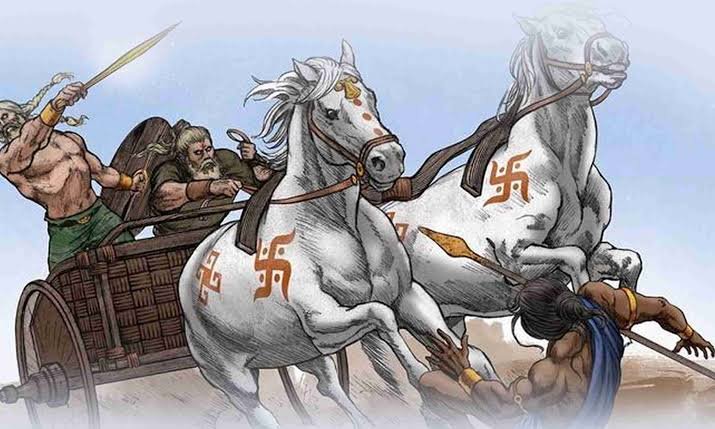
Colonial era scholars, working within the intellectual currents of their time, often framed this movement as an invasion, imagining warlike newcomers on chariots sweeping down and displacing or subjugating the darker skinned inhabitants of the Indus Valley cities. This invasion narrative fit neatly into contemporary European ideas about racial hierarchies and conveniently positioned British colonizers as simply the latest in a long line of foreign rulers bringing civilization to India, a framing many historians today recognize as deeply problematic and politically convenient rather than strictly evidence based.
Modern archaeology and genetics have significantly revised this picture. There is no clear archaeological evidence of a sudden violent invasion coinciding with the decline of the Indus Valley cities. Instead, most contemporary scholars favor a model of gradual migration, occurring over centuries in relatively small groups, involving movement, intermarriage and cultural exchange rather than conquest. Genetic studies published in the past decade have found evidence of steppe ancestry entering the Indian gene pool during roughly the second millennium BCE, blending with populations that already carried ancestry from Iranian farmers and South Asian hunter gatherers. This layered genetic history suggests a far more complex and gradual process than either the old invasion theory or its complete denial would allow.
The debate remains politically charged within India itself. Some scholars and cultural commentators reject any migration theory entirely, arguing instead for an indigenous origin of Sanskrit and Vedic culture entirely within the subcontinent, viewing the migration theory as a colonial construct designed to undermine claims of indigenous civilizational continuity. Others argue that acknowledging migration does not diminish India’s ancient achievements, since the Indus Valley Civilization itself was indigenous and immensely sophisticated, and later Vedic culture represents a genuine synthesis rather than a simple replacement.
What emerges from careful reading of the evidence is a story far richer than either extreme position allows. India’s ancient population history involved multiple waves of movement and mixture over thousands of years, producing one of the most genetically diverse regions on earth. The Vedic hymns themselves, composed over centuries, describe a society in motion, engaging with rivers, cattle, and unfamiliar peoples, suggesting a period of genuine cultural formation rather than a single conquest.
Understanding this history requires patience and comfort with uncertainty rather than the false certainty offered by either colonial invasion narratives or purely nationalist counter narratives. The truth, as is so often the case in ancient history, lies in careful synthesis of genetics, archaeology, linguistics and textual analysis, each contributing a piece to a puzzle that continues to be reassembled with every new discovery.
Related Reading
- After Ashoka: The Slow Twilight of the Mauryan Dynasty
- The Aryan Question: What Genetics Now Tells Us
- Vedic Society: Caste, Family and Faith in Early India
Official context: Readers can compare this story with public information from Archaeological Survey of India.
Ancient India - Batch 1
Part 2 of 20 in this chapter.