
 In 30 Seconds




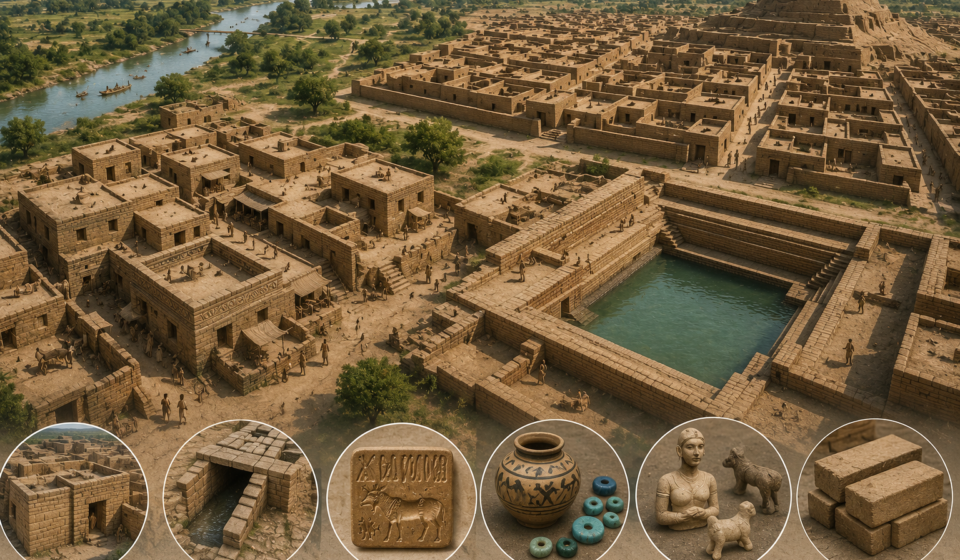
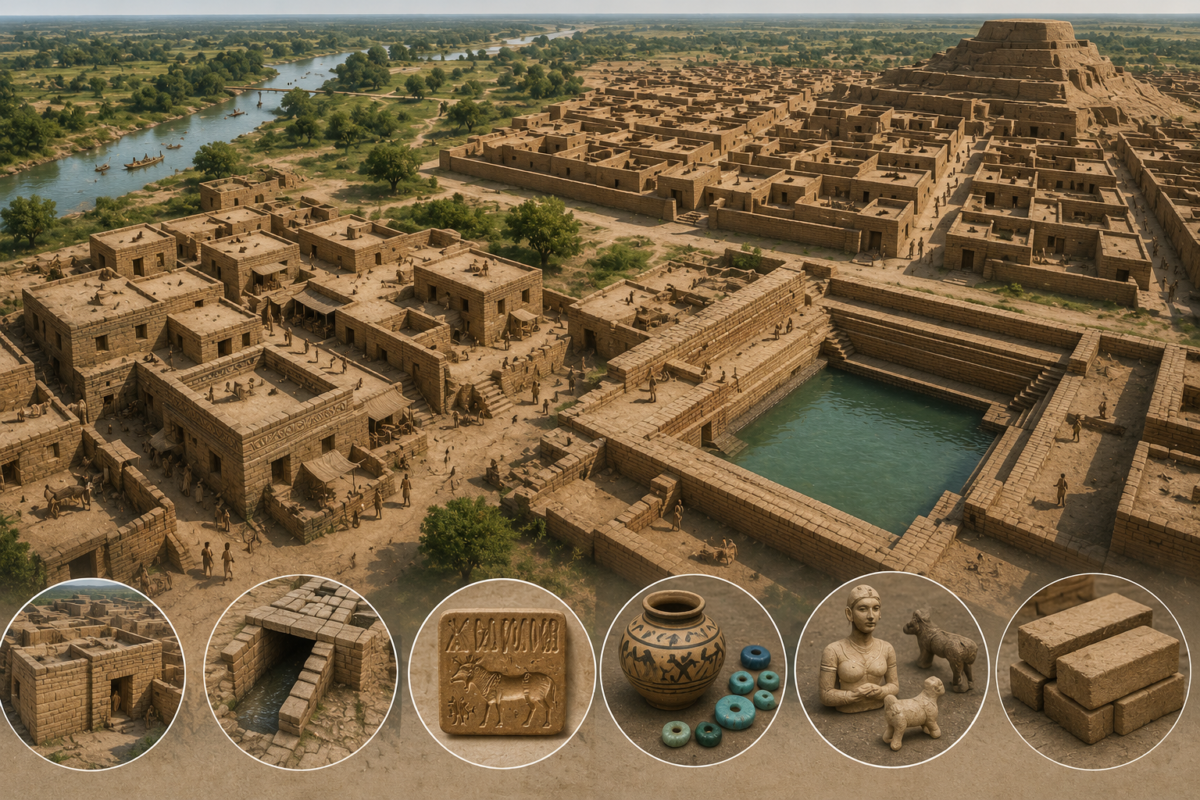
When British engineers laying railway tracks through the Punjab in the nineteenth century stumbled upon ancient bricks scattered across mounds near a village called Harappa, few could have imagined they were standing atop the remains of one of the world’s earliest and most sophisticated urban civilizations. Decades later, excavations at Harappa and its sister city Mohenjodaro, located along the Indus river in present day Pakistan, would reveal cities so advanced in their planning that they continue to astonish engineers and archaeologists alike.
What strikes every visitor to these excavated sites first is the sheer regularity of the design. Streets ran in straight lines, intersecting at near perfect right angles, dividing each city into organized blocks long before the concept of city planning had a name anywhere else in the ancient world. Houses were constructed using kiln fired bricks manufactured to a standardized ratio of four by two by one, a proportion so consistent across sites separated by hundreds of kilometers that it points to shared engineering knowledge transmitted across an enormous cultural network.
Mohenjodaro in particular showcases the civilization’s mastery of hydraulic engineering. The city featured an extensive covered drainage system running beneath its main streets, connecting to individual household drains through which wastewater flowed away from living spaces. Manholes allowed for periodic cleaning and maintenance, a level of civic infrastructure that many cities around the world would not achieve again until well into the modern era. Private wells provided many homes with direct access to clean water, while the famous Great Bath, a large sunken tank lined with finely fitted bricks and sealed with bitumen to prevent leakage, suggests sophisticated ritual bathing practices tied to purification and community life.
Harappa reveals additional dimensions of this civilization’s organizational sophistication. Large granaries, believed to have stored surplus grain for the community, point toward centralized food management and possibly some form of taxation or tribute system. Workers’ quarters found near these granaries suggest organized labor arrangements, while a variety of craft workshops producing beads, pottery, metal tools and textiles indicate a thriving specialized economy supporting artisans who could dedicate themselves fully to their trades rather than subsistence farming alone.
The uniformity of weights and measures discovered across Harappan sites is perhaps the most compelling evidence of centralized economic coordination. Cubical stone weights, calibrated in a binary system, have been found at settlements separated by vast distances yet conforming to nearly identical standards, suggesting either a shared governing authority or an extraordinarily effective system of voluntary standardization among trading communities.
What remains genuinely puzzling is how this level of coordination was achieved without the monumental palaces, grand tombs or triumphant inscriptions that typically accompany centralized power in other ancient civilizations like Egypt or Mesopotamia. No image of a Harappan king has ever been definitively identified. This absence has led some scholars to propose the civilization may have functioned through a form of collective or merchant led governance rather than a single divine monarchy, though this remains an open question given the undeciphered script.
The engineering achievements of Harappa and Mohenjodaro remind us that human ingenuity does not follow a simple linear progression from primitive to advanced. Five thousand years ago, on the banks of the Indus, communities were already solving problems of sanitation, urban organization and economic standardization with a thoughtfulness that many modern cities still struggle to match, leaving behind not monuments to individual glory but a quiet, enduring testament to collective human intelligence.
Related Reading
- After Ashoka: The Slow Twilight of the Mauryan Dynasty
- The Aryan Question: What Genetics Now Tells Us
- Vedic Society: Caste, Family and Faith in Early India
Official context: Readers can compare this story with public information from Archaeological Survey of India.
Ancient India - Batch 1
Part 5 of 20 in this chapter.