 In 30 Seconds




To open the Rigveda is to enter a hall of voices. More than four hundred poets are named by the tradition as authors of its hymns, organised into priestly clans whose rivalries and loyalties flicker through the verses. To read it well, one needs to know who is speaking, in what form, and which of its thousand hymns have echoed loudest down the centuries. This article is a guided walk through that hall.
The seers and the seeresses
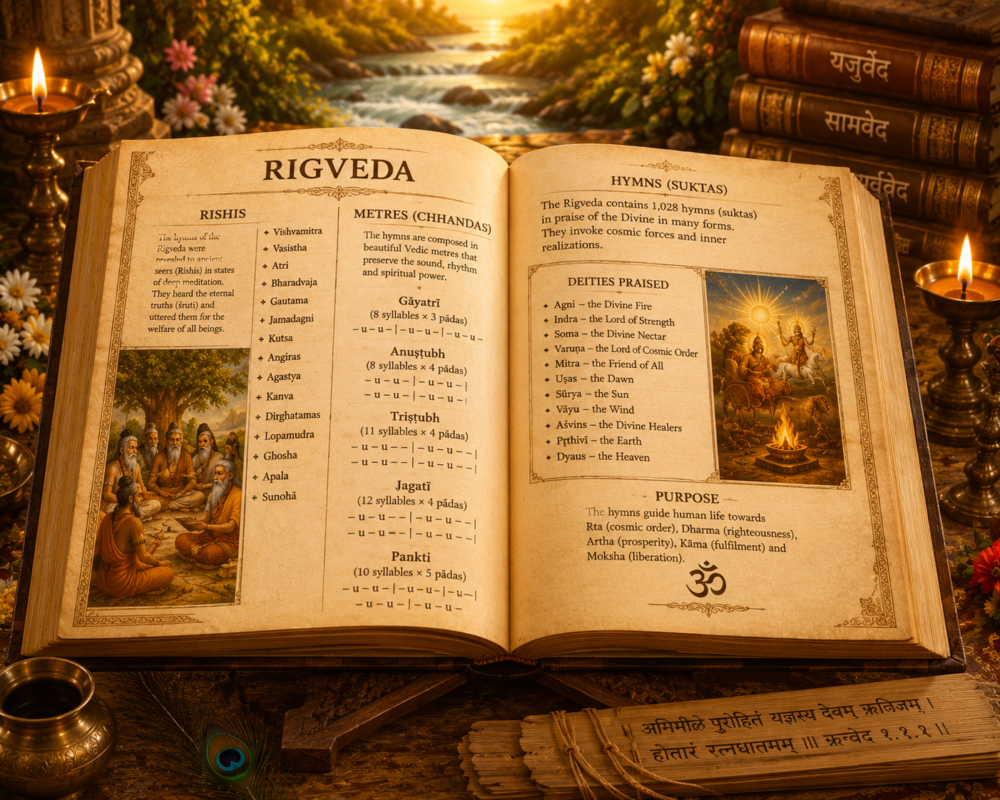
The composers of the hymns are called rishis, a word the tradition connects with seeing. A rishi does not invent a mantra, the theologians insisted, he sees it, already existing, and clothes it in speech. The great family books of the Rigveda are the estates of these seers. The house of Vasishtha, priest of king Sudas, dominates the seventh mandala and gives us the drama of the Battle of the Ten Kings, in which Sudas of the Bharata tribe defeated a confederacy of rivals on the river Parushni. Vasishtha’s great rival Vishvamitra holds the third mandala, and their feud, elaborated endlessly in later epic and Purana, begins here as a competition between court poets. Gritsamada, Vamadeva, Atri and Bharadvaja hold their own books, and the tradition of attributing each hymn to a named seer, a metre and a deity was maintained with bureaucratic exactness.
Among the seers are women. Lopamudra, wife of Agastya, speaks in a frank dialogue hymn about the claims of married love against ascetic withdrawal. Apala, a young woman afflicted in skin and abandoned in love, presses soma with her teeth for Indra and asks him to heal her. Ghosha, Romasha and Vishvavara are remembered as rishikas in their own right. Their presence in the most authoritative of all Hindu texts has never lost its significance.
The music of the metres
Rigvedic poetry is built on syllable counting metres, and three tower above the rest. The gayatri, three lines of eight syllables, is quick and bright, the metre of invocation. The tristubh, four lines of eleven syllables, is the heroic metre, carrying nearly half the Rigveda, the natural stride of hymns to Indra. The jagati, four lines of twelve, is its more flowing sister. The poets prized the metres so highly that they deified them, and later ritual texts assign each metre to a god, a time of day and a social order. When the Gayatri mantra is named, it is named after its metre, for the verse itself, addressed to Savitri the solar power, is properly the Savitri verse of Vishvamitra in the third mandala: may we meditate on the lovely splendour of the god Savitri, that he may inspire our thoughts.
Hymns that everyone should know
A handful of hymns have become the common property of civilisation. The Nasadiya Sukta, the creation hymn of the tenth mandala, begins with the line that there was neither non existence nor existence then, and ends by doubting whether even the overseer in highest heaven knows the origin of the world. No ancient text anywhere matches its poised scepticism. The Purusha Sukta imagines the universe as the sacrificed body of a cosmic person, moon from his mind, sun from his eye, and contains the first mention of the four varnas, a passage debated ever since. The Hiranyagarbha hymn asks after the unknown god with the refrain, to which god shall we offer our oblation. The frog hymn compares chanting brahmins to croaking frogs at the monsoon’s arrival, proof that the rishis could laugh. The gambler’s lament gives us the dice player who has lost wife and home, still drawn helplessly to the rolling nuts, with the sober advice: play not with dice, plough your field instead. And the dialogue of Purururavas and Urvashi, the mortal king and the celestial nymph, begins a love story that Kalidasa would still be retelling two thousand years later.
These hymns reward slow reading. They are difficult, allusive and sometimes deliberately riddling, for the poets loved enigma and called the gods lovers of the hidden. But they repay every effort, because inside them one meets the first articulate human beings of Indian history: proud, quarrelsome, awestruck, funny and profound, singing to their gods across the fire, and unknowingly to us.
The Four Vedas
Part 3 of 10 in this chapter.