
 In 30 Seconds




Story
In the holiest city of Hinduism, in the fifteenth century, a weaver from a community of converted Muslim julahas stood up in the market and told the priests and the mullahs, with equal relish, that they had both missed the point. Kabir of Banaras is the great refuser of Indian religious history, and six hundred years have not blunted him. His verses, transmitted in the mouths of the poor long before they reached any book, remain the most quoted poetry in the Hindi world, and his challenge remains exactly as uncomfortable as he built it to be. If God is everywhere, he asked the mullah, for whom is the loud azaan? If bathing in the river brought liberation, he told the pandit, the frogs would be first in line.
The life beneath the legend is thinly documented and thickly mythologised, which is itself instructive, for every community wanted him. Tradition makes him the foundling of Lahartara pond, raised by the Muslim weaver couple Niru and Nima, and gives him initiation, by a famous trick, from the Vaishnava master Ramananda, whose name Kabir took as his mantra, though the Ram of Kabir’s poetry is explicitly the nirguna absolute, the One without form or attribute, not the prince of Ayodhya. Around him the traditions braided everything the city held, the bhakti of the Vaishnavas, the yoga vocabulary of the Naths, the monotheism of the Sufis, and Kabir wove them, as he wove cloth, into something entirely his own and belonging to no supplier.
The poetry’s method is assault by common sense, delivered in the rough, punchy vernacular of the bazaar, the ulatbansi, the upside down sayings, and above all the doha, the two line missile the whole Hindi world can still fire from memory. He mocked circumcision and the sacred thread in the same verse, asked the stone worshipper why the millstone that feeds the world was not holier than the idol, and reserved his tenderest voice for the interior country where, he insisted, the Beloved actually lives, in the breath, in the loom’s rhythm, in the body’s own Kashi. Caste received no mercy at all, and no voice in Indian literature before the modern era attacked it more directly, which is why, five centuries later, Kabir remains a living presence in Dalit assertion, sung at protests as readily as at satsangs, a thread this series picks up in its caste batches.
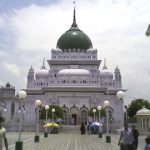
The refusals were not merely rhetorical. He is said to have spent his life at the loom, a working man to the end, scorning renunciation as one more costume. And his final gesture, in the tradition’s telling, was the greatest refusal of all. Aged and aware of his death, Kabir left Kashi, the city of guaranteed liberation, and walked to Maghar, a town near Gorakhpur that superstition held to be so inauspicious that dying there earned rebirth as a donkey. He died at Maghar deliberately, to demolish the franchise of sacred geography with his own corpse, and the legend completes the teaching, for when Hindu and Muslim followers quarrelled over the body, cremation against burial, they lifted the shroud and found only flowers, which they divided. At Maghar today his samadhi and his mazar stand side by side, one grave with two liturgies, the tidiest summary of the man ever built.
The legacy institutionalised itself in the way of all legacies, somewhat against his grain. The Kabir Panth, the order of his followers, maintains its seats including the Kabir Chaura math in Banaras, keeps the anthologies, and counts adherents in the millions, while his verses entered the Sikh scripture in their hundreds, the Guru Granth Sahib preserving more of Kabir than of any voice outside the Gurus themselves, his reach thus running from the panth’s villages to the Golden Temple. Modern India put him in every textbook, every classical and folk repertoire, and every argument, for secularists claim his scorn of orthodoxy, devotees his intoxication with the divine, and Dalit thinkers his rage at caste, each correctly, none completely.
For the UP Files, Kabir is the indispensable witness. In the state whose disputes over temples and mosques this series has just surveyed, the most beloved poet in the language stood at the exact midpoint six centuries ago and declared both addresses empty and the tenant within. Uttar Pradesh did not resolve the argument between its faiths. But it produced the man who transcended it, and it still knows his couplets by heart.