 In 30 Seconds




Story
The map of sacred Uttar Pradesh drawn so far in this series has followed the temples and the stupas. It is incomplete without the green domed geography that lies across the same districts, the dargahs, the tomb shrines of the Sufi saints, where for seven centuries the plain’s Muslims, and in enormous numbers its Hindus, have gone to tie threads, offer chadars, hear qawwali, and ask the buried friend of God to carry a petition upward. Sufi UP is not a footnote to the state’s religious history. It is one of its main currents, and its shrines are among the few institutions in the state where the crowd has never sorted itself by faith.
The current arrived with the Chishti order, whose khanqahs spread across Hindustan from the thirteenth century, preaching a devotion of love, music, and service that took root in the Gangetic soil as naturally as bhakti did, the two movements borrowing each other’s songs. The plain filled with foundations. At Kichaucha in the east, the shrine of Ashraf Jahangir Semnani, the wandering Persian prince turned saint, became one of the subcontinent’s great healing dargahs, famed for its treatment of the afflicted. Rudauli kept the seat of Shaikh Ahmad Abdul Haq, Bahraich the vast and ancient shrine of Salar Masud, whose annual fair has drawn Hindu and Muslim peasants alike for centuries in one of North India’s oldest shared devotions. Amroha, Kakori, Safipur, Jais, the roll of shrine towns runs through every region, and around them grew the literature, for it was in the khanqahs’ orbit that Awadhi produced the great Sufi romances, Jayasi’s Padmavat above all, Hindu epic material sung in Persian mystical keys, the plain’s two imaginations writing with one pen.
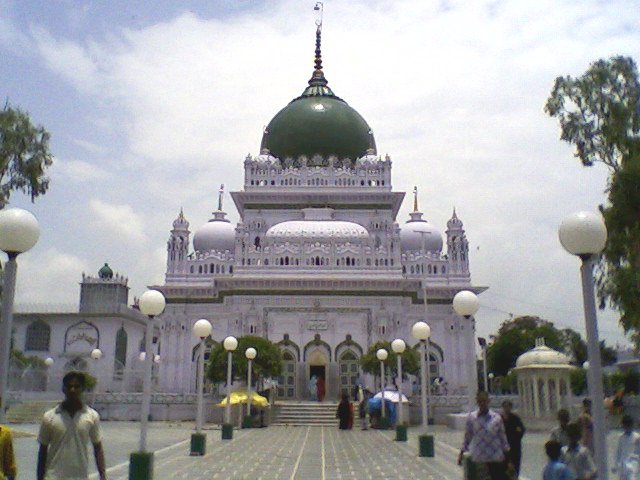
The tradition’s Awadhi capital of the heart, though, is a village outside Barabanki, and its saint is startlingly recent. Haji Waris Ali Shah of Dewa, who died in 1905, was a Sufi of the modern era, photographed, travelled, host to Europeans, whose teaching reduced the path to a sentence, jo rab hai wahi Ram hai, the one who is Rab is the very one who is Ram. He initiated Hindus without conversion, wore the ochre of the sadhu as easily as the patched cloak of the faqir, and his mausoleum at Dewa Sharif, raised in a style that quotes dome and shikhara together, became and remains the region’s great open house. The annual Dewa mela, fair, urs, and festival at once, fills the village each autumn with lakhs of pilgrims of every community, and the shrine’s kitchens and qawwals maintain, into the present, the proposition on which it was founded, that the door is one and the names are many.
Lucknow adds its own register, for Awadh’s Shia dynasty made the capital the subcontinent’s great centre of Muharram, its imambaras, the colossal Bara Imambara above all, built not as tombs but as houses of mourning, where the majlis and the processions of Ashura have been performed with royal grandeur since the eighteenth century, Hindus historically participating in the mourning as tazia bearers and patrons, another of Awadh’s braided devotions that this series returns to in its culture batches.
The ledger notes the pressures honestly. Reform movements within Islam, from the nineteenth century onward, criticised shrine devotion as accretion, and the Deoband article that follows in this batch maps that argument’s UP headquarters, while the Barelvi school arose in the shrines’ defence. Political mobilisation of religious identity in recent decades has strained, though nowhere dissolved, the mixed attendance that was the dargahs’ signature, and disputes have occasionally reached even the fairs. Yet the observable fact on any Thursday evening at Dewa, Kichaucha, or a hundred lesser shrines remains what it has been for centuries, a queue of petitioners in which the tilak and the taqiyah wait together.
For this series, Sufi UP matters beyond its own beauty because it falsifies the simplest tellings of the state’s religious history. The heartland’s faiths did not merely collide. They conversed, sang, intermarried their metaphors, and built shared addresses, and those addresses are still staffed and still visited. Whatever else the UP Files must record of the state’s communal ledger in later batches, it records this first, that the oldest working model of coexistence in Uttar Pradesh was built not by a commission but by the saints, and it is open every day.