
 In 30 Seconds




Story
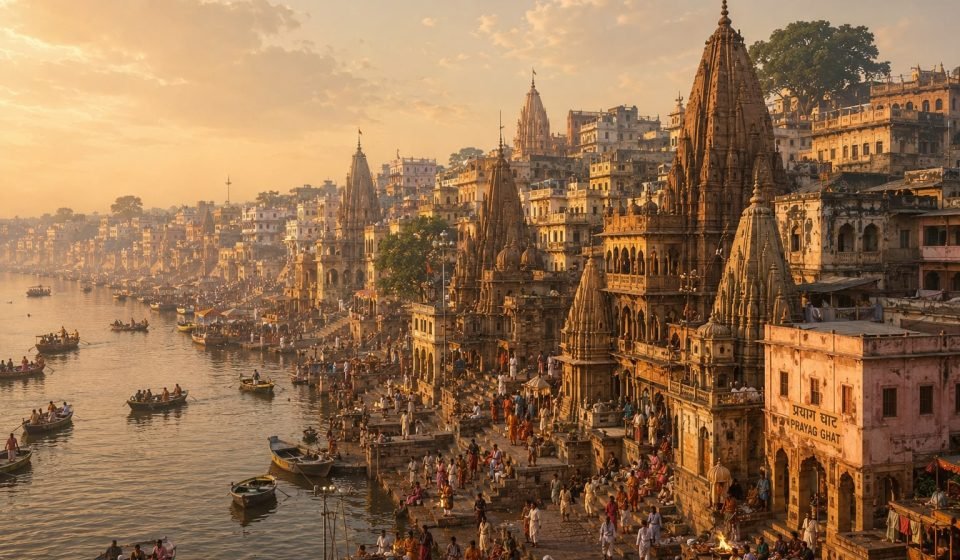
Mark Twain, arriving on the Ganga in 1896, reached for a formulation that has never been bettered. Banaras, he wrote, is older than history, older than tradition, older even than legend, and looks twice as old as all of them put together. The line survives because it captures the city’s essential claim, which is not merely to age but to permanence. Other ancient cities are ruins or reconstructions. Kashi asserts that it has simply never stopped, that the lamps on its ghats have been lit in unbroken succession since before anyone was counting, and archaeology, which has traced settlement in the area back roughly three thousand years, has found the claim harder to dismiss than to prove.
The names themselves are strata. Kashi, the luminous one, is the oldest, the name of the kingdom counted among the sixteen mahajanapadas of the age of the Buddha. Varanasi, the settlement between the Varuna and Assi streams, is the formal name the republic restored. Banaras is the same word softened by centuries of everyday speech, and it carries the city’s worldly flavour, its silk and paan and music, as Kashi carries its sanctity. The city answers to all three, and the three together describe what it is, a kingdom of memory, a geography, and a temperament.
The sanctity rests on a promise. Kashi is Shiva’s own city, Avimukta, the never forsaken, the one place the god is said never to leave, and the tradition holds that to die within its sacred boundary is to be released from the cycle of rebirth altogether, with Shiva himself whispering the liberating mantra into the ear of the dying. This is why the city’s relationship with death is unlike any other place on earth. The cremation fires at Manikarnika and Harishchandra ghats burn day and night and have done so beyond memory, and the dying travel to Kashi deliberately, checking into hospices along its lanes to complete their lives at the one address where death is promotion.
The riverfront gives the promise its stage. The Ganga, having flowed south, turns at Kashi to flow briefly north, back toward its Himalayan origin, a reversal the tradition reads as auspicious, and along the western bank the city descends to meet her in the great crescent of ghats, dozens of stone stairways where the entire human drama, bathing, trading, mourning, performing, and praying, is conducted in public and has been for as long as travellers have kept diaries.
Kashi’s antiquity is not Hindu alone, and the record should be kept whole. The Buddha, upon attaining enlightenment, walked to the deer park at Sarnath on this city’s outskirts to deliver his first teaching, a story this series takes up in its own article. Jain tradition honours Varanasi as the birthplace of Parshvanatha, the twenty third tirthankara, and of others besides. Kabir, the weaver whose voice cut through every orthodoxy, was a son of this city, and its Muslim weaving communities have made the Banarasi sari for centuries. The city of liberation has always been a city of many roads.
It has equally been a city of the mind. From the disputations of the ancient shastris through the Sanskrit colleges of the medieval and early modern eras to the founding of Banaras Hindu University in 1916, Kashi held the position of Hindu civilisation’s supreme seat of learning, the place where a scholar’s reputation was made or unmade. Its gharana gave North Indian music some of its greatest voices, and its literary sons, Tulsidas above all, who composed much of the Ramcharitmanas here, wrote works that became the daily scripture of the entire Hindi world.
History battered the city without dislodging it. Kashi was sacked and its temples broken more than once between the twelfth and seventeenth centuries, the Vishwanath temple itself demolished and rebuilt across the generations, a history whose modern consequences this series examines separately. The present temple rose in the eighteenth century under Ahilyabai Holkar of Indore, part of the great Maratha era restoration that gave the riverfront much of its current stone.
The city now lives one of the most consequential chapters of its long life, its lanes opened by the corridor project, its ghats floodlit for the evening aarti that draws crowds beyond any temple’s capacity, its name carrying renewed political weight as the constituency of a prime minister. Kashi has absorbed empires before and outlasted every one of them. Its eternal claim was never that it cannot change. It is that, through every change, the lamps stay lit.