
 In 30 Seconds




In a significant development for space enthusiasts and the scientific community, NASA has announced a crucial milestone in its ambitious endeavor to preserve the Swift telescope. A robotic rescuer, dispatched to intercept and stabilize the crucial observatory, has successfully established communication, according to recent reports. This achievement marks a vital first step in what promises to be an intricate and challenging mission aimed at preventing the 3,200 pound spacecraft from descending further out of its operational orbit. The successful contact signals hope for the future of the Swift Observatory, a cornerstone for various astronomical observations.
This daring mission underscores the increasing complexity and ingenuity required to maintain invaluable assets in Earth’s orbit. With the robot rescuer having ‘phoned home’, as some outlets have described it, the stage is now set for the next, even more intricate phases of the operation: physically engaging with the observatory and executing the maneuvers necessary to raise its altitude. The stakes are high for NASA and for the international scientific collaborations that rely on the data provided by the Swift telescope, making every step of this space rescue mission critically important.
Background
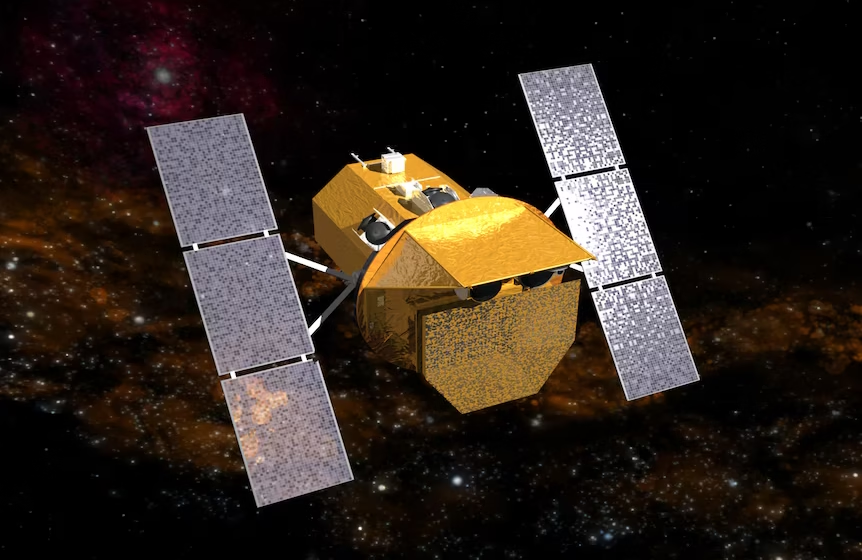
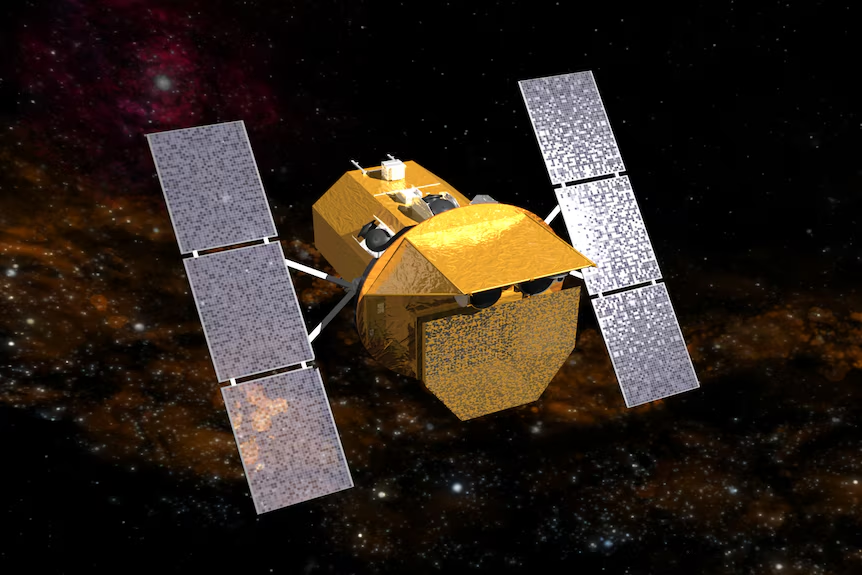
The Swift Observatory, a scientific marvel weighing 3,200 pounds, represents a cornerstone of NASA’s fleet of space telescopes. Launched with the primary objective of studying gamma ray bursts, these powerful cosmic explosions offer insights into the universe’s most energetic phenomena. Over its operational lifespan, Swift has delivered invaluable data, contributing significantly to our understanding of stellar evolution, black holes, and the early universe. Its capabilities extend beyond gamma ray bursts, encompassing a wide range of X ray and ultraviolet observations, making it a versatile and indispensable asset for astrophysicists globally.
However, the relentless pull of Earth’s gravity and the subtle drag from residual atmospheric particles in low Earth orbit present an ongoing challenge for all orbiting spacecraft. Over time, these forces inevitably cause satellites to lose altitude, gradually spiraling closer to the planet until they eventually reenter the atmosphere. For the Swift telescope, this orbital decay reached a critical point, necessitating an urgent intervention. The prospect of losing such a prolific scientific instrument prompted NASA to devise a highly complex and daring rescue mission, deploying a specialized robot to physically alter the observatory’s trajectory and extend its operational life.
Timeline of Events
Public awareness of this extraordinary rescue mission first emerged on July 4, 2026, at 13:43:18. At this time, reports indicated that NASA had initiated a significant operation to save its Swift telescope, which was reportedly experiencing orbital degradation. The crucial update alongside this initial announcement confirmed that the robot rescuer, a key component of this intricate operation, had already successfully established contact, signaling the commencement of active intervention in the spacecraft’s orbital mechanics. This singular event marked the official public acknowledgment and the first major success point for the mission.
Why It Matters
The fate of the Swift telescope holds profound implications for the global scientific community and the broader field of space exploration. Swift is not merely another satellite; it is a dedicated observatory that has provided a decade and a half of groundbreaking data, particularly in time domain astrophysics. Its unique ability to rapidly slew towards new gamma ray bursts and observe them across multiple wavelengths has revolutionized our understanding of these enigmatic events. Losing Swift would create a significant void in our observational capabilities, potentially delaying or even halting critical research into fundamental questions about the cosmos.
Moreover, the success or failure of this audacious rescue mission carries broader significance for the future of space operations. If NASA’s robot rescuer can effectively reboost the 3,200 pound telescope, it could establish a precedent for future satellite servicing missions. Such capabilities become increasingly vital as humanity relies more heavily on an aging constellation of orbital assets for communication, navigation, Earth observation, and scientific research. A successful intervention would demonstrate a powerful new paradigm for extending the lifespan of valuable space hardware, potentially saving billions in replacement costs and reducing the volume of space debris by preventing controlled or uncontrolled deorbiting.
This mission also highlights NASA’s commitment to maximizing the utility of its existing assets, promoting sustainability in space, and pushing the boundaries of what is technologically possible in orbital mechanics and robotics. The lessons learned from this complex endeavor will undoubtedly inform future space missions and maintenance protocols, shaping the approach to space exploration for decades to come.
What Could Happen Next
Following the successful establishment of communication by the robot rescuer, the next critical phase of the mission will likely involve the intricate process of orbital adjustment. The primary objective is to raise the Swift Observatory’s orbit, effectively pushing it to a higher altitude where atmospheric drag is significantly reduced, thus prolonging its operational life. This maneuver is expected to be a delicate dance of engineering precision. The robot rescuer, now physically connected or in close proximity to the 3,200 pound telescope, will need to execute a series of controlled thrusts, gently nudging the massive spacecraft into a more stable and elevated trajectory.
Engineers at NASA will be meticulously monitoring every parameter, from the fuel consumption of the rescuer to the orbital velocity and altitude changes of Swift. The success of these maneuvers will dictate the extent to which Swift’s mission can be extended. Should the reboost operations proceed as planned, the Swift telescope could potentially continue its vital scientific observations for many more years, adding to its already impressive legacy of discoveries. Conversely, any unforeseen technical challenges during this complex orbital adjustment phase could complicate the recovery efforts, making the sustained operation of the telescope uncertain. Further communications from NASA are anticipated as the mission progresses through these critical stages.
Frequently Asked Questions
What is the Swift telescope?
The Swift telescope, also known as the Swift Observatory, is a 3,200 pound NASA spacecraft designed primarily to detect and study gamma ray bursts, the most powerful explosions in the universe. It provides crucial data across multiple wavelengths, including X ray and ultraviolet, enhancing our understanding of cosmic phenomena.
Why is NASA rescuing the Swift telescope?
The Swift telescope is gradually falling from its orbit due to the subtle drag of Earth’s atmosphere. To prevent its eventual reentry and loss, NASA launched a rescue mission to reboost its orbit to a higher, more stable altitude, thereby extending its operational lifespan and continued scientific contributions.
How does the robot rescuer operate?
A specialized robot rescuer, dispatched by NASA, has made contact with the Swift telescope. Its mission is to physically engage with the observatory and execute orbital maneuvers, likely through controlled thrusts, to raise the telescope’s altitude and place it into a more sustainable orbit, allowing it to continue its scientific work.
Related Reading
- Centre Intensifies Scrutiny on Social Media Applications
- India’s Passport Ranking Dips to 125th in 2026 Global Index
- Deadly Hodeidah Clashes Ignite Fears of Wider Yemen Conflict
Official context: Readers can compare this story with public information from India.gov.in.