
 In 30 Seconds




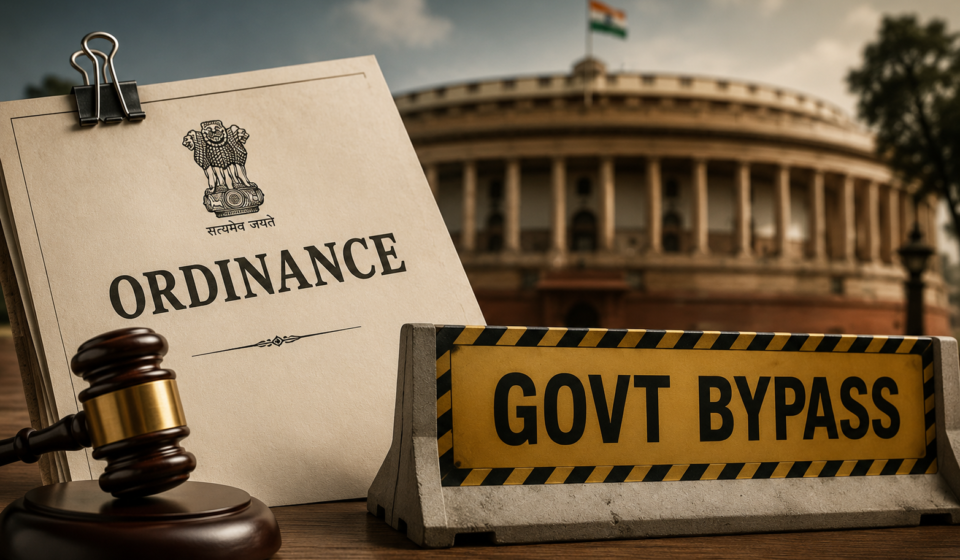
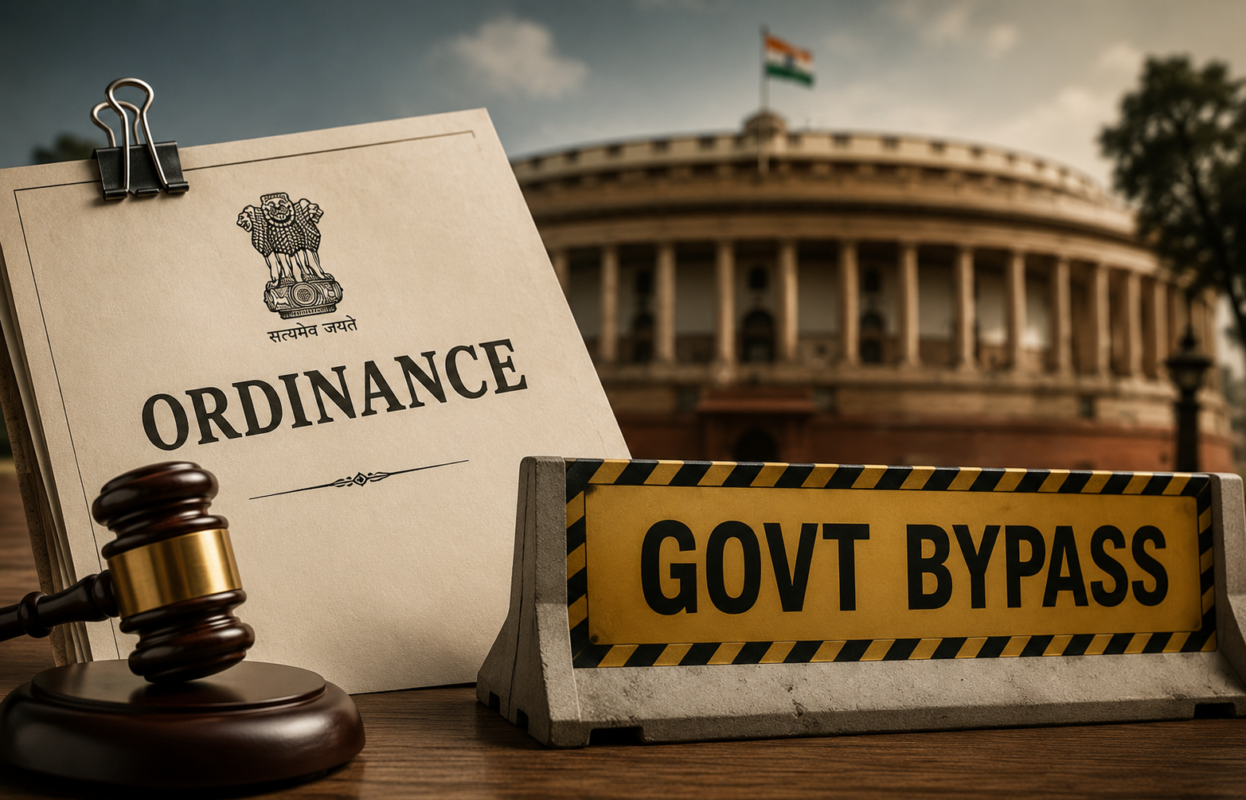
An Ordinance is one of the more unusual tools available within India’s constitutional framework, allowing the President of India, acting on the advice of the Council of Ministers, to issue what is effectively a temporary law without going through Parliament’s normal legislative process. Understanding what an Ordinance is, when it can be used, and why it periodically generates political controversy requires looking closely at both its constitutional purpose and the ways governments have stretched that purpose in practice.
The Constitutional Basis for Ordinances
Article 123 of the Constitution grants the President the power to promulgate an Ordinance when Parliament is not in session and circumstances exist that, in the President’s judgment, require immediate action. A parallel provision, Article 213, grants similar Ordinance making power to state Governors at the state legislative level. In both cases, this power exists specifically to address situations where waiting for Parliament or a state legislature to reconvene would create an unacceptable gap in necessary legal authority.
Once issued, an Ordinance carries the same legal force and effect as an Act of Parliament passed through the ordinary legislative process described in our explainer on how laws are passed in India. This means an Ordinance can amend existing laws, create new legal obligations, or otherwise function exactly as full legislation would, immediately upon being issued.
Why Ordinances Are Inherently Temporary
The defining characteristic that distinguishes an Ordinance from an ordinary Act of Parliament is its built in expiration. An Ordinance must be placed before Parliament once it reconvenes, and Parliament has six weeks from the date it reassembles to formally approve the Ordinance through normal legislative procedure. If Parliament fails to pass a corresponding Act within that six week window, the Ordinance automatically lapses and ceases to have legal effect.
Parliament also retains the power to actively disapprove an Ordinance before the six week period expires, in which case it ceases to operate immediately upon that disapproval rather than waiting out the full window. This built in expiration is what gives the Ordinance mechanism its constitutional legitimacy, since it ensures that emergency executive lawmaking remains genuinely temporary and subject to eventual parliamentary ratification rather than becoming a permanent substitute for the legislative process.
When Ordinances Are Meant to Be Used
The constitutional language requiring that an Ordinance only be issued when circumstances necessitate immediate action implies a fairly narrow, emergency oriented purpose, situations where a genuine and pressing need for legal authority arises precisely during a period when Parliament happens not to be in session. Classic examples might include urgent regulatory gaps, natural disaster response measures, or time sensitive economic interventions that cannot reasonably wait for Parliament’s next scheduled sitting.
Why Ordinances Have Become Politically Controversial
In practice, successive Indian governments across different political parties have at times used the Ordinance route more frequently and for a broader range of purposes than the narrow emergency framing in the Constitution would seem to anticipate. Critics have periodically accused governments of using Ordinances to enact substantive policy changes without subjecting them to the full scrutiny of parliamentary debate, particularly in cases where a government anticipates a difficult or contentious passage through one or both houses of Parliament.
This pattern has drawn judicial scrutiny over the decades. The Supreme Court has held that the President’s satisfaction in issuing an Ordinance, while given considerable deference, is not entirely beyond judicial review, particularly in cases of mala fide use or where an Ordinance is repeatedly re issued in succession specifically to avoid placing the matter before Parliament at all, a practice the Court has found constitutionally impermissible since it would effectively convert what is meant to be a temporary measure into a permanent bypass of the legislature.
The Re Promulgation Problem
A particularly contentious pattern involves governments allowing an Ordinance to lapse just before Parliament reconvenes, only to immediately re issue a near identical Ordinance once the session ends, effectively keeping a piece of executive made law continuously in force for extended periods without ever subjecting it to an actual parliamentary vote. The Supreme Court has explicitly disapproved of this practice in multiple rulings, holding that repeated re promulgation of Ordinances undermines the constitutional scheme that places Parliament, not the executive, as the primary lawmaking authority in India’s democracy.
Why Understanding Ordinances Matters
For anyone following Indian governance, recognising when a major policy change has arrived via Ordinance rather than through the full legislative process explained in our companion piece is often the key to understanding both the urgency a government is claiming and the level of parliamentary scrutiny that change has, or has not yet, actually received. An Ordinance announcement frequently signals either a genuine emergency or a government’s calculation that a particular measure would face significant resistance if debated openly in Parliament, and distinguishing between those two scenarios is central to evaluating any individual Ordinance on its merits. For the full constitutional text governing Ordinance making power, the official Indian legal code repository provides authoritative reference.