
 In 30 Seconds




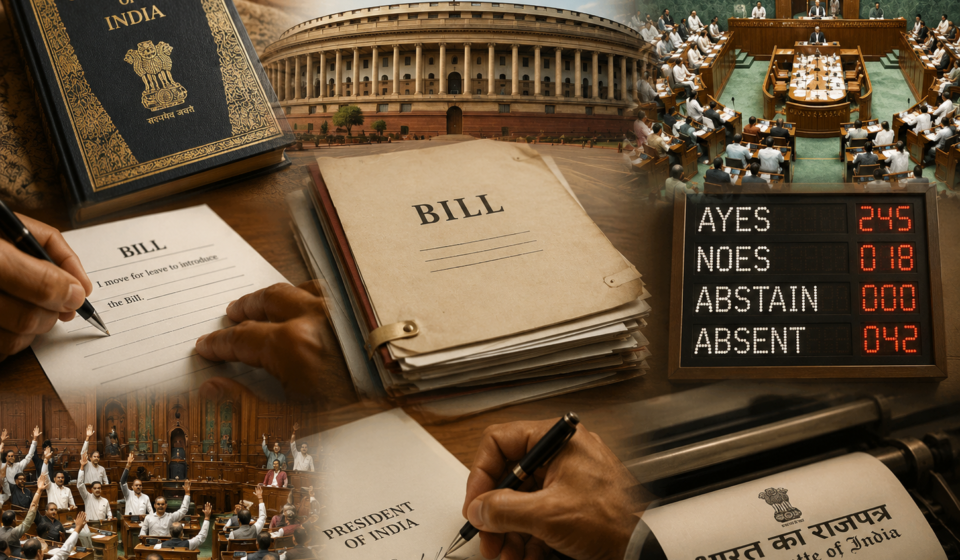
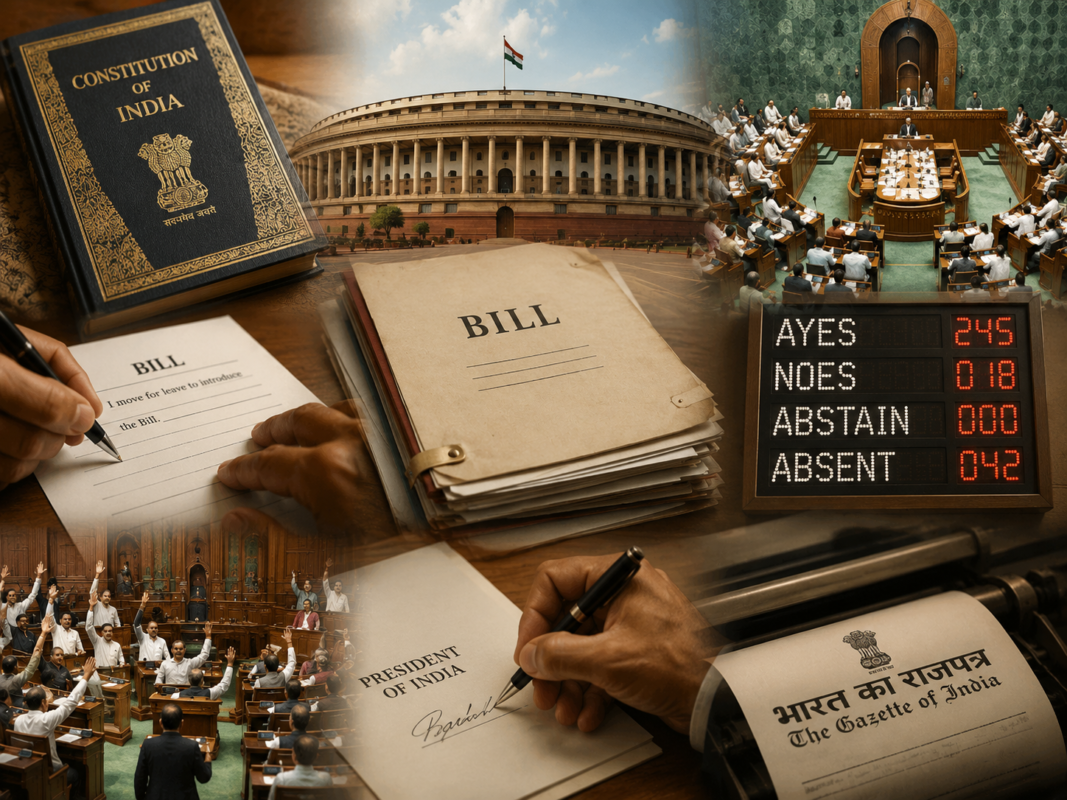
Understanding how laws are passed in India means following a bill through a structured, multi stage process that begins with introduction in one house of Parliament and ends with the President’s formal assent. While our broader explainer on how Parliament works covers the institutional structure, this piece walks through the specific procedural journey every bill must complete before it becomes enforceable law.
Step One: Drafting and Introduction
Most bills in India originate with the government, drafted by the relevant ministry in consultation with the Law Ministry and, where necessary, the Ministry of Law and Justice’s legislative department. A bill can also be introduced by an individual Member of Parliament who is not part of the government, known as a Private Member’s Bill, though these rarely become law given limited parliamentary time allocated to them compared to government business.
Once drafted, the bill is formally introduced in either the Lok Sabha or the Rajya Sabha, with one critical exception, Money Bills must originate exclusively in the Lok Sabha. This introduction stage is referred to as the first reading, during which the bill’s title and basic objectives are presented, and its text is published for public and parliamentary access.
Step Two: Committee Scrutiny and Detailed Debate
After introduction, significant bills are often referred to a Parliamentary Standing Committee, a smaller group of Members of Parliament from across party lines who examine the bill in considerable technical detail, take input from experts and stakeholders, and produce a report recommending changes. This committee stage is where much of the substantive, less partisan scrutiny of legislation actually happens, away from the more visible floor debates that dominate news coverage.
Following committee review, the bill returns to the house for its second reading, the stage at which the most substantive debate occurs. Members discuss the bill’s principles and provisions clause by clause, propose amendments, and the government typically responds to concerns raised, sometimes accepting amendments to secure broader political support for the legislation.
Step Three: Voting and the Third Reading
Once debate concludes, the house moves to the third reading, where the bill as amended is put to a final vote. If passed, the bill moves to the second house of Parliament, where the entire process, introduction, committee review where applicable, debate and voting, repeats. Both houses must pass an identical version of the bill for it to proceed further, which is why amendments made in one house often require the bill to return to the originating house for fresh approval if the two versions differ.
Step Four: Resolving Disagreements Between the Houses
If the Lok Sabha and Rajya Sabha cannot agree on a non Money Bill, the Constitution provides for a joint sitting of both houses, presided over by the Speaker of the Lok Sabha, where the matter is resolved by simple majority of members present and voting from both chambers combined. Given the Lok Sabha’s significantly larger membership, this mechanism generally favours whichever position commands support there. Money Bills bypass this entire dynamic, since the Rajya Sabha can only offer non binding recommendations on them within a fourteen day window before they are deemed passed regardless of the upper house’s position.
Step Five: Presidential Assent
Once both houses have passed an identical version of the bill, it is presented to the President for assent. The President can grant assent, in which case the bill becomes an Act of Parliament and enforceable law, or in the case of non Money Bills, return the bill once for reconsideration with specific recommendations. If Parliament passes the bill again, with or without incorporating the President’s suggestions, the President is constitutionally required to grant assent on that second occasion, meaning this power functions as a delay rather than an absolute veto.
How Ordinances Fit Into This Process
When Parliament is not in session and the government deems immediate legislative action necessary, the President can promulgate an Ordinance on the advice of the Council of Ministers, which carries the same legal force as an Act of Parliament from the moment it is issued. However, an Ordinance is inherently temporary, it must be approved by Parliament within six weeks of the houses reassembling, or it automatically lapses, meaning Ordinances function as a stopgap mechanism rather than a substitute for the full legislative process described above.
Why This Process Matters
Understanding this full sequence, from drafting through committee review, dual house passage, and presidential assent, helps explain why some legislation in India moves quickly while other bills remain pending for years, sometimes lapsing entirely when a Lok Sabha’s term ends before a bill completes its full journey through both houses. Every major law shaping Indian governance, from economic regulation to criminal justice reform, has passed through this exact structural process, making it essential background for understanding why and how Indian policy actually changes. For the specific category of legislation that follows a distinct, faster track through this process, see our explainer on what a Money Bill is, and for further official detail on Parliament’s legislative functions, the National Portal of India offers comprehensive public resources.