
 In 30 Seconds




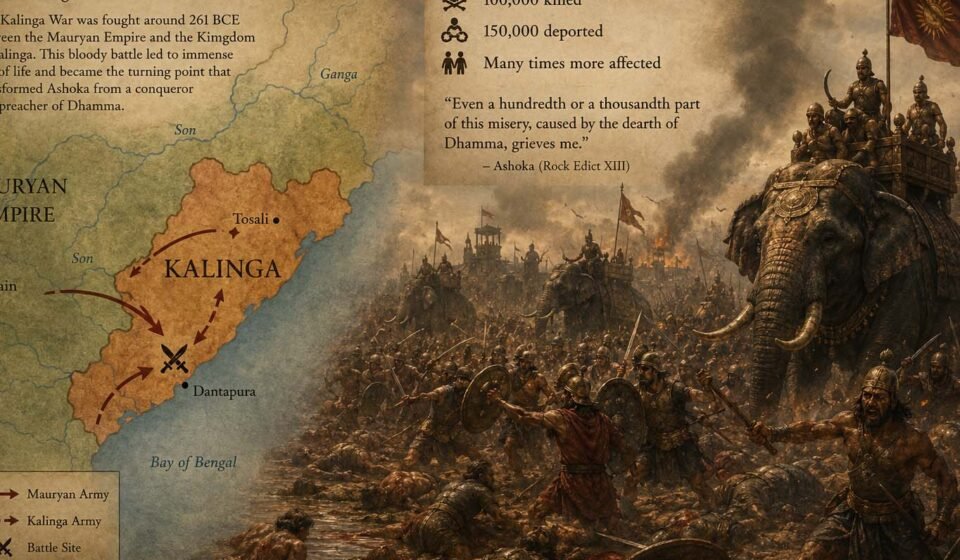
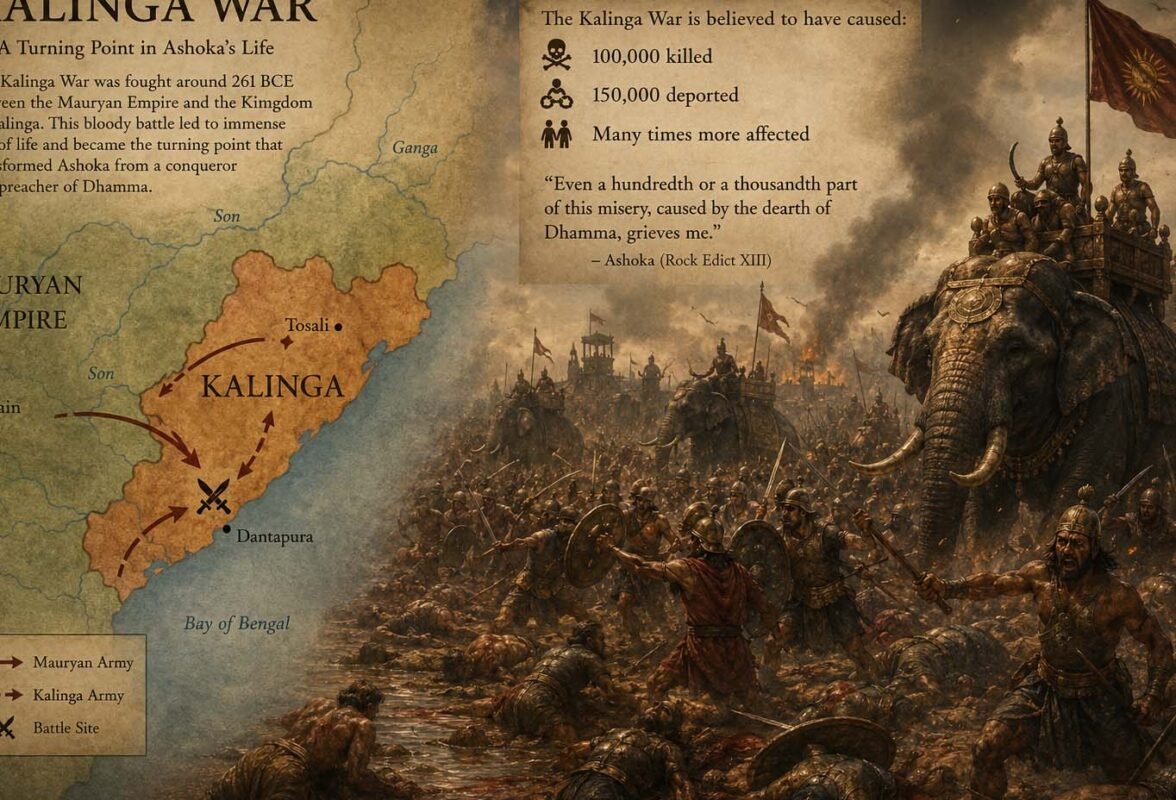
In the annals of ancient warfare, few battles carry the emotional and historical weight of the Kalinga War, fought around 261 BCE between the expanding Mauryan Empire and the independent kingdom of Kalinga, located along the eastern coast of the Indian subcontinent in what is now the state of Odisha. This was not simply another territorial conquest in a long series of Mauryan military campaigns. It became the pivotal turning point in the life of one of history’s most consequential rulers, Emperor Ashoka.
By the time Ashoka ascended to the Mauryan throne, the empire founded by his grandfather Chandragupta had already grown to encompass most of the Indian subcontinent, stretching from Afghanistan in the northwest to Bengal in the east. Kalinga remained one of the last significant independent territories, a wealthy and fiercely proud kingdom known for its skilled navy, prosperous maritime trade and formidable military resistance. Ancient sources suggest Kalinga could field an army of enormous size, and its people were determined to defend their independence against Mauryan expansion.
The invasion that followed was catastrophic in its scale of destruction. Ashoka’s own inscriptions, carved into rock edicts that survive to this day, provide a remarkably candid account of the war’s devastating human cost. According to the Thirteenth Major Rock Edict, one hundred and fifty thousand people were carried away as captives, one hundred thousand were killed in the fighting itself, and many times that number died afterward from the resulting famine, disease and displacement that inevitably follow warfare on this scale. These are staggering figures for the ancient world, and what makes them extraordinary is that they come not from an enemy chronicler seeking to condemn Ashoka but from the emperor’s own official record, carved in stone for his subjects and for posterity to read.
What happened next represents one of the most remarkable personal and political transformations recorded in ancient history. According to Ashoka’s own testimony, witnessing the immense suffering caused by the Kalinga War filled him with profound remorse. He describes feeling deep sorrow and regret at the destruction his conquest had wrought, a confession almost unheard of among ancient rulers, who typically celebrated military victories as glorious achievements rather than sources of guilt and reflection.
This remorse catalyzed a fundamental shift in Ashoka’s approach to governance and to life itself. He turned toward Buddhism, embracing its teachings on nonviolence, compassion and moral conduct with the same intensity he had once brought to military conquest. Rather than continuing his campaign of territorial expansion, Ashoka declared that he would pursue what he called dhamma vijaya, or conquest through righteousness and moral example, rather than through warfare and bloodshed.
This transformation manifested in concrete policy changes across the empire. Ashoka established hospitals for both humans and animals, planted trees and dug wells along major roads for travelers, promoted religious tolerance among the diverse faiths practiced across his vast realm, and sent emissaries and missionaries to spread Buddhist teachings as far as Sri Lanka, Central Asia and possibly even the Hellenistic kingdoms of the Mediterranean world. His rock and pillar edicts, inscribed in multiple languages and scripts across the empire, articulated principles of ethical governance, religious tolerance and social welfare that remain strikingly progressive even by modern standards.
The Kalinga War stands as a profound reminder that even the most powerful conquerors can be transformed by confronting the human cost of their ambitions. Ashoka’s journey from ruthless expansion to compassionate rule offers a rare historical example of genuine moral awakening translated into lasting institutional change, a legacy that continues to resonate wherever people search for examples of power tempered by conscience.
Related Reading
- After Ashoka: The Slow Twilight of the Mauryan Dynasty
- The Aryan Question: What Genetics Now Tells Us
- Vedic Society: Caste, Family and Faith in Early India
Official context: Readers can compare this story with public information from Archaeological Survey of India.
Ancient India - Batch 1
Part 10 of 20 in this chapter.