 In 30 Seconds




When historians speak of the Mauryan Empire’s greatest achievements, military conquest and territorial expansion often dominate the conversation, yet arguably the dynasty’s most enduring contribution to Indian civilization lies elsewhere, in the sophisticated architecture of governance it developed to manage an empire of staggering size and diversity. The administrative innovations pioneered under Chandragupta Maurya and refined through the reigns of Bindusara and Ashoka established patterns of statecraft that would influence Indian governance for centuries after the empire itself had faded into history.
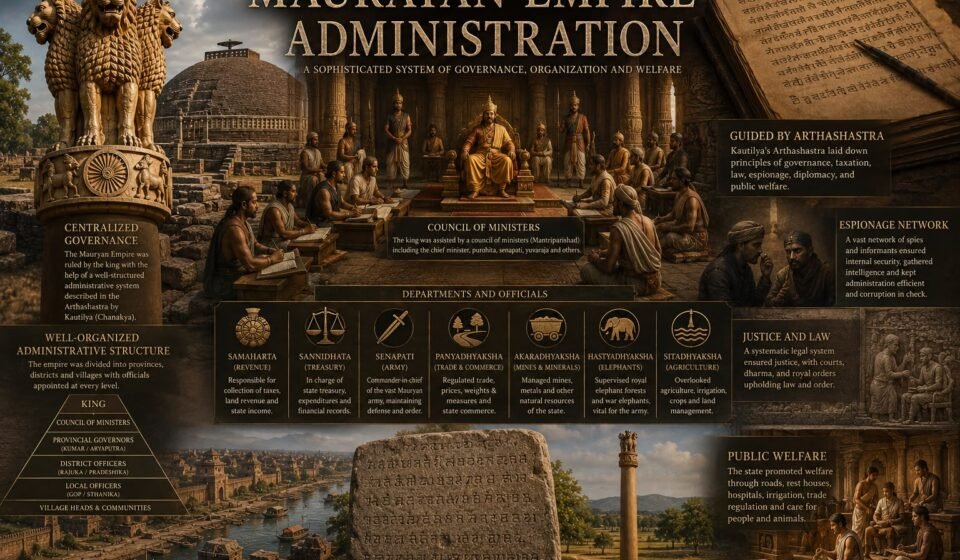
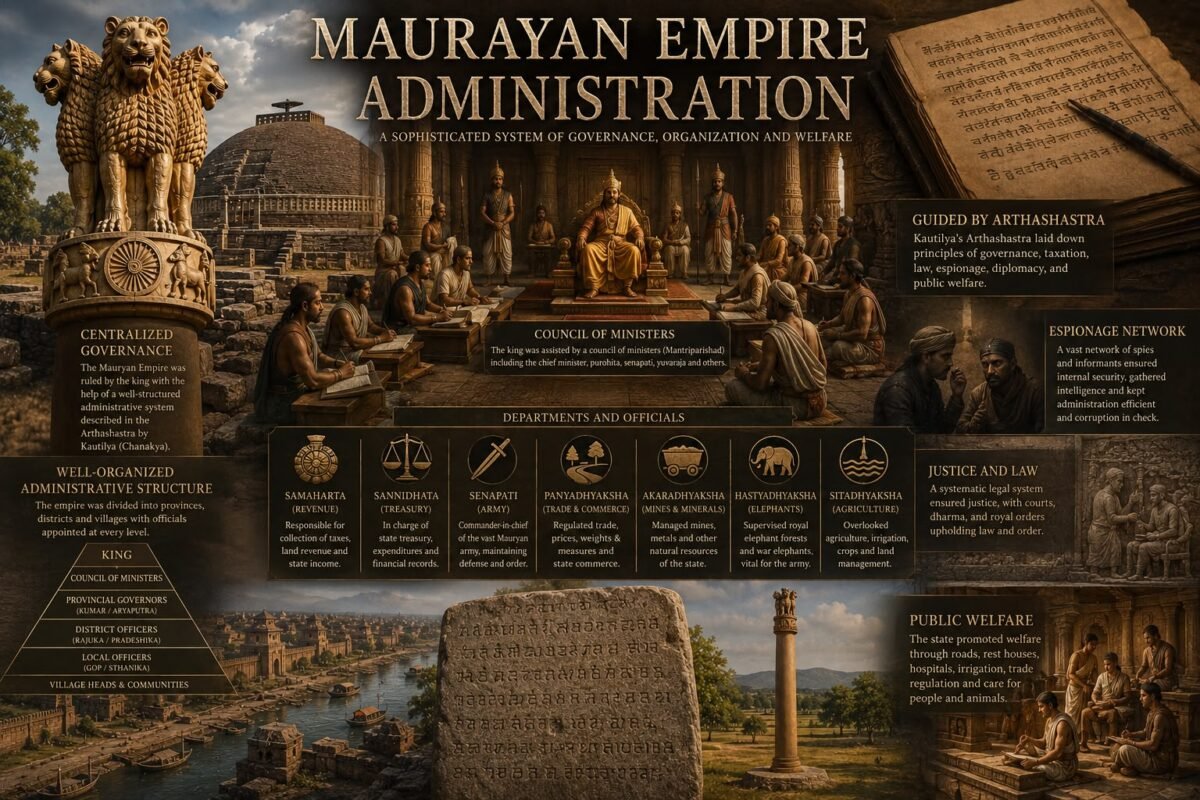
At the heart of Mauryan administration lay a deeply hierarchical yet remarkably systematic structure, much of it detailed in Chanakya’s Arthashastra. The empire was divided into several major provinces, each governed by a viceroy who was frequently a member of the royal family or a figure of exceptional trust, given the immense distances and communication challenges involved in ruling territory that stretched from Afghanistan to Bengal. Below these provincial administrations, the empire was further subdivided into districts and villages, creating a nested hierarchy of authority that allowed the central government at Pataliputra to maintain oversight even in the empire’s most distant reaches.
Taxation formed the essential financial backbone of this administrative system. Agricultural land, the primary source of wealth in ancient India, was subject to careful assessment based on soil quality, irrigation access and crop yield, with tax rates calibrated accordingly rather than applied uniformly. Officials called rajukas were responsible for measuring and assessing land in rural areas, while separate officials oversaw taxation of trade, craft production and other commercial activities in urban centers. The Arthashastra describes an impressively detailed taxonomy of revenue sources, including tolls on goods transported along trade routes, taxes on mining and forest resources, and licensing fees for various trades and professions.
Justice and legal administration under the Mauryans similarly reflected considerable sophistication. The empire maintained a system of courts operating at different levels of the administrative hierarchy, with provisions for both criminal and civil matters. Ashoka’s own edicts reveal his personal concern with judicial fairness, expressing worry that overly harsh punishments or wrongful imprisonment might occur despite his instructions, and describing measures such as periodic reviews of prisoners and provisions for royal amnesty on certain occasions, reflecting an unusually humane sensibility for an ancient legal system.
Espionage and intelligence gathering represented another distinctive feature of Mauryan governance, heavily emphasized in the Arthashastra as essential to maintaining control over such a vast and diverse territory. Spies disguised in various guises, including merchants, ascetics, students and even prostitutes according to some interpretations of the text, were deployed to monitor not only external threats and rival kingdoms but also the conduct and loyalty of the empire’s own officials, reflecting Chanakya’s deeply pragmatic understanding that internal corruption and disloyalty posed just as significant a threat to imperial stability as external invasion.
Public works and welfare initiatives, particularly under Ashoka’s reign, added another dimension to Mauryan administrative achievement. The construction and maintenance of roads connecting distant regions of the empire facilitated both military movement and commercial trade, while the digging of wells, planting of shade trees and establishment of rest houses along these routes reflected genuine attention to the welfare of ordinary travelers and merchants. Ashoka’s dhamma mahamatras represented an early and remarkable experiment in dedicated welfare administration, officials specifically tasked with monitoring and promoting the ethical treatment of vulnerable populations across the empire.
The Mauryan administrative legacy did not vanish with the empire’s eventual decline in the early second century BCE. Later Indian dynasties, including the Guptas who would establish their own golden age of Indian civilization several centuries afterward, drew significant inspiration from Mauryan precedents in structuring their own systems of taxation, provincial governance and public administration. Even today, historians studying the origins of organized statecraft in the Indian subcontinent inevitably return to the Mauryan period as the foundational moment when the diverse, sprawling territories of ancient India were first bound together not merely through conquest, but through the patient, systematic work of administration, taxation and governance that transformed military victory into lasting political order.
Related Reading
- After Ashoka: The Slow Twilight of the Mauryan Dynasty
- The Aryan Question: What Genetics Now Tells Us
- Vedic Society: Caste, Family and Faith in Early India
Official context: Readers can compare this story with public information from Archaeological Survey of India.
Ancient India - Batch 1
Part 16 of 20 in this chapter.