 In 30 Seconds




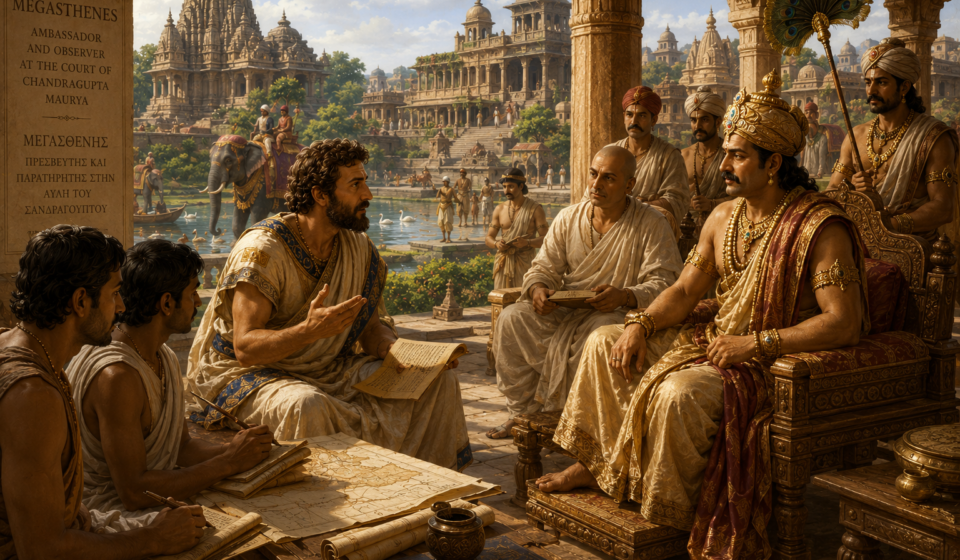
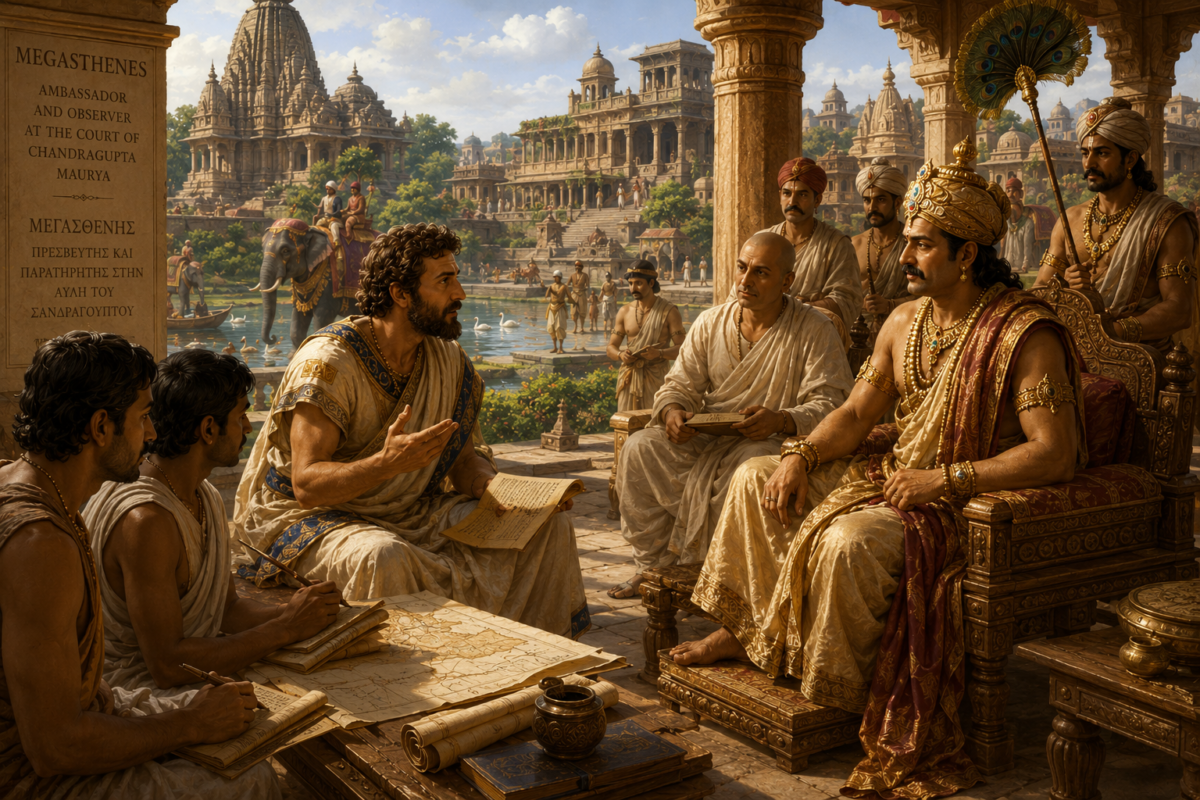
Sometime around 302 BCE, a Greek diplomat named Megasthenes arrived at the magnificent Mauryan capital of Pataliputra, sent as an ambassador by Seleucus Nicator, one of Alexander the Great’s most powerful successors who had inherited the eastern territories of Alexander’s fractured empire. What Megasthenes witnessed and later recorded during his time at the court of Chandragupta Maurya would become one of the most valuable, if imperfectly preserved, sources for understanding ancient Indian civilization from an outsider’s perspective.
Megasthenes composed his observations in a work titled Indica, a comprehensive account of Indian geography, society, government and customs as understood by a cultured Greek visitor encountering a civilization vastly different from his own Hellenistic world. Unfortunately, the original text of Indica has not survived intact. What we know of its contents comes instead through fragments quoted and paraphrased by later classical authors including Strabo, Arrian and Diodorus Siculus, who drew extensively upon Megasthenes’ original observations in their own geographical and historical writings centuries later.
Despite these limitations, the surviving fragments offer remarkably detailed glimpses into Mauryan society. Megasthenes described Pataliputra itself in vivid terms, portraying an enormous fortified city stretching along the riverbank, protected by wooden walls studded with defensive towers and surrounded by a substantial moat. He documented an elaborate municipal government responsible for the city’s administration, organized into specialized boards overseeing matters ranging from trade regulation and manufacturing to the welfare of foreign visitors, revealing a level of organized urban governance that clearly impressed this visitor from the Hellenistic world.
Megasthenes also attempted to describe and categorize Indian society more broadly, famously dividing the population into seven distinct classes based loosely on occupation, including philosophers, farmers, herdsmen, artisans and traders, soldiers, overseers or inspectors, and councillors who advised the king. While modern historians recognize this classification as somewhat imprecise and likely reflecting Megasthenes’ attempt to fit unfamiliar Indian social structures into categories more comprehensible to his Greek audience rather than a perfectly accurate depiction of the complex realities of caste and occupation in Mauryan India, it nonetheless offers valuable insight into how a sophisticated foreign observer perceived and organized his understanding of Indian social structure.
The Greek ambassador paid particular attention to the Mauryan military and administrative apparatus, describing a formidable standing army supported by an extensive bureaucracy responsible for supply, logistics and organization, along with what he characterized as an effective system of espionage keeping the emperor informed of developments throughout his vast territories. His accounts of Chandragupta’s court described elaborate royal processions, careful security precautions surrounding the emperor’s daily movements, and audiences in which the king personally heard petitions and administered justice, offering rare corroborating detail alongside the administrative principles later articulated in Chanakya’s Arthashastra.
Megasthenes also documented aspects of Indian agriculture, natural resources and trade, describing the fertility of the land, the abundance of exotic animals including elephants prized for their military value, and various crops and products that formed the basis of the Mauryan economy. His observations regarding Indian religious and philosophical life, including references to ascetic practitioners he called gymnosophists, or naked philosophers, reflect early Greek fascination with Indian spiritual traditions that would continue to influence Western perceptions of Indian philosophy for centuries afterward.
While historians today approach Megasthenes’ account with appropriate caution, recognizing the inevitable distortions introduced by cultural distance, imperfect translation and the fragmentary nature of the text’s survival through later secondary sources, Indica nonetheless remains an irreplaceable historical resource. It offers modern scholars a rare external perspective on Mauryan India, complementing and sometimes corroborating the internal evidence provided by Ashoka’s edicts and the administrative theories found in the Arthashastra, together painting a richer and more textured picture of one of the ancient world’s truly great civilizations.
Related Reading
- After Ashoka: The Slow Twilight of the Mauryan Dynasty
- The Aryan Question: What Genetics Now Tells Us
- Vedic Society: Caste, Family and Faith in Early India
Official context: Readers can compare this story with public information from Archaeological Survey of India.
Ancient India - Batch 1
Part 15 of 20 in this chapter.