
 In 30 Seconds



In the first week of June 1984, the Indian Army entered the Golden Temple complex to remove the armed men fortified within it. The operation, codenamed Blue Star, achieved its stated objective. Jarnail Singh Bhindranwale and his commanders were killed and the complex was cleared. By every other measure it was a catastrophe whose consequences included the assassination of a prime minister, the massacre of thousands of Sikh civilians, a decade of insurgency, and a wound in the Sikh psyche that remains unhealed four decades later.
The Decision
By late May 1984, with negotiations collapsed and killings mounting, Indira Gandhi’s government settled on military action. Punjab was sealed: a curfew imposed, rail, road and telephone links cut, and the press expelled from the state, a blackout that ensured the first accounts of what happened would be the government’s own and that the fog of contested numbers would never fully lift. The timing has drawn lasting criticism, because the operation coincided with the martyrdom anniversary of Guru Arjan Dev, when the complex was crowded with thousands of pilgrims.
The Battle
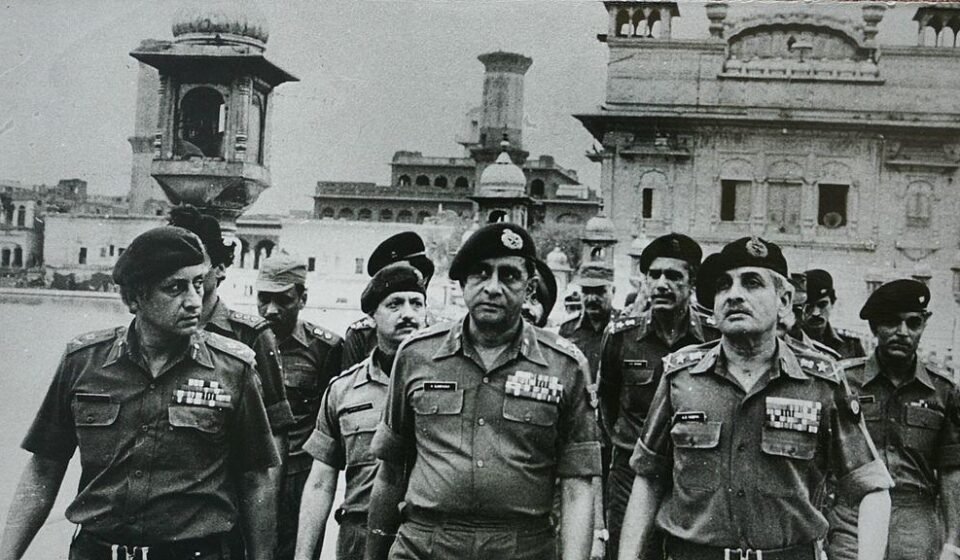
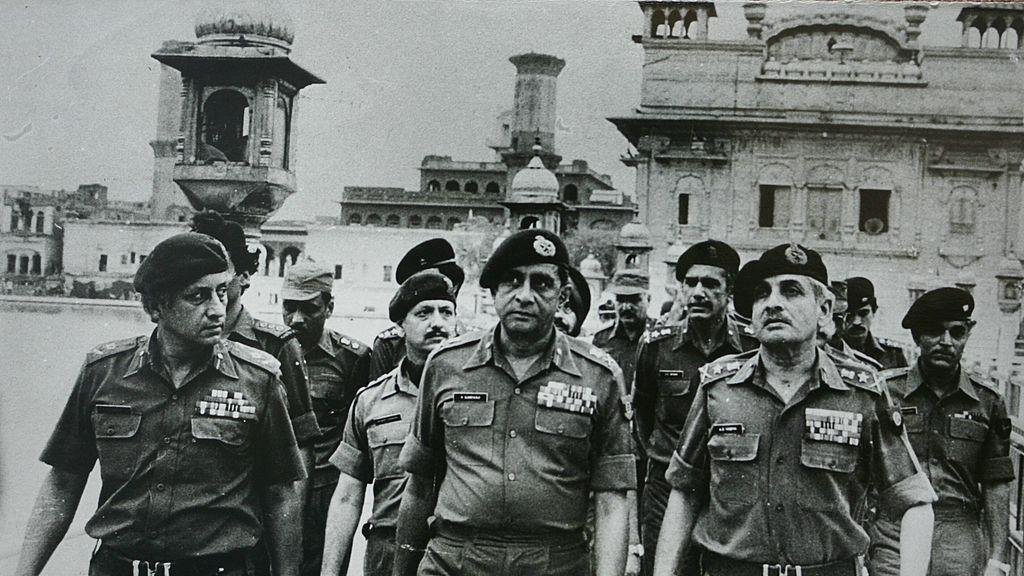
The army, under Major General Kuldip Singh Brar, expected a short action. Instead it met defences prepared by Shabeg Singh with professional skill. Attempts on the night of June 5 to take the Akal Takht with infantry and commandos were beaten back with heavy casualties, machine gun fire from fortified positions cutting down troops in the confined marble spaces. In the early hours of June 6, tanks were brought into the parikrama, and the guns of Vijayanta tanks fired on the Akal Takht, reducing the front of the temporal throne of the Sikhs to rubble. By June 7 the complex was under army control. Bhindranwale, Shabeg Singh, and Amrik Singh were dead. Simultaneous actions at dozens of other gurdwaras across Punjab, and the fierce fighting some of them saw, are among the least remembered parts of the operation.
The Arithmetic of the Dead
The official white paper recorded 83 soldiers killed and 492 others, militants and civilians together, a figure almost no independent account accepts as complete. Unofficial estimates, drawn from journalists, eyewitnesses, and later investigations, have ranged from many hundreds to several thousand dead, including large numbers of pilgrims trapped by the curfew and the battle. Accounts collected by journalists and rights groups describe pilgrims killed in crossfire, alleged summary shootings of young men with their hands bound, and bodies cremated in heaps without identification. The government has disputed such accounts; the blackout it imposed ensured they could never be conclusively resolved. The Sikh Reference Library, holding irreplaceable manuscripts, was destroyed by fire in circumstances that remain contested, with the community’s demand for the return of removed documents unmet to this day.
The Shockwave
The reaction was immediate and profound. Sikh soldiers in several regiments mutinied on hearing the news. Sikh public figures returned honours and resigned offices. For millions of Sikhs with no sympathy for Bhindranwale, the image of tank shells striking the Akal Takht transformed the story from a police matter into a wound of faith. Khushwant Singh, who had opposed the militancy unwaveringly, returned his Padma Bhushan, writing that the assault had made him feel a stranger in his own country. On October 31, 1984, Indira Gandhi was assassinated by two of her Sikh bodyguards, and the pogrom that followed is the subject of the next article.
Could It Have Gone Differently
The debate has never closed. Critics, including senior police and intelligence officers of the era, have argued that a siege of the complex, cutting supplies and waiting, could have achieved the objective without a battle, and that alternatives were rejected in favour of speed. Defenders reply that hostages, tunnels, stockpiles, and the risk of a Punjab wide uprising made a prolonged siege untenable. What is beyond argument is the sequence: a state that had allowed a shrine to be fortified for two years chose the most violent possible remedy at the most sensitive possible moment, and everyone from the prime minister to the poorest villager in Majha would pay for it.
Operation Blue Star is the hinge of this entire series. Everything before it explains how it became thinkable. Everything after it, the pogrom, the insurgency’s explosion, the disappearances, flows from those days in June. It remains the starkest lesson in the Indian republic’s history of what happens when politics fails long enough that only soldiers are left.
Related Reading
- The Killing Fields of Majha: Tarn Taran and Amritsar in the Late 1980s
- The Bus Massacres: When the Militancy Turned Its Guns on Passengers
- The Air India Kanishka Bombing: Terror Crosses the Ocean
Official context: Readers can compare this story with public information from India.gov.in.
Origins and Escalation
Part 9 of 10 in this chapter.