
 In 30 Seconds




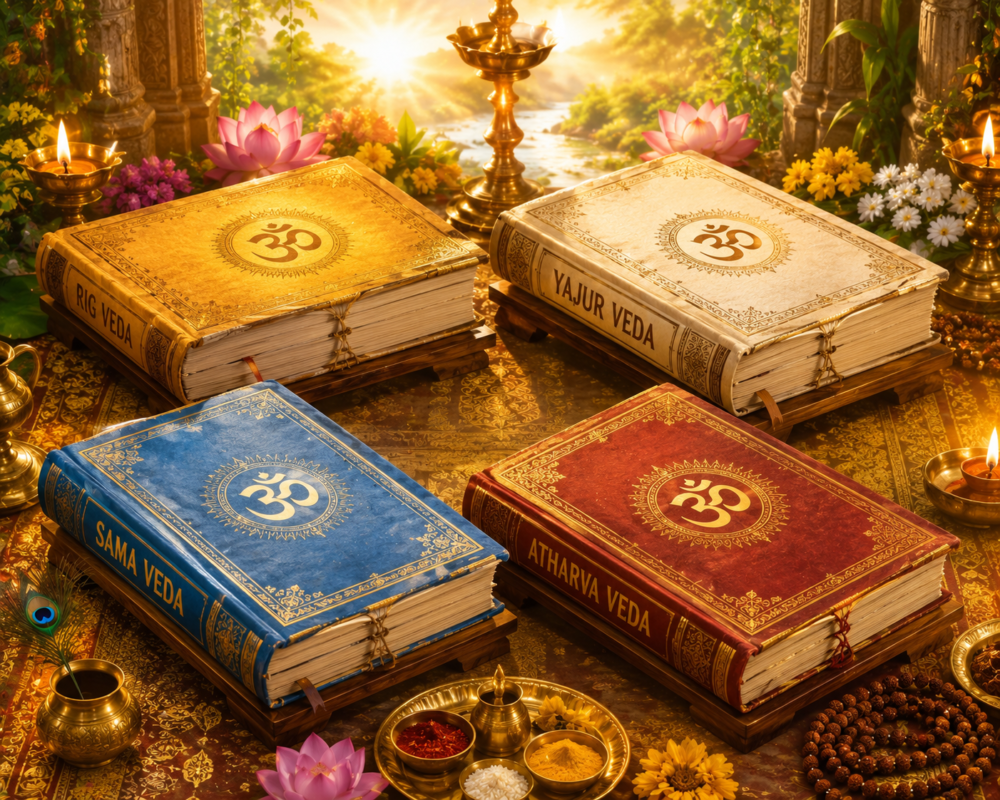
Long before India had cities of stone, before it had coins or scripts or empires, it had sound. Somewhere in the plains of the Punjab, more than three thousand years ago, families of priests began to compose hymns in an early form of Sanskrit and to memorise them with a precision that the modern world still struggles to comprehend. Those hymns grew into vast collections, the collections grew into schools, and the schools carried their inheritance across a hundred generations without the aid of paper. The result is the Vedic corpus, the oldest continuously transmitted body of literature on the planet, and at its heart stand four great collections: the Rigveda, the Yajurveda, the Samaveda and the Atharvaveda.
The word Veda comes from the Sanskrit root vid, to know. A Veda is therefore knowledge itself, and the tradition regards these texts not as the compositions of men but as shruti, that which was heard. The rishis, the seer poets to whom the hymns are attributed, are described as those who perceived eternal truths and gave them the shape of language. Whatever position one takes on that claim, the historical fact remains astonishing enough. The oldest portions of the Rigveda are generally placed around 1500 BCE, and some scholars argue for earlier dates still. These verses were already ancient when the Buddha walked the Gangetic plains.
Four collections, four functions
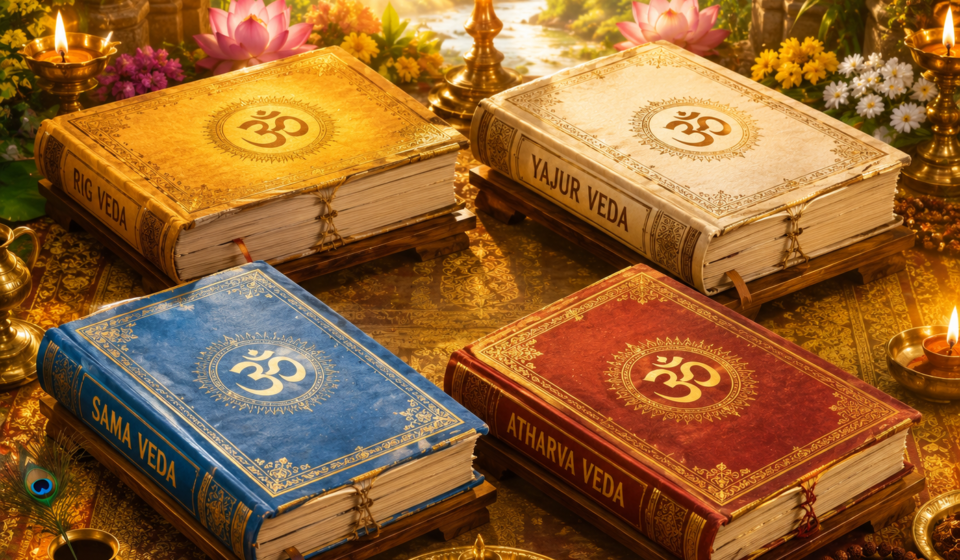
The four Vedas were never four rival books. They were four departments of a single ritual civilisation, and each was tied to a specific class of priest in the great Vedic sacrifice. The Rigveda, the collection of praise verses, belonged to the hotri, the priest who invoked the gods by reciting hymns. The Samaveda, the collection of melodies, belonged to the udgatri, the singer who set those verses to elaborate chant. The Yajurveda, the collection of sacrificial formulas, belonged to the adhvaryu, the priest of action who measured the altar, kindled the fire and poured the offerings while murmuring his prose formulas. The Atharvaveda stood slightly apart, a collection of hymns, charms and speculations concerned less with the grand public sacrifice and more with the whole of human life, from healing fevers to blessing kings.
Each Veda, moreover, is not a single text but a layered library. The core of each is its Samhita, the collection of hymns or formulas. Around the Samhitas grew the Brahmanas, prose works explaining the ritual and telling the stories behind it. From the Brahmanas emerged the Aranyakas, the forest books composed for those who had withdrawn from household life, and finally the Upanishads, the philosophical dialogues that turned the outer sacrifice inward and asked what lies behind the gods, the ritual and the self. When Indians speak of Vedanta, the end of the Veda, they mean these Upanishads, the crown of the corpus.
A civilisation preserved in sound
What separates the Vedas from every other ancient literature is the manner of their survival. Mesopotamia wrote on clay and Egypt on papyrus, and both traditions died with their scripts. The Vedas were preserved in living memory, transmitted from teacher to student through techniques of recitation so rigorous that the texts have come down to us with barely a syllable displaced. Students learned each hymn in multiple patterns, forwards, backwards, in interlocking pairs, so that any error would announce itself immediately. Accent, tone and even the length of pauses were fixed. In 2003 UNESCO recognised this tradition of Vedic chanting as a masterpiece of the intangible heritage of humanity.
The Vedas also gave India its intellectual scaffolding. Out of the need to preserve them grew the sciences of phonetics, grammar and etymology, culminating in Panini, the greatest grammarian of the ancient world. Out of the need to time the sacrifices grew astronomy and the calendar. Out of the altar geometry of the Yajurveda grew the Shulba Sutras, which contain early statements of the theorem the world attributes to Pythagoras. Ritual, in other words, became the mother of science.
In the articles that follow in this series, The Indic Journal takes up each of the four Vedas in turn: the Rigveda and its ten mandalas, the Yajurveda in its white and black recensions, the Samaveda and the birth of Indian music, and the Atharvaveda with its herbs, charms and startling philosophy. Together they form not merely the scripture of a religion but the memory of a civilisation at its dawn, still chanted every morning in temples and homes from Kashi to California, an unbroken voice from the Bronze Age speaking into our own.
The Four Vedas
Part 1 of 10 in this chapter.