 In 30 Seconds




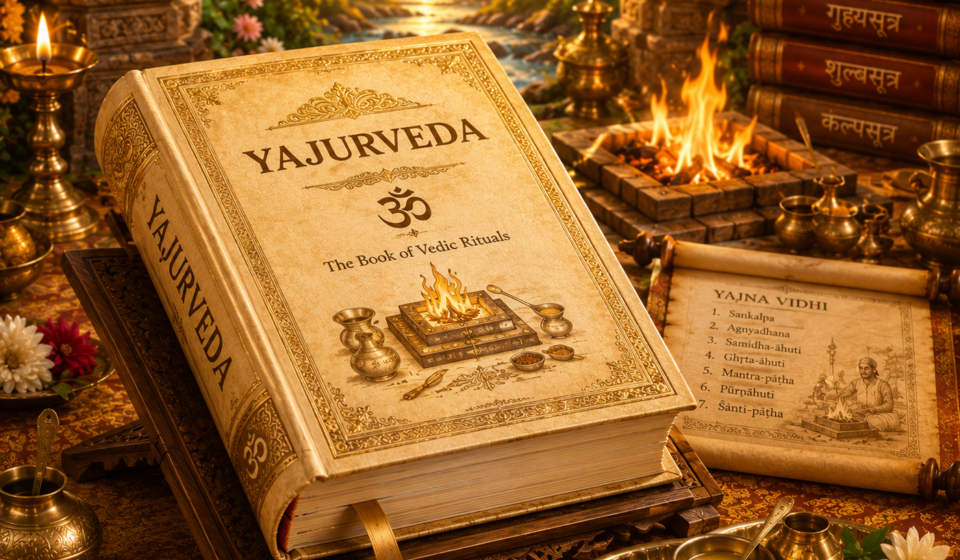
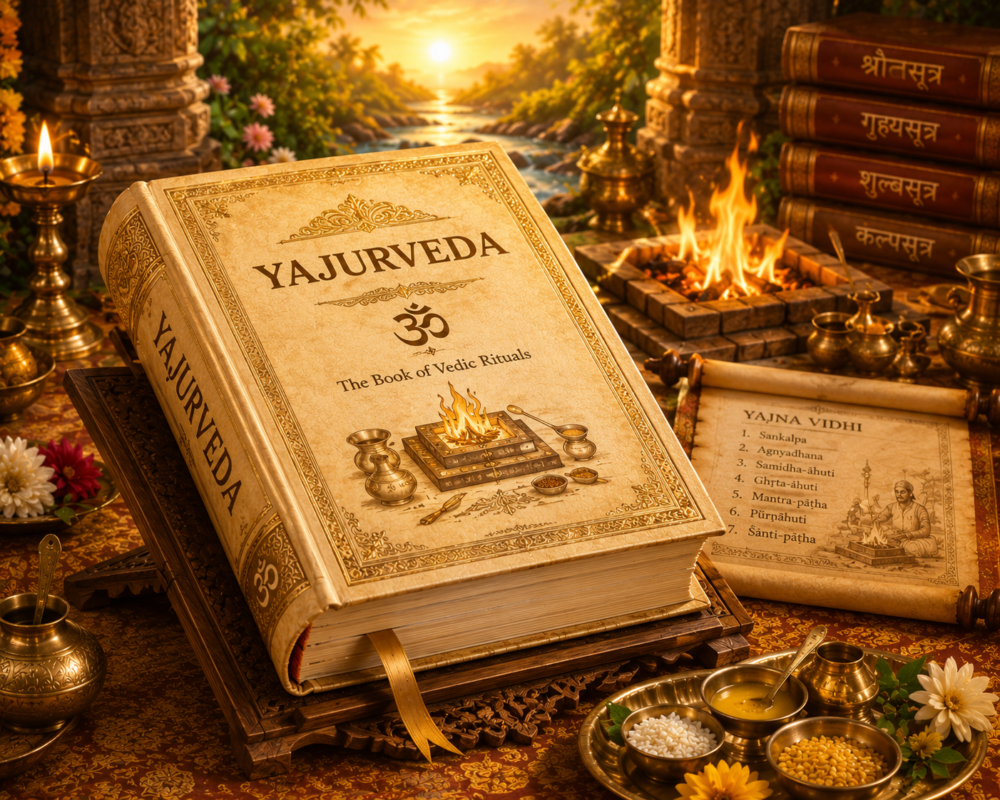
If the Rigveda is the poetry of the Vedic world, the Yajurveda is its engineering manual. The word yajus means a sacrificial formula, a unit of ritual prose or verse uttered at the moment of ritual action, and the Yajurveda is the collection of such formulas arranged in the order of the ceremonies themselves. It belonged to the adhvaryu, the working priest of the Vedic sacrifice, the man who actually did things: measured the ground, built the altar, kindled the fire, cooked the offerings, poured the ghee. While the hotri recited and the udgatri sang, the adhvaryu moved, and every movement had its muttered formula. The Yajurveda is the script of his hands.
For that reason it reads unlike any other Veda. Its sentences accompany actions and often address the implements themselves. The priest speaks to the strew of sacred grass, to the wooden sword with which he draws lines on the earth, to the pot, the spoon, the fire. At the harnessing of the sacrifice he declares, for strength thee, for rain thee. The prose is compact, rhythmic and formulaic, and scholars regard it as the oldest prose literature of India, the first time Sanskrit walked instead of sang.
White and black: the two Yajurvedas
The Yajurveda comes down to us in two great streams. The Krishna or Black Yajurveda mixes its formulas with prose explanation, mantra and commentary interwoven in the same text, and survives in schools such as the Taittiriya, Maitrayani, Katha and Kapishthala. The Shukla or White Yajurveda, associated with the seer Yajnavalkya and preserved in the Vajasaneyi Samhita of the Madhyandina and Kanva schools, separates the two cleanly: the Samhita holds only the formulas, while the explanation is gathered into the enormous Shatapatha Brahmana, the most detailed account of ritual and myth in all Vedic literature. Tradition tells the story of the quarrel between Yajnavalkya and his teacher Vaishampayana, after which Yajnavalkya received the pure white formulas afresh from the sun. Behind the legend lies a real editorial revolution, a school deciding that scripture and commentary should live in separate houses.
The world the Yajurveda built
The Yajurveda is the charter of the great shrauta rituals. The daily agnihotra offering of milk into the fire at dawn and dusk, the new and full moon sacrifices, the seasonal offerings, the soma sacrifices rising to the twelve day rite, all take their order from it. Grandest of all were the royal rituals: the rajasuya, the consecration that made a chief a king, with its chariot drive and dice game; the vajapeya with its seventeen fold symbolism and its race; and the ashvamedha, the horse sacrifice, in which a consecrated stallion wandered for a year followed by armed men, claiming for its king every land it crossed. Centuries later, historical monarchs from Pushyamitra Shunga to the Gupta emperor Samudragupta would still perform the ashvamedha of the Yajurveda to proclaim paramount power.
The most spectacular of its constructions was the agnichayana, the piling of the great fire altar in the shape of a falcon from over a thousand baked bricks laid in five layers. The geometry required to build such altars, and to build altars of different shapes but identical area, produced the Shulba Sutras, appendices of the Yajurvedic schools that state the diagonal theorem long before Pythagoras and wrestle with the problem of squaring the circle. Indian mathematics was born on the sacrificial ground.
The Yajurveda also carries some of the most beloved mantras of living Hinduism. The Shri Rudram, the great litany to Rudra in which the god of the storm is praised in his hundred forms and the phrase namah shivaya first sounds, is chanted daily in Shiva temples across the world. The Taittiriya school gave the tradition the mahamrityunjaya context and, in its Upanishad, the verses recited at convocations to this day: speak the truth, follow the dharma, treat your mother as a god, treat your guest as a god. The purnamadah invocation, that fullness from which fullness taken leaves fullness still, closes the Isha Upanishad, itself the fortieth chapter of the White Yajurveda. The Veda of ritual action ends, fittingly, in the most concentrated philosophy, as if the long labour of the adhvaryu’s hands had all along been building a stairway for the mind.
The Four Vedas
Part 4 of 10 in this chapter.