 In 30 Seconds



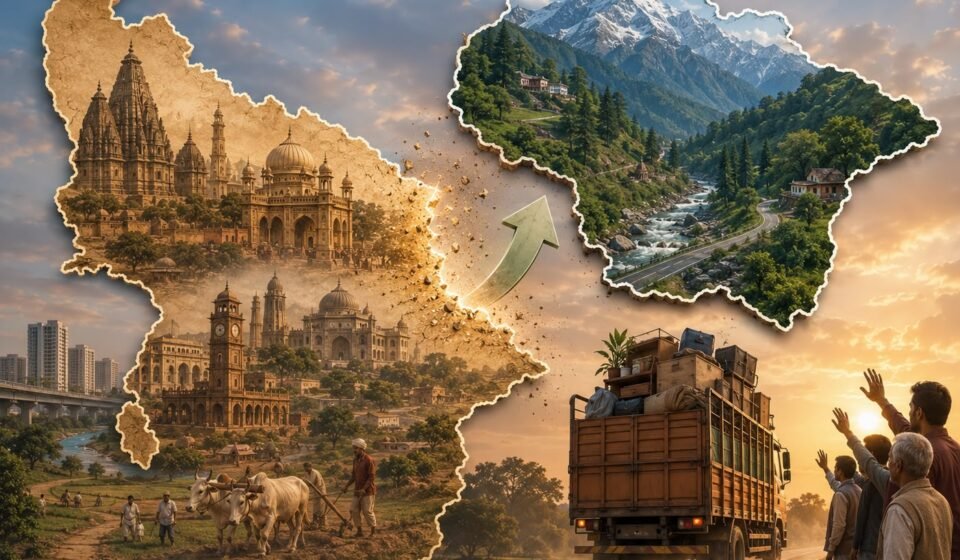
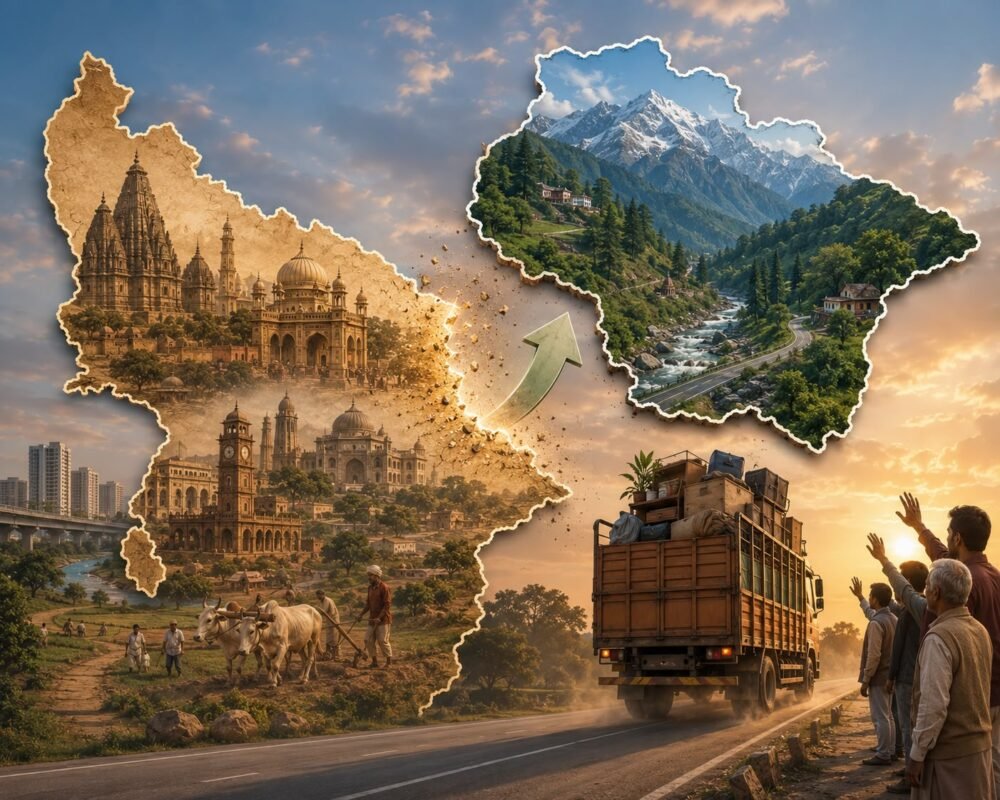
On November 9, 2000, Uttar Pradesh did something it had never done before and has never done since. It became smaller. The hill districts of Kumaon and Garhwal, along with the tarai belt at their feet, departed to form India’s twenty seventh state, initially named Uttaranchal. It remains the only successful division of UP in the republic’s history, and the story of how the hills left the plains explains, by contrast, why every other separation has failed.
The hills had always been a different country wearing the same administrative uniform. Their languages, Kumaoni and Garhwali, their terraced agriculture, their pattern of male outmigration to the army and the plains, and their ecological life of forest and river bore little resemblance to the doab. The distances were absurd. A villager in Pithoragarh with business before the state government faced a journey to Lucknow that could consume days. Within the giant state’s legislature, the hill seats were a rounding error, roughly twenty members in an assembly of more than four hundred, permanently outvoted on every question that mattered to them.
The grievances accumulated in the way mountain grievances do, slowly and then suddenly. The Chipko movement of the 1970s, when hill villagers embraced trees to stop commercial felling, had already announced a distinct political consciousness rooted in the land itself. Statehood demands circulated for decades through organisations like the Uttarakhand Kranti Dal, founded in 1979, without achieving critical mass. What ignited the final movement, in 1994, was reservation. The Mulayam Singh Yadav government’s extension of a twenty seven percent OBC quota to the hills, where the OBC population was tiny and the social structure entirely unlike the plains, struck the region as proof that Lucknow neither understood nor cared to understand them.
The agitation that followed was a genuine mass movement, drawing students, women, and pensioned soldiers into the streets of Nainital, Almora, and Dehradun. It also acquired its martyrs. In Khatima and Mussoorie in September 1994, police firing on protesters killed several people. Then came the episode that seared itself into the region’s memory. On the night of October 1, 1994, a convoy of activists travelling to a rally in Delhi was stopped at Rampur Tiraha in Muzaffarnagar district. In the violence that followed, protesters were shot dead, and multiple women in the convoy alleged rape and molestation by police personnel, allegations that courts and the CBI pursued through convictions of individual policemen decades later, with some proceedings continuing into the 2020s. The plains state’s police had given the hills their final, unanswerable argument. After Rampur Tiraha, the question was no longer whether the hills would leave, only when.
The when depended on Delhi. The BJP, strong in the hills, embraced the demand, and after the state assembly forwarded a reorganisation proposal, the Vajpayee government carried the Uttar Pradesh Reorganisation Act through Parliament in August 2000. That November, thirteen hill and tarai districts became Uttaranchal, a name the movement resented as a dilution of its own chosen word. The resentment persisted until 2007, when the state was formally renamed Uttarakhand, and the movement’s vocabulary finally won.
For Uttar Pradesh, the departure was demographically minor, well under a tenth of the population, and symbolically immense. The state lost its mountains, its glaciers, and the sources of the Ganga and Yamuna, the rivers that define it. Badrinath, Kedarnath, and the whole Char Dham geography passed to the new state. UP became, for the first time, entirely a creature of the plains. Disputes over the division of assets, water, and the shared irrigation infrastructure of the tarai trailed on for years afterward.
The quarter century since has complicated the movement’s hopes without dishonouring them. Uttarakhand built a capital at Dehradun, grew its income well past its parent’s, and drew industry and tourism the old arrangement never delivered. Yet the hills themselves kept emptying, with village after village abandoned for the plains in the very outmigration statehood was meant to reverse, and the state’s politics settled into a churn of short lived chief ministers that observers wryly compared to old Lucknow. Statehood, the region learned, was a door and not a destination. What lay behind the door still had to be built, and much of it still does.
The larger lesson lodged in Indian politics. Uttarakhand succeeded because it had everything the other separatist demands lacked, a compact and defensible territory, a genuinely distinct identity, a mass agitation sanctified by sacrifice, and a national government willing to act. Bundelkhand, Purvanchal, and Harit Pradesh have grievances. The hills had a movement. That difference, twenty six years on, still marks the line between the division that happened and all the divisions that never came.
UP Files - Batch 1
Part 7 of 10 in this chapter.