 In 30 Seconds




Every legal system has one case that reads like a novel, and for the courts of Bengal it was the case of the sannyasi of Bhawal. It began with a death in Darjeeling in 1909 and ended thirty seven years later before the Privy Council in London, having consumed two of the longest trials in Indian legal history, hundreds of witnesses, and the certainties of an entire province. Though its final verdict came months before independence, no chronicle of crime and justice in modern India can begin anywhere else, for the Bhawal case is the great prologue: a story about identity, inheritance and proof that still shapes how Indian courts think about evidence.
Ramendra Narayan Roy was the second kumar of the Bhawal estate, one of the largest zamindaris in eastern Bengal, centred near Dhaka. In 1909, suffering from illness, he travelled to Darjeeling with his wife Bibhabati and her brother. There, according to the family’s account, he died and was cremated. The estate absorbed the loss, the widow moved to Calcutta, and the matter appeared settled.
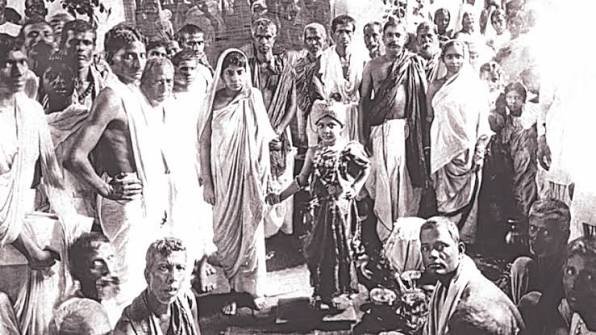
Twelve years later, in 1921, an ash smeared sadhu appeared on the streets of Dhaka. He said little at first, but his face unsettled those who had known the second kumar. Word spread. Tenants and relatives came to look, and many left convinced. Eventually the sadhu declared what the crowds already believed: he was Ramendra Narayan Roy. He said he had not died in Darjeeling at all, that he had been drugged, that the cremation had been interrupted by a storm, and that wandering ascetics had carried him away and nursed him back to life, after which he had spent years travelling with them, his memory clouded.
The claim split Bengal. Thousands of tenants of the estate accepted him and began paying him homage. His sister recognised him. His widow, Bibhabati, denounced him as an impostor, and behind her stood the Court of Wards and the colonial administration, which had been managing the estate and had no desire to hand it to a resurrected claimant. In 1930 the sadhu filed suit for his share of the estate, and the machinery of law took over from the machinery of rumour.
The trial before the Dhaka court became a spectacle unlike anything the province had seen. Over a thousand witnesses testified. The court examined the claimant’s body for the second kumar’s known marks and scars, heard doctors reconstruct a twenty year old night in Darjeeling, and weighed the memories of tenants, servants, relatives and officials. In 1936 the judge ruled that the claimant was indeed Ramendra Narayan Roy. The Calcutta High Court upheld the finding in 1940 by majority. The final appeal went to the Privy Council, which delivered its judgment on 30 July 1946: the sannyasi was the kumar, and the estate was his.
The ending belongs entirely to fiction. Two days after learning of his victory, the kumar suffered a stroke while offering thanks at a Kali temple in Calcutta, and died shortly afterwards. Bibhabati, unyielding to the last, refused the widow’s rites a second time. The case left behind a question that trials of identity still wrestle with: when documents, officials and family divide against memory, scars and the recognition of a thousand ordinary people, what does it actually mean to prove who someone is?
Related Reading
- What Is Cybercrime? Common Threats and How India Responds
- The Kilvenmani Massacre: Forty Four Lives and the Price of a Wage Dispute
- The Assassination of Lalit Narayan Mishra: A Minister Dies, Questions Remain
Official context: Readers can compare this story with public information from National Crime Records Bureau.
The Foundational Era - Batch 1
Part 3 of 10 in this chapter.